
Researchers in a 2022 study found that women who had a fetal reduction after a double embryo transfer had increased risk of miscarriage, preterm premature rupture of membranes and other adverse outcomes.
Having a single embryo transfer (SET) is often recommended over a double embryo transfer (DET) due to the increased risks of twins. Twin pregnancies more frequently lead to preterm births and low birth weights and for that reason the ASRM recommends SETs in the majority of cases.
Many people believe that transferring two or more embryos increases the chance of a pregnancy. While this is true to some degree, this comes with a much higher risk of having a multifetal pregnancy. In a 2021 study by Gingold et al. (reviewed here), having a single embryo transfer in women <35 resulted in a 52.7% live birth rate with a 3.5% chance of twins, compared to a 61.6% for a double embryo transfer with a 59.5% chance of twins.
Having twins comes with an increased risk of complications for both the mother and children and in some cases reducing the number of fetuses to one is recommended. This can occur spontaneously (spontaneous fetal reduction or SPFR), which occurs at a frequency of about 17.1% with dichorionic diamniotic twins (Luo et al. 2019), or can be induced by the doctor (selective fetal reduction or SEFR).
However it’s not clear what the impact of SPFR or SEFR has on the remaining fetus, and how this compares to avoiding the issue altogether by transferring a single embryo.
🔗 Original studies are referenced in this post or within the linked Remembryo posts.
💡 Reminder: Terms underlined with a dotted black line have glossary definitions. Hover or tap to see a short definition, or select “Read full definition” in the pop-up to view the complete glossary entry. Viewing glossary entries does not count toward your paywall limit.
In their new study, Wang et al. (2022) compared the outcomes of over 4500 SETs to reduction after a DET by either SEFR (390) and SPFR (865) between 2011 and 2021.
Women who had a selective reduction were more likely to miscarry and had a lower rate of live birth compared to those with a spontaneous reduction or a single embryo transfer.

There was also an increased risk of gestational diabetes mellitus (GDM) and preterm premature rupture of membranes (PPROM) compared to the SET group.
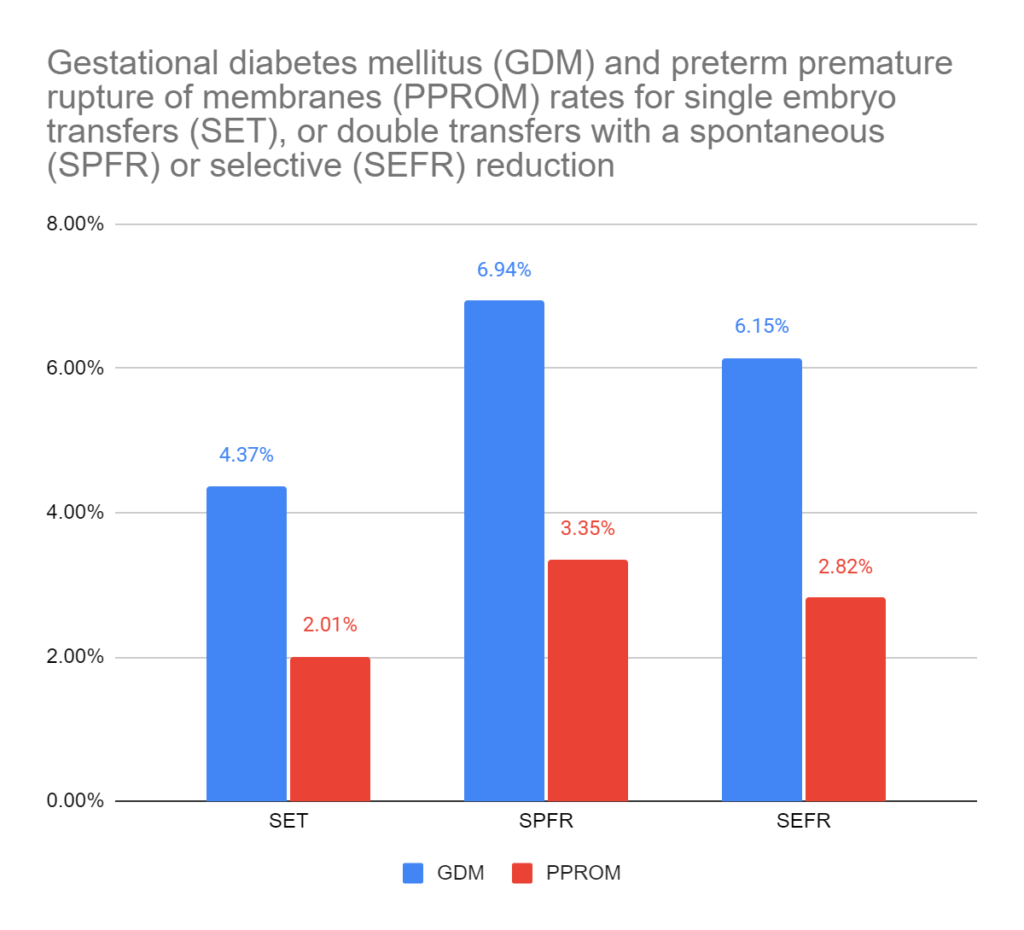
A higher proportion of newborns were low-weight when either selective or spontaneous reduction occurred (8.72% in SEFR vs 6.63% in SPFR vs 4.28% in SET). Babies born from SEFR had a lower average weight (3191.62 g vs 3391.75 g in SET). There were no differences in birth defects.
These results persisted even when they adjusted for age, infertility durations, types of infertility, states of embryos, BMI and factors affecting SET or DET decisions.
Overall, this study found that double embryo transfers that were reduced either spontaneously or selectively had a higher chance of complications compared to SET alone.
“We recommend that DET with subsequent fetal reduction should only be considered as a rescue method for multiple pregnancy patients with potential complications, and SET is more advisable.”
Wang et al. (2022)
Reference

About Embryoman
Embryoman (Sean Lauber) is a former embryologist and the founder of Remembryo, an IVF research and fertility education website. After working in an IVF lab in the US, he returned to Canada and now focuses on making fertility research more accessible. He holds a Master’s in Immunology and launched Remembryo in 2018 to help patients and professionals make sense of IVF research. Sean shares weekly study updates on Facebook, Instagram, and Reddit regularly. He also answers questions on Reddit or in his private Facebook group.