
Researchers found that excessive bending of a Cryotop, a cryostorage device used to freeze eggs or embryos, can damage embryos and reduce thaw survival rates.
A cryostorage device is a device that’s used to freeze embryos or eggs. The sample can be frozen within a straw that’s sealed, or it can be frozen at the end of a specialized Cryotop or Cryolock device.
🔗 Original studies are referenced in this post or within the linked Remembryo posts.
💡 Reminder: Terms underlined with a dotted black line are linked to glossary entries. Clicking these does not count toward your paywall limit.
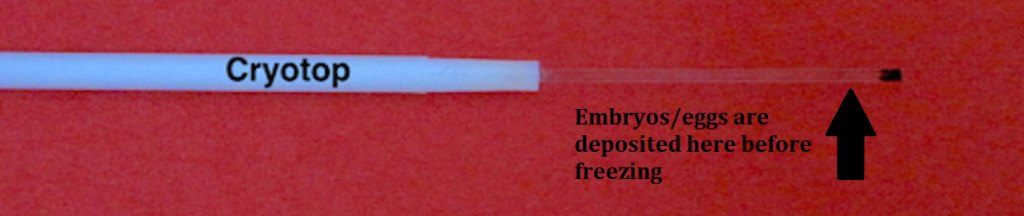
A Cryotop is stick-like device that has a flattened end for sample loading (on the right in the image below). The egg or embryo is deposited onto this flattened area, near the black mark, and then the device is plunged into liquid nitrogen and stored. This flattened end is flexible to prevent it from snapping off and losing the sample, and can be bent. This will be important to understand the paper that I’ll review here, but first let’s talk about the Cryotop some more and how embryos are frozen.
You could see the end of the Cryotop magnified below, near the black mark, with an embryo deposited. The embryo is deposited in a solution called “vitrification solution,” which helps pull the water out of the embryo. You could see the vitrification solution surrounding the embryo. Dehydrating embryos using this solution is an important part of freezing them, and prevents the formation of ice crystals in the embryo that could potentially damage it.
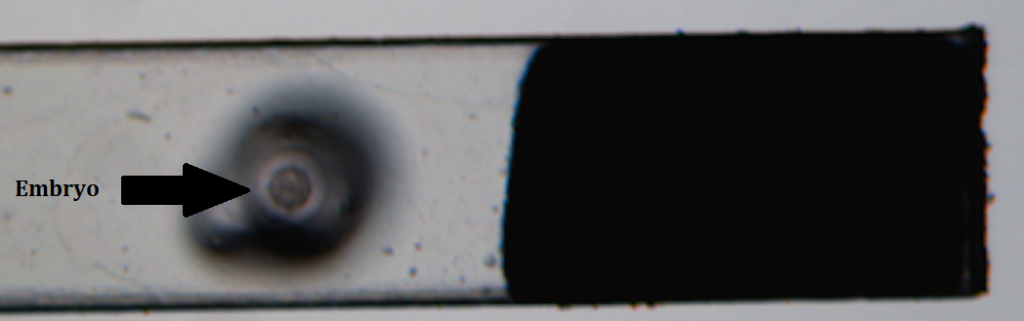
Adapted from Marco-Jiménez et al. 2016, CC by 4.0
After the embryo is loaded onto the flexible end, the end of the Cryotop is plunged into liquid nitrogen to freeze the sample. Then, a sleeve or cap is placed over the flexible end to protect the frozen sample. You can see the Cryotop and sleeve below (aka “Cryotop top”).

To see the freezing (and thawing) process in action, you can watch a video from Kitazato below (who manufactures the Cryotop). They cap the Cryotop around 1:30, which is what will be important for this article.
After the embryo is plunged into liquid nitrogen and frozen, the Cryotop is capped and it’s possible that the flexible part can be accidently bent. This is the area where the embryos are, so they might be damaged by the bending.
A new study wanted to see if this bending could damage the embryos!
To do this, researchers deposited cleavage stage embryos onto the flexible end of the Cryotop device, plunged them into liquid nitrogen to freeze them, and then purposely bent the end of the Cryotop to see if this damaged the embryos.
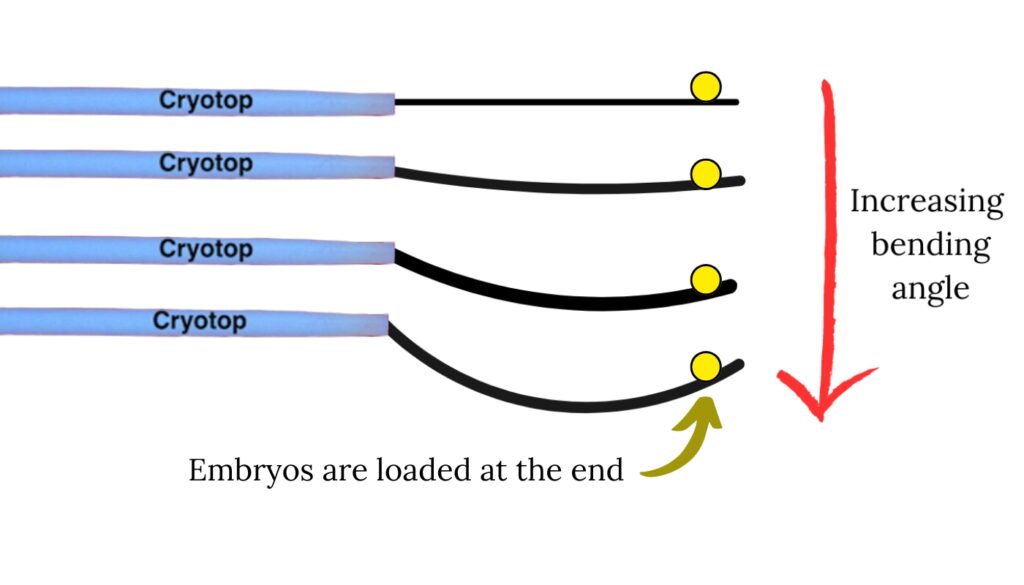
They used 3 degrees of bending: 1.6 mm, 3.2 mm and 4.8 mm. You can get an idea of how this might look below (these angles aren’t meant to be accurate to the study — it’s just for illustrative purposes).
After they froze the embryos and the Cryotops were bent, they noticed cracks where the embryos were deposited (shown below; images used with permission from the corresponding author). These cracks formed in the vitrification solution that the embryos were suspended in.

The researchers then thawed the embryos and noticed that some of the embryos from these bent Cryotops showed damage. You can see an example below, with the embryo on the right showing damage between 6-9 o’clock (it looks sliced through, presumably where the crack occurred; images used with permission from the corresponding author).

This shows that bending can cause cracks in the vitrification solution and damage to the embryos. The researchers measured this damage and related it to the embryo thaw survival rate. Embryos that experienced a higher degree of bending were more likely to be damaged and less likely to survive the thaw. The data below is based on 55-100 embryos for each measurement.

This shows that embryos can be damaged by bending the Cryotop, and that embryologists should be careful to avoid bending the device. This study mimicked what would happen if the Cryotop was accidently bent when inserting it into the sleeve, but it’s probably a good idea to avoid bending the device in general.
While this study focused on embryos, bending the Cryotop could also damage eggs and potentially blastocysts. Other devices that have a bendable portion, like the Cryolock, may also be susceptible to damage from bending. Bending probably isn’t a concern for straws, since these can’t be bent.
The authors recommend that embryologists should be properly trained to avoid bending of the Cryotop device, particularly when placing it in the sleeve or when placing the device in the goblet (a tube used to store cryostorage devices), as this could damage embryos.
Reference

About Embryoman
Embryoman (Sean Lauber) is a former embryologist and the founder of Remembryo, an IVF research and fertility education website. After working in an IVF lab in the US, he returned to Canada and now focuses on making fertility research more accessible. He holds a Master’s in Immunology and launched Remembryo in 2018 to help patients and professionals make sense of IVF research. Sean shares weekly study updates on Facebook, Instagram, and Reddit regularly. He also answers questions on Reddit or in his private Facebook group.
Related posts:
 An Italian consensus on key performance indicators for assessing IVF clinics
 Meta-analysis combines 74 studies to examine factors linked to euploid transfer success
 Egg freezing and thawing
 Improved IVF outcomes when embryos are cultured in groups
 Embryologist and physician success rates variable, not related to experience
 No differences in IVF outcomes when using fresh or frozen donor eggs
 Prolonged embryo storage >6 years may reduce pregnancy, live birth rates
 Using multiple plastic consumables in the IVF lab increases risk of embryo or gamete toxicity