
Researchers in a 2026 study found that higher beta-hCG levels measured 9 days after a single euploid embryo transfer were linked to a higher chance of live birth and a lower chance of biochemical pregnancy loss or ectopic pregnancy.
A positive beta-hcg (β-hCG) result is usually the first sign of successful implantation after an embryo transfer. Generally, higher early β-hCG levels are associated with an increased chance of live birth.
A new study by Clarke et al. (2026) wanted to determine how well an initial β-hCG level predicts live birth after a single euploid transfer, measured 9 days after transfer (9dp5dt).
🔗 Original studies are referenced in this post or within the linked Remembryo posts.
💡 Reminder: Terms underlined with a dotted black line are linked to glossary entries. Clicking these does not count toward your paywall limit.
Study details
- Study type: Retrospective study conducted between 2016 and 2024 at a single fertility center in the US
- Participants: 6410 single euploid embryo transfer cycles with a positive β-hCG measured 9 days after transfer:
- Initial β-hCG 2.5 to <11 mIU/mL (n=376)
- 11 to <25 (n=353)
- 25 to <50 (n=555)
- 50 to <75 (n=547)
- 75 to <100 (n=574)
- ≥100 (n=4,005)
- Embryo stage: Mostly day 5 (58.8%) and day 6 (38.1%)
- Primary outcome: Live birth per positive β-hCG result
- Statistical adjustment: Adjusted for oocyte age, BMI, and treatment year
Higher β-hCG levels were associated with higher live birth rates
The chance of clinical pregnancy and live birth increased steadily with each higher β-hCG category:
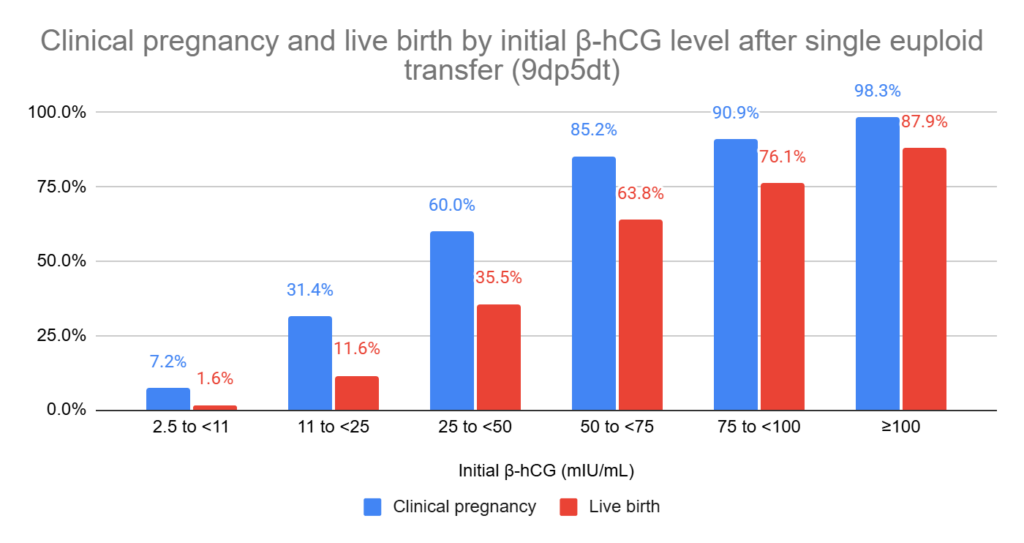
After adjusting for factors like egg age, BMI, and treatment year, each increase in β-hCG category was associated with a higher chance of live birth.
- Patients with an initial β-hCG of 11 to <25 mIU/mL were 6.76 times more likely to have a live birth than those with β-hCG 2.5 to <11 mIU/mL (adjusted relative risk [95% CI]: 6.76 [3.02–15.11]).
- 25 to <50 mIU/mL vs 11 to <25 mIU/mL (aRR [95% CI]: 3.08 [2.28–4.16])
- 50 to <75 mIU/mL vs 25 to <50 mIU/mL (aRR [95% CI]: 1.80 [1.59–2.04])
- 75 to <100 mIU/mL vs 50 to <75 mIU/mL (aRR [95% CI]: 1.16 [1.08–1.25])
- ≥100 mIU/mL vs 75 to <100 mIU/mL (aRR [95% CI]: 1.15 [1.10–1.21])
Overall, 71.0% of pregnancies with a positive β-hCG resulted in a live birth. The lowest β-hCG level that ultimately resulted in a live birth was 4.1 mIU/mL.
Low β-hCG levels were associated with biochemical pregnancy loss
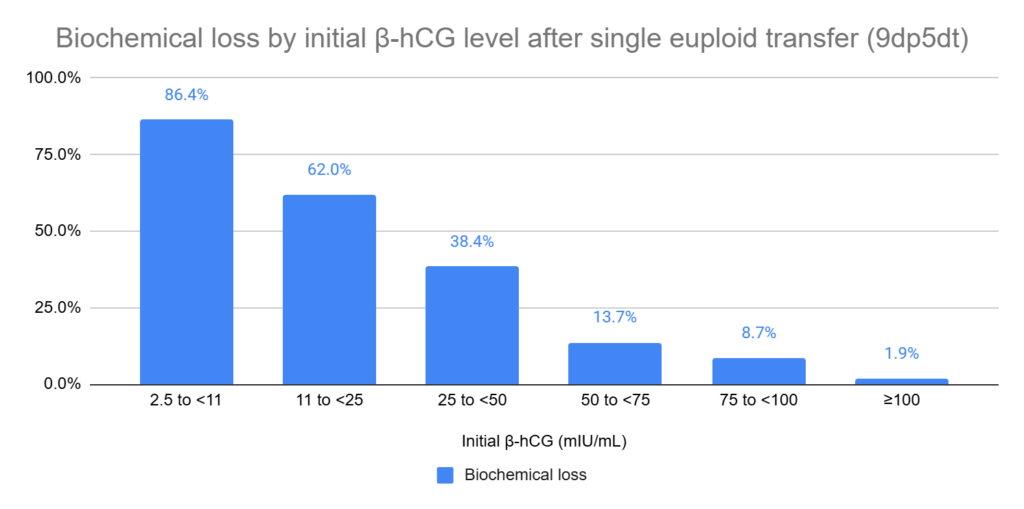
Biochemical pregnancy loss became much less common as β-hCG levels increased.
Clinical pregnancy loss was highest in the intermediate β-hCG groups and lower at both very low and very high β-hCG levels. Clinical pregnancy was defined as the presence of a gestational sac per positive hCG.
- 4.8% for β-hCG 2.5 to <11 mIU/mL
- 19.3% for β-hCG 11 to <25 mIU/mL
- 24.0% for β-hCG 25 to <50 mIU/mL
- 20.8% for β-hCG 50 to <75 mIU/mL
- 14.6% for β-hCG 75 to <100 mIU/mL
- 10.4% for β-hCG ≥100 mIU/mL
Ectopic pregnancy was more common with very low β-hCG levels
The risk of ectopic pregnancy was highest in the two lowest β-hCG groups (p< 0.01).
- 6.9% for β-hCG 2.5 to <11 mIU/mL
- 7.1% for β-hCG 11 to <25 mIU/mL
- 2.2% for β-hCG 25 to <50 mIU/mL
- 1.6% for β-hCG 50 to <75 mIU/mL
- 0.5% for β-hCG 75 to <100 mIU/mL
- 0.1% for β-hCG ≥100 mIU/mL
Note that these values are per positive β-hCG and not per transfer
Monozygotic twinning increased slightly with higher β-hCG levels
Monozygotic twinning was uncommon overall but became slightly more frequent as β-hCG levels increased (p< 0.01).
- 0% for β-hCG 2.5 to <11 mIU/mL
- 0% for β-hCG 11 to <25 mIU/mL
- 0.7% for β-hCG 25 to <50 mIU/mL
- 1.5% for β-hCG 50 to <75 mIU/mL
- 2.6% for β-hCG 75 to <100 mIU/mL
- 2.8% for β-hCG ≥100 mIU/mL
Note that these values are per positive β-hCG and not per transfer
Conclusion
This study found that as β-hCG levels increased, live birth rates rose steadily while the chance of biochemical pregnancy loss dropped.
The risk of ectopic pregnancy was highest when initial β-hCG levels were <25 mIU/mL. The chance of monozygotic twinning increased with higher β-hCG levels, with the highest rate seen when β-hCG was ≥100 mIU/mL.
Even very low β-hCG levels could result in a live birth, with the lowest successful value being 4.1 mIU/mL.
Limitations include that this was a retrospective study from a single center, nearly all transfers were performed using medicated FETs, and the findings apply specifically to β-hCG measurements obtained 9 days after transfer.
Want to read more about hCG and pregnancy outcomes after IVF?

Researchers in a 2019 study compared pregnancy outcomes with different serum β-hCG levels that were measured on day 16 of the embryo's age (13dp3dt/11dp5dt). Read more.
A small 2025 study found that most pregnancies show detectable hCG by day 6 after a blastocyst transfer, and those that first become positive on day 8–10 have higher rates of biochemical and ectopic pregnancy and a lower chance of ongoing pregnancy. Read more.

Researchers in a 2023 study developed a model to predict the chance of live birth after a positive β-hCG (beta-hCG), using the first measurement and a second one taken 48 hours later. Read more.
A 2026 study found that low β-hCG levels (≤50 mIU/mL at 9 days after blastocyst transfer) were linked to much lower live birth rates, and that how hCG rises over time is more predictive of outcome than the initial value. Read more.
Reference

About Embryoman
Embryoman (Sean Lauber) is a former embryologist and the founder of Remembryo, an IVF research and fertility education website. After working in an IVF lab in the US, he returned to Canada and now focuses on making fertility research more accessible. He holds a Master’s in Immunology and launched Remembryo in 2018 to help patients and professionals make sense of IVF research. Sean shares weekly study updates on Facebook, Instagram, and Reddit regularly. He also answers questions on Reddit or in his private Facebook group.