
Researchers in a 2022 study performed a meta-analysis on the impact of acupuncture on FET outcomes and found that there were improvements in clinical pregnancies but not live birth rates, with most included studies small.
Acupuncture is a common add-for IVF and may improve outcomes by increasing blood flow to the uterus. Some studies have focused on the impact of acupuncture on fresh embryo transfers, or a combination of fresh and frozen transfers, and it’s not clear what impact acupuncture has on frozen embryo transfers (FETs) alone.
Zhu et al. (2022), in their systematic review and meta-analysis, compared FET outcomes in women who used acupuncture. A total of 14 randomized controlled trials (RCTs) were included with 1,130 participants. There were no restrictions on the country the RCT came from, but all of the included RCTs were based in China.
All types of acupuncture were included (traditional, electroacupuncture
and transcutaneous electrical acupuncture point stimulation) and it was performed around the time of FET (before or after).
🔗 Original studies are referenced in this post or within the linked Remembryo posts.
💡 Reminder: Terms underlined with a dotted black line are linked to glossary entries. Clicking these does not count toward your paywall limit.
Clinical pregnancy rates improved with acupuncture
Based on 14 RCTs and 1,130 participants, there was a statistically significant increase in clinical pregnancy rates in women who had an FET and acupuncture compared to those who didn’t or had sham acupuncture (46.7% vs 32.4%, risk ratio [95%] CI: 1.54 [1.28-1.85]). This means that women who had acupuncture around the time of FET had a 54% increase in the chance of clinical pregnancy compared to those who didn’t or had a sham procedure. The quality of evidence was low.

No difference in live birth rates with acupuncture
Based on 4 RCTs and 431 participants, there was no difference in live birth rates in women who had an FET and acupuncture compared to those who didn’t or had sham acupuncture (41.4% vs 32.4%, risk ratio [95%] CI: 1.48 [0.90-2.43]). The quality of evidence was low.
Increased endometrial thickness with acupuncture
Based on 12 RCTs and 836 participants, there was a statistically significant increase in endometrial thickness in women who had an FET and acupuncture compared to those who didn’t or had sham acupuncture (average difference [95%] CI: 0.95 [0.43-1.51]). This means that women who had acupuncture around the time of FET had on average a 0.95 mm increase in the thickness of their endometrium compared to those who didn’t or had a sham procedure. The quality of evidence was moderate.
Increased rate of trilaminar endometrial pattern with acupuncture
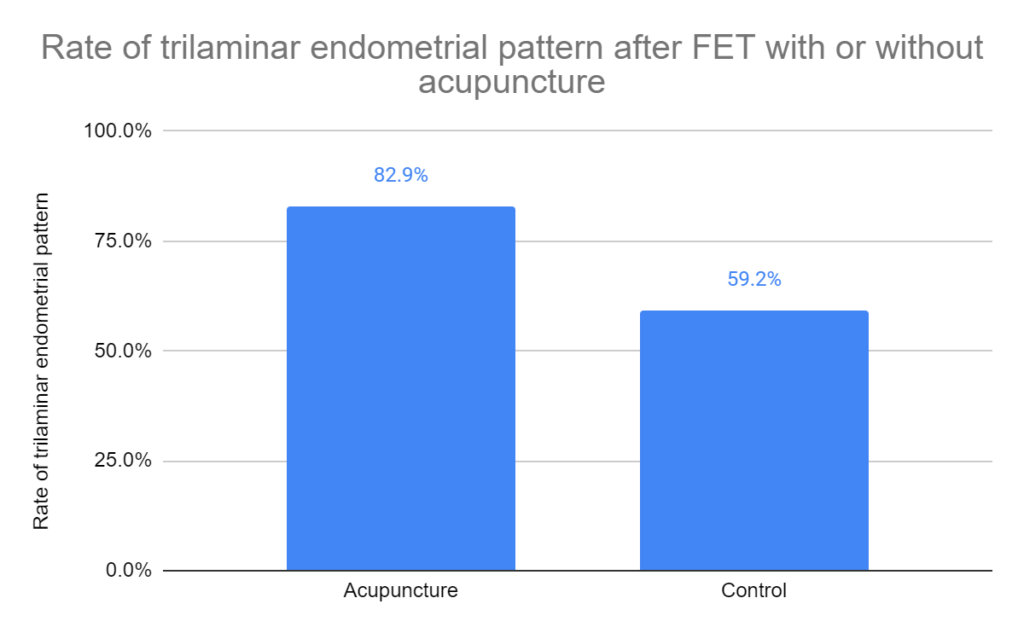
Based on 7 RCTs and 473 participants, there was a statistically significant increase in the number of women with a trilaminar endometrium who had an FET and acupuncture compared to those who didn’t or had sham acupuncture (82.9% vs 59.2%, risk ratio [95%] CI: 1.41 [1.13-1.75]). This means that women who had acupuncture around the time of FET had a 41% increase in having a trilaminar endometrium compared to those who didn’t or had a sham procedure. The quality of evidence was moderate.
Subgroup analyses on impact of acupuncture on FETs
They did a number of subgroup analyses to evaluate the impact of the type of control used, the timing of acupuncture, the frequency and the diagnosis of the patients.
Type of control used. The studies that had a sham acupuncture control had no statistically significant differences while the RCTs that used no treatment as a control had significant differences. This means that the sham procedure (where a blunt needle is used) appears to have the same benefit as true acupuncture on FET outcomes, at least based on the 2 RCTs included.
Timing of acupuncture. Based on these studies, there was a statistically significant improvement with acupuncture when it was performed before or around the time of FET, and not after.
Frequency of acupuncture. Based on these studies, there was a statistically significant improvement with acupuncture when it was performed 5 or more times, and not less. This impact was more pronounced in women who performed it more than 15 times.
Diagnosis. Women with recurrent implantation failure, anovulation, PCOS and those that were >35 showed statistically significant improvements after acupuncture. The included RCTs didn’t look at any additional diagnoses.
Conclusions
This study found that acupuncture for FETs improved clinical pregnancy rates, endometrial thickness and the rate of trilaminar endometrial pattern. There was no increase in live birth rates. The best results were in women who performed acupuncture before the FET at least 5 times.
A limitation of this study was the risk of publication bias, particularly in the results for clinical pregnancy as there were mostly studies that showed positive results. Publication bias is when studies that have statistically significant results or positive results are published while negative studies are not.
Another limitation is that most of the RCTs included were small (generally 60-90 participants in total). The largest study was by So et al. (2010) with 226 participants that found no benefit. Larger RCTs need to be performed to draw meaningful conclusions.
Reference

About Embryoman
Embryoman (Sean Lauber) is a former embryologist and the founder of Remembryo, an IVF research and fertility education website. After working in an IVF lab in the US, he returned to Canada and now focuses on making fertility research more accessible. He holds a Master’s in Immunology and launched Remembryo in 2018 to help patients and professionals make sense of IVF research. Sean shares weekly study updates on Facebook, Instagram, and Reddit regularly. He also answers questions on Reddit or in his private Facebook group.
Related posts:
 Complete guide to embryo implantation and implantation failure
 How lining thickness affects success in 30,000 euploid transfers
 Comparing frozen embryo transfer/FET protocols
 Meta-analysis finds no difference in pregnancy outcomes when using the ERA
 RCT finds no change in birth rates for standard or ERA-timed euploid transfer
 Evidence-based recommendations from ESHRE for 27 IVF add-ons
 Growth hormone (omnitrope) increases number of eggs retrieved in updated meta-analysis
 Live birth rates higher with natural cycle FETs vs medicated FETs