
Researchers in a 2023 study discovered a new cell type contained within the ICM that they called REject cells, which are marked for cellular death through their expression of retrotransposons, presumably as a means for embryonic quality control.
Apoptosis, or programmed cell death, has been observed in human embryos during the cleavage stage and is common in other mammalian embryos at the morula and blastocyst stages. It is not known which specific cell types in the embryo undergo apoptosis.
In a study by Singh et al. (2023), researchers analyzed single-cell transcriptome data to classify different cell types in the human embryo. This transcriptome data represents the RNA being expressed in each cell of an embryo at different stages of development (ie. the 8-cell stage, morula stage and so on).
🔗 Original studies are referenced in this post or within the linked Remembryo posts.
💡 Reminder: Terms underlined with a dotted black line are linked to glossary entries. Clicking these does not count toward your paywall limit.
From the day 5 embryo data, they identified 3 clusters of cells: the pre-trophectoderm (pre-TE), the inner cell mass (ICM) and a group of unknown cells they called “not-characterized cells,” or NCCs. They also found NCC-like cells on day 4 when the embryo is a morula.
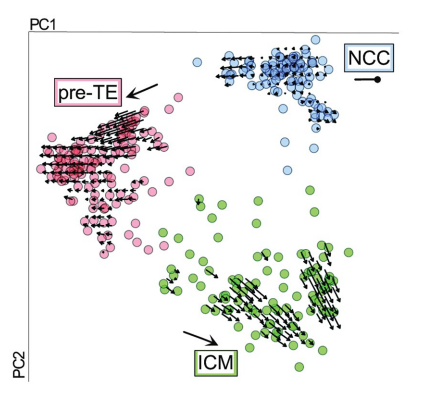
These NCCs expressed genes involved in DNA damage responses and apoptosis. This suggests that NCCs are eliminated from the embryo’s development by way of apoptosis due to DNA damage.
The researchers wanted to learn more about what was causing these NCCs to enter apoptosis and looked for repetitive DNA sequences known as retrotransposons.
Retrotransposons are ancient DNA segments that can copy and paste themselves in an organism’s genome. Because they can make copies of themselves, they make up a large portion of an organism’s genetic material. In humans, about half of our genome consists of retrotransposons!
Most retrotransposons are inactive in humans, but some are still active and can insert themselves into different parts of the genome, potentially introducing mutations and disrupting genes, which could lead to apoptosis.
The researchers found a group of “young” retrotransposons that were active in NCCs, with some being associated with apoptosis, while cells of the ICM showed elevated expression of “old” retrotransposons. Young and old here refer to how old these elements are in terms of when they were introduced in our genome during evolution, being less than or greater than 7 million years ago.
They found that the expression of old retrotransposons was tied to the decreased expression of young retrotransposons in embryonic cells. Further experiments showed that this was mediated through another group of factors called APOBEC by the old retrotransposon HERVH.
Because these NCCs contain retrotransposons (RE) that ultimately die and are rejected from the ICM, they renamed these cells REject cells.
Let’s put it all together:
- The ICM in a blastocyst consists of ICM cells and REject cells.
- REject cells express young retrotransposons that trigger DNA damage that leads to death by apoptosis.
- ICM cells suppress young retrotransposons using old transposons, ensuring their survival.
It’s not clear what triggers retrotransposon expression, but the authors believe it may be due to chance and “probably because we cannot get our genetic defenses in place fast enough,” they stated in a press release.
The authors explain that the human embryo may function as a “selection arena” where nearly identical cells with chance variations in retrotransposon activity compete to survive and become the ICM.
Some view retrotransposons as a type of genetic parasite that possesses the ability to copy and paste themselves within our DNA, similar to retroviruses like HIV. While most retrotransposons are silenced by different mechanisms, some embryonic cells (like REject cells) may lack these defenses. Consequently, the embryo becomes a “selection arena” where cells that cannot cope with these genetic parasites are eliminated.
This quality control process is also illustrated by euploid and aneuploid ICM cells in a mosaic embryo. Other studies have shown that aneuploid cells in a mosaic are more likely to die, or become trophectoderm cells, presumably in an effort to enrich the ICM with healthy cells.
Making a baby is tough work, so it makes sense that embryos have a mechanism for quality control!
Reference

About Embryoman
Embryoman (Sean Lauber) is a former embryologist and the founder of Remembryo, an IVF research and fertility education website. After working in an IVF lab in the US, he returned to Canada and now focuses on making fertility research more accessible. He holds a Master’s in Immunology and launched Remembryo in 2018 to help patients and professionals make sense of IVF research. Sean shares weekly study updates on Facebook, Instagram, and Reddit regularly. He also answers questions on Reddit or in his private Facebook group.
Related posts:
 Complete Guide to Embryo Grading and Success Rates
 Embryo Gallery
 Study examines potential of PGT-A on poor quality embryos
 Grade C (poor quality) embryo success rates
 Study examines transferring a good and poor quality embryo together
 Comparable outcomes with good quality day 6 and poor quality day 5 embryos
 Aneuploidy is a key factor in embryo arrest
 Embryos that change grade after thaw show different success rates