
Researchers in a 2023 study found comparable pregnancy and neonatal outcomes when transferring a day 5 poor quality or a day 6 good quality embryo.
Poor quality embryos have been shown to have lower success rates compared to better quality embryos. Similarly, embryos that take longer to develop and become blastocysts on day 6 instead of day 5 show lower success rates. It’s not clear how an embryo’s quality and day of development relate.
Check out my complete guide to embryo grading and success rates to learn more about embryo development, grading and success rates.
He et al. (2023), in their retrospective study, compared pregnancy outcomes after 1,623 poor quality day 5 blastocyst and good quality day 6 blastocyst frozen embryo transfers. This study took place at a single IVF center in China and involved patients between 2014 and 2020.
Key points:
- Poor quality embryos included any grade with a “C” quality, but no CC embryos (ie. AC, BC, CA, CB)
- Good quality embryos included any grade that didn’t contain a C (ie. AA, AB, BA, BB)
- Besides the grouping based on grades, women were also split into groups based on age: <35 and ≥35
- Women were all <40 in this study.
- This was the first IVF or ICSI cycle for the patients, and no PGT-A.
- Endometrial thickness was ≥ 7 mm for all patients.
- All transfers were frozen and the endometrial preparation was either natural or medicated.
The baseline characteristics were similar for the <35 and ≥35 age groups with either poor quality day 5 FETs or good quality day 6 FETs (in terms of age, BMI, infertility duration, type of infertility, fertilization method, endometrial preparation method and endometrial thickness).
🔗 Original studies are referenced in this post or within the linked Remembryo posts.
💡 Reminder: Terms underlined with a dotted black line are linked to glossary entries. Clicking these does not count toward your paywall limit.
Women <35 had comparable pregnancy outcomes with day 5 poor quality embryo and day 6 good quality embryo FETs
First let’s look at the group of women that were <35 in age.
For day 5 poor quality embryos vs day 6 good quality embryos, there was no difference in pregnancy rates (44.80% vs 42.41%, p=0.400), live birth rates (35.48% vs 31.13%, p=0.097) or miscarriage rates (<12 weeks, 17.60% vs 21.63%, p=0.149).

There were no differences in neonatal outcomes:
- Preterm births
- Gestational age
- Birth height
- Birth weight
- Low birth weight (<2500 g)
- Very low birth weight (<1500 g)
Women ≥35 had improved pregnancy rates, but otherwise comparable outcomes with day 5 poor quality embryo and day 6 good quality embryo FETs
Next, they looked at women who were ≥35.
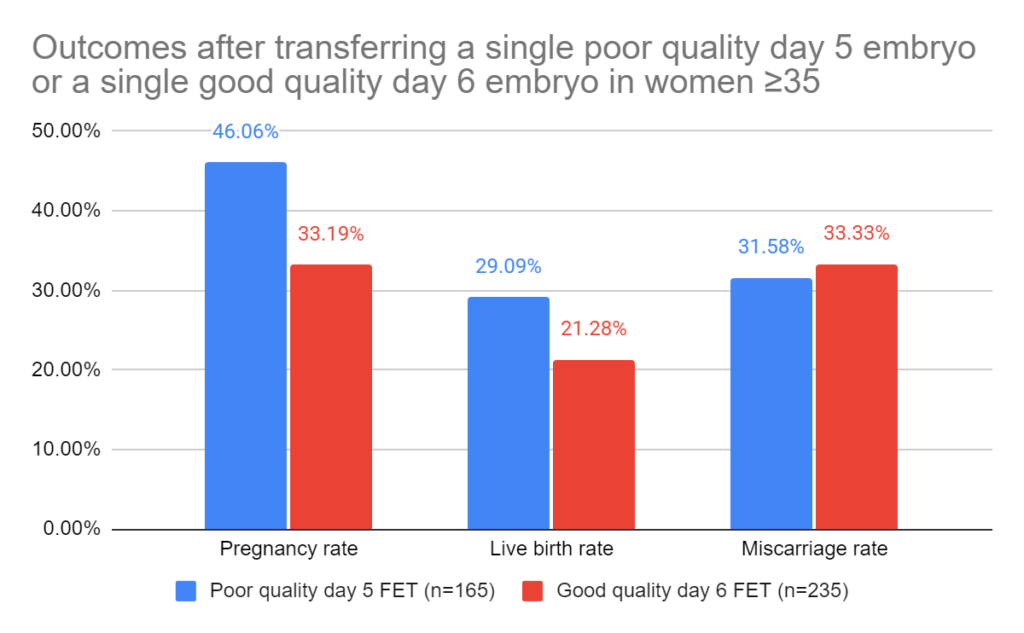
For day 5 poor quality embryos vs day 6 good quality embryos, there was an improvement in pregnancy rates (46.06% vs 33.19%, p=0.009), but not for live birth rates (29.09% vs 21.28%, p=0.074) or miscarriage rates (31.58% vs 33.33%, p=0.816).
There were no differences in neonatal outcomes:
- Preterm births
- Gestational age
- Birth height
- Birth weight
- Low birth weight (<2500 g)
- Very low birth weight (<1500 g)
Conclusions
For women <35, they found no difference in pregnancy, live birth or miscarriage rates when a poor quality day 5 or good quality day 6 embryo was transferred. For women ≥35, there was an increase in pregnancy rates when a day 5 poor quality embryo was transferred, but no change in live birth rates or miscarriage rates.
For both age groups, there was no difference in neonatal outcomes resulting from poor quality day 5 or good quality day 6 embryos (preterm births, birth weight, etc.).
This is important because it shows that poor quality day 5 embryos can have comparable or better success rates than good quality day 6 embryos. Poor quality embryos are often discarded by clinics because they’re believed to not have acceptable success rates.
The difference in day 5 vs day 6 comes down to how fast the embryo develops. Embryos that take longer to develop may be more likely to have inherent problems.
The authors indicate this may be due to abnormal components within the embryo, such as the spindle, which is a structure involved in separating chromosomes as the cell divides. This can lead to errors in chromosome numbers, or aneuploidy, and can reduce the chances of an embryo implanting.
One limitation of this study is that women 40 and above weren’t included. It’s interesting they saw increases in day 5 poor quality embryo pregnancy rates with older women, and maybe this would be more pronounced (and statistically significant!) with a larger sample size.
Another limitation is that they didn’t use CC quality embryos. As I cover in my grade C (poor quality) embryo success rates post, these embryos also have an acceptable chance of working.
Reference

About Embryoman
Embryoman (Sean Lauber) is a former embryologist and the founder of Remembryo, an IVF research and fertility education website. After working in an IVF lab in the US, he returned to Canada and now focuses on making fertility research more accessible. He holds a Master’s in Immunology and launched Remembryo in 2018 to help patients and professionals make sense of IVF research. Sean shares weekly study updates on Facebook, Instagram, and Reddit regularly. He also answers questions on Reddit or in his private Facebook group.