

Researchers in a 2023 study found that arrested embryos have a high degree of aneuploidy, which is mainly due to mitotic errors that occur after fertilization. In a separate analysis of non-arrested embryos, they found that good quality/day 5 embryos have less aneuploidies compared to poor quality/day 6 and 7 embryos.
Aneuploidy is characterized by an abnormal number of chromosomes and can be detected by PGT-A. An embryo can be completely aneuploid, where all the cells are aneuploid, or can be mosaic, where some of the cells are aneuploid.
This study wanted to investigate how common aneuploidy is in arrested embryos. They also wanted to see if aneuploidy was associated with embryo quality and how fast the embryo develops to become a blastocyst (day 5 to 7).
This is a pretty big study, so buckle up! If you need more background, I suggest checking out my post on Embryo Arrest and PGT-A.
🔗 Original studies are referenced in this post or within the linked Remembryo posts.
💡 Reminder: Terms underlined with a dotted black line are linked to glossary entries. Clicking these does not count toward your paywall limit.
Study details
- This is a prospective study that took place between 2016 and 2018.
- It involved 125 patients (average age 38.9) and 1,232 embryos.
- Arrested embryos stopped growing for at least 24 hours, and included cleavage stage embryos, morulas and early blastocysts.
- They performed PGT-A on arrested and non-arrested embryos.
The paper uses the terms “meiotic” and “mitotic” aneuploidy, to describe embryos that are fully aneuploid or mosaic.
- Meiotic aneuploidy comes from an error during meiosis — the type of cell division that makes our eggs and sperm. In this case, all the cells of the embryo are affected. On a PGT-A report, this is the same as having an aneuploid embryo (where all the cells are affected).
- Mitotic aneuploidy comes from an error during mitosis, which occurs after fertilization — the type of cell division that the embryo uses to divide. In this case, only the cells that divide from that affected cell are affected, which you can see below. This is how mosaics form (where only some cells are affected).
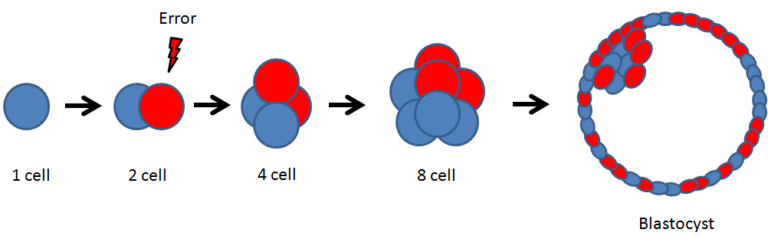
They also use the term “copy number” which refers to the chromosomal copy number. They defined a 30-70% chromosomal copy number change as mitotic aneuploidy (referring to mosaicism), or >70% as meiotic aneuploidy (referring to full aneuploidies). Check the glossary if you need more information on this.
I think this paper in general can be a bit confusing for some, especially regarding the meiotic/mitotic aneuploidies. You can think about meiotic aneuploidies as errors that occur in the egg or sperm, and mitotic aneuploidies as errors that occur in the embryo (just after fertilization). Keep in mind that the embryos studied here are arrested and stopped developing for 24 h (except for the last section of the study). These arrested embryos are not viable and wouldn’t be transferred.
As maternal age increases, so does the chance of getting an arrested embryo
Of the 1,232 embryos in this study, about half of them arrested. The proportion of arrested embryos increased with age (p= 0.00037).

Embryos are more likely to arrest when more chromosomes are aneuploid
Of these 1,232 embryos, 909 were tested by PGT-A: 612 embryos became blastocysts (and didn’t arrest), and 297 arrested at various stages (they didn’t grow for at least 24 h).
- 16% of the embryos that tested as euploid were arrested embryos
- 36% of the embryos with meiotic aneuploidies were arrested embryos
- 55-64% of embryos with mitotic aneuploidies were arrested embryos
This shows that embryos with mitotic aneuploidies are more likely to arrest.
The researchers write that this is counterintuitive — embryos that are completely aneuploid (meiotic) should be more likely to arrest, since all the cells are affected, right?
The difference is, they found, that embryos with mitotic aneuploidies had more chromosomes affected. When they looked at he number of aneuploid chromosomes (from either meiotic or mitotic aneuploidies), they found that embryos with a higher number of aneuploidies were more likely to arrest.
You can see this below. As the number of aneuploid chromosomes increases, the chance of the embryo arresting increases.

Additionally, they found that the increased risk of embryo arrest with maternal age was because of the increased chance of aneuploidy. In other words, as maternal age increases, so does the chance of aneuploidy, and this increase in aneuploidy is what is increasing the chance of embryo arrest.
Embryos that have abnormal cell division are more likely to arrest
This study was done using time-lapse technology, so the researchers were able to analyze videos of the embryo’s development before it arrested. This is useful in monitoring for abnormal cleavage during the first two cell divisions.
If you need more information on this concept, check my post Abnormal embryo cleavage.
Embryos with mitotic aneuploidies were more likely to show abnormal cell division (51%) than normal cell division (23%).
As you can see below, if the embryo divided from 1 cell into 2, there was a low chance of embryo arrest. But if it divided from 1 into 3 or more, there was a higher chance of arrest. Embryos that divided from 1 cell into 4 or more cells had nearly a 100% chance of arresting.

Low quality embryos are more likely to show increased aneuploidy
In the last part of this study, they did something a bit different and looked at embryos that did not arrest. Here, they investigated the relationship between blastocyst grades and the chance of the embryo having aneuploidy.
They graded their embryos a bit differently, using an A-D scale. They even provided pictures! And since this article is open source, I can share all these wonderful images with you:

To convert this to the standard A-C Gardner system, I would say that the AA and BB here correspond to an AA and BB from the A-C system, while the CC and DD both look like CCs (the CC might be a CB — but without a microscope, it’s hard to be certain). Remember, I’m a former embryologist, so I’m out of practice!
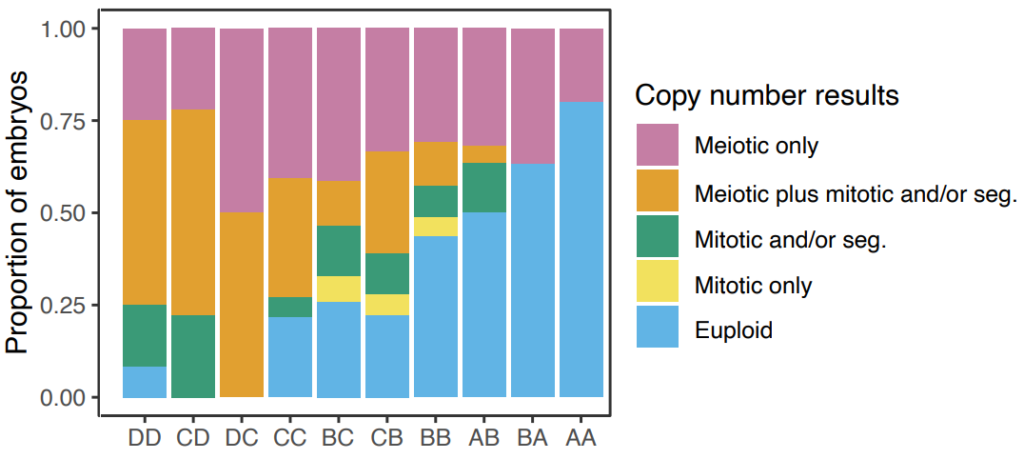
They found that good quality embryos (AA) were more likely to be euploid. You can see this below (notice how the blue bars get bigger as the quality grade improves — about 75% of AA embryos were euploid while about 25% had meiotic aneuploidies). Lower quality embryos were more likely to have a variety of aneuploidies.
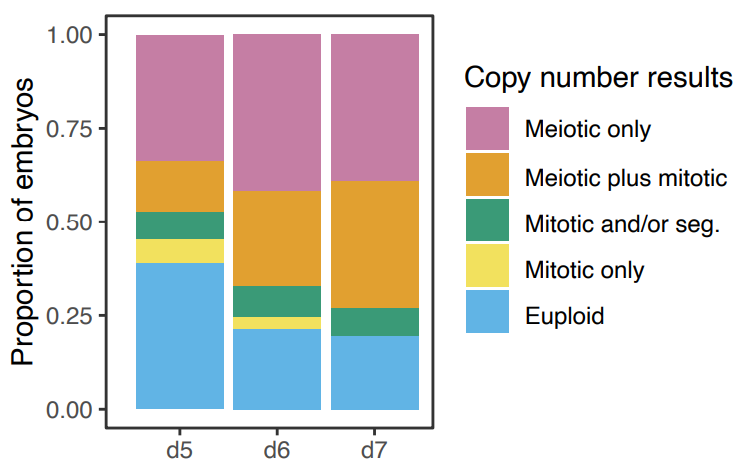
They also did the same thing with day 5 to day 7 embryos. Day 5 embryos were more likely to be euploid compared to day 6 and 7 (about 35% of day 5 embryos were euploid compared to about 20% for day 6 and 7). Day 6 and 7 embryos had more aneuploidies than day 5.
Conclusions
This study found that embryo arrest is more common with older maternal age.
Embryos that arrest are more likely to have increased aneuploidy. Here, it’s the number of aneuploid chromosomes that matters, regardless of it being mitotic or meiotic (although more mitotic aneuploidies were detected). More aneuploid chromosomes = more likely to arrest.
There were more mitotic aneuploidies that contributed to arrest — these are errors that occur after fertilization. This shows that embryo arrest is mostly a consequence of errors the embryo makes, rather than being entirely from egg or sperm aneuploidy.
The authors propose that this increased mitotic aneuploidy could be because the early developing embryo is more likely to make mistakes (as aneuploidy) during cell division, and embryos that make too many mistakes arrest. However, after embryonic genome activation these mistakes may be minimal. For more interesting (but super scientific) reading on this topic, check this recent study by Cavazza et al. (2021).
It’s also possible that non-ideal embryo culturing conditions can cause stress to the embryo, despite efforts to replicate the natural environment.
They also found that embryos with abnormal early cleavage were more likely to arrest. The authors state that they try to de-prioritize embryos for transfer if they show early cleavage errors.
Lastly, in non-arrested embryos, they found that blastocyst grades and how fast they develop (day 5-7) is associated with aneuploidy. Good quality day 5 blastocysts were most likely to be euploid.
Embryos can arrest for a variety of reasons, and before this study, the evidence for aneuploidy wasn’t great. Check my post on Embryo arrest to learn more about it.
Reference

About Embryoman
Embryoman (Sean Lauber) is a former embryologist and the founder of Remembryo, an IVF research and fertility education website. After working in an IVF lab in the US, he returned to Canada and now focuses on making fertility research more accessible. He holds a Master’s in Immunology and launched Remembryo in 2018 to help patients and professionals make sense of IVF research. Sean shares weekly study updates on Facebook, Instagram, and Reddit regularly. He also answers questions on Reddit or in his private Facebook group.
Related posts:
 Complete Guide to Embryo Grading and Success Rates
 Embryo Arrest
 Study examines potential of PGT-A on poor quality embryos
 Predicting live birth rates, multiples based on 223,377 transfers
 Meta-analysis combines 74 studies to examine factors linked to euploid transfer success
 Study examines potential of day 7 euploid transfers
 Study evaluates the potential of day 4, 5, 6 and 7 blastocysts
 Poor quality blastocysts show acceptable live birth rates, no change in perinatal outcomes