
Researchers in a 2026 study proposed statistical thresholds that may help distinguish between poor IVF results that can happen by chance and those that may need a closer look.
IVF patients often ask whether their fertilization rate, blastocyst rate, or number of arrested embryos is normal. While IVF laboratories have benchmark rates for these outcomes, it can be difficult to know when a poor result is simply due to chance and when it might suggest an underlying problem.
Some patients carry genetic variants (mutations) that can interfere with egg maturation, fertilization, or early embryo development. For example, mutations in the TUBB8 gene have been linked to egg maturation arrest and infertility. These conditions are collectively known as oocyte, zygote, and embryo maturation arrest (OZEMA).
Van Der Kelen et al. (2026) reviewed more than 500 patients with known female genetic causes of OZEMA and used statistical modeling to identify IVF outcome patterns that were unlikely to occur by chance alone. The authors suggest that these thresholds could help identify patients that might benefit from additional evaluation like genetic testing.
🔗 Original studies are referenced in this post or within the linked Remembryo posts.
💡 Reminder: Terms underlined with a dotted black line are linked to glossary entries. Clicking these does not count toward your paywall limit.
Study details
- Study type: Systematic review and pooled analysis of published cases involving patients with OZEMA.
- Participants: 253 female patients from 93 publications carrying variants in 35 genes associated with developmental arrest were included in the patient-based analysis. The researchers also included 381 IVF cycles from 176 patients when cycle-specific data were available. Patients were included if they showed repeated problems with oocyte maturation, fertilization, or embryo development across at least two IVF cycles. The authors only evaluated developmental arrest when at least four follicles, eggs, or embryos were available, since very small numbers can produce poor outcomes by chance alone. This cutoff was based on clinical experience rather than statistical modeling.
- Laboratory benchmarks: Researchers compared outcomes against the Vienna Consensus laboratory performance benchmarks (ESHRE/ALPHA 2017), which represent expected IVF laboratory outcomes. These benchmarks were 75% for mature oocytes, 60% for fertilization, 95% for cleavage, and 40% for blastocyst formation.
Egg maturation arrest
Egg maturation arrest is when an unusually high number of retrieved eggs aren’t mature. It was linked to variants (mutations) in 11 genes involved in egg development: CCNB3, CDC20, ENSA, LHX8, MAD2L1BP, PABPC1L, PATL2, TBPL2, TRIP13, TUBB8, and ZFP36L2.
Almost all patients with these variants (98%) produced fewer mature eggs than expected.
The researchers used this pattern to build a statistical model that estimates when a low number of mature eggs is unlikely to be due to chance alone.
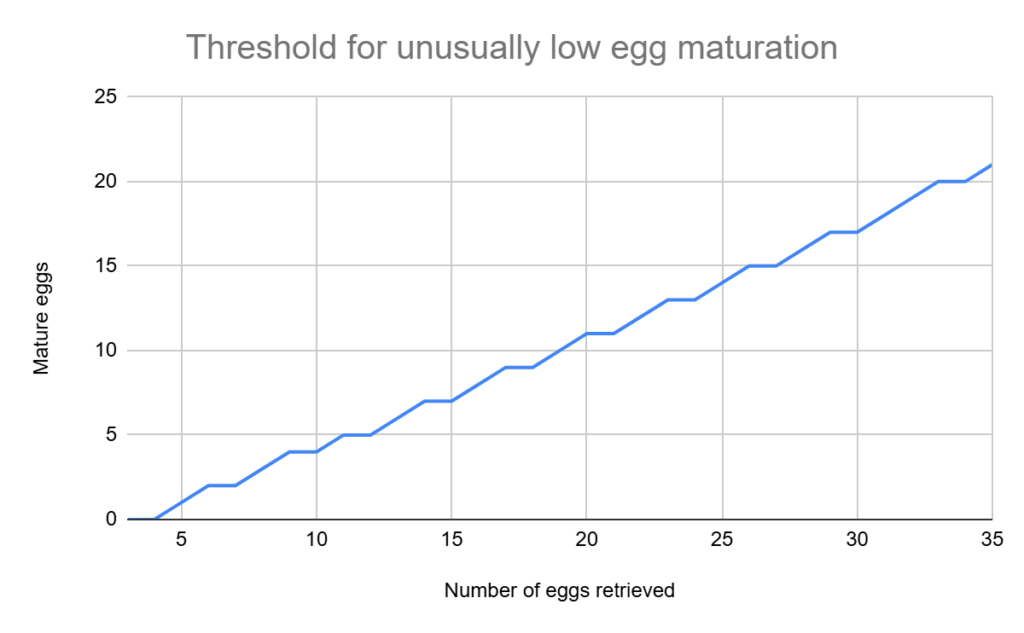
How to read this graph: Results at or below the line would be considered unusually low based on the study’s model. For example, obtaining 2 or fewer mature eggs from 6 retrieved eggs would be considered unusually low. The study excluded patients with less than 4 eggs retrieved, since poor outcomes can occur by chance when numbers are very small.
Fertilization failure
Fertilization failure is when an unusually low number of mature eggs fertilize normally (to form 2PN zygotes). It was linked to variants (mutations) in 5 genes involved in fertilization: ASTL, CDC20, PATL2, TUBB8, and WEE2.
Almost all patients with these variants (96%) had fertilization rates that were lower than expected.
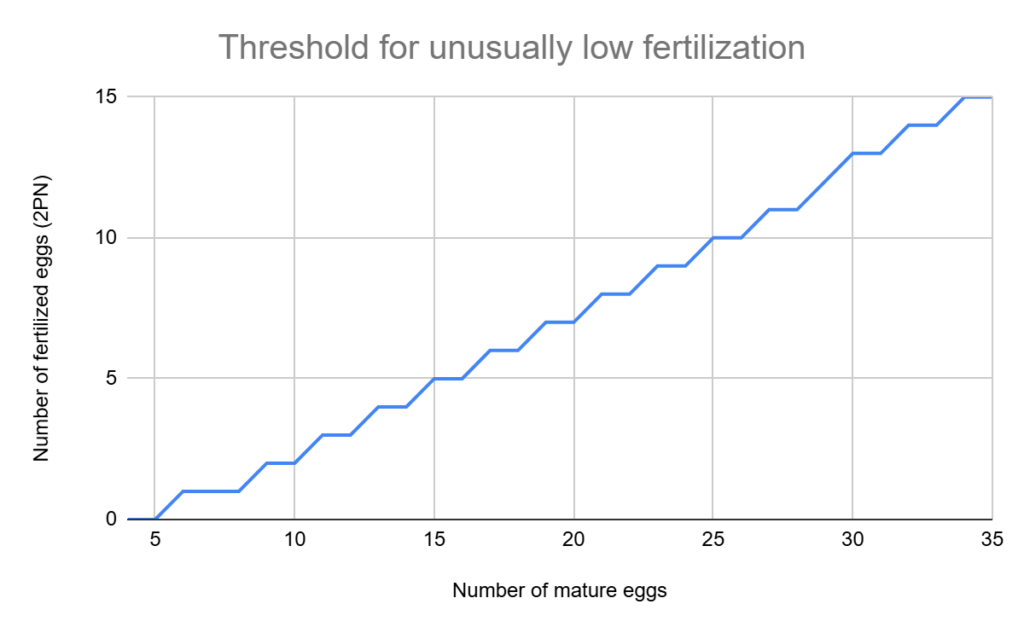
For example, obtaining 1 or fewer normally fertilized eggs (2PNs) from 6 mature eggs would be considered unusually low. The study excluded patients with fewer than 4 mature eggs, since poor outcomes can occur by chance when numbers are very small.
Zygote arrest
Zygote arrest is when fertilized eggs (zygotes) fail to divide into cleavage stage embryos. It was linked to variants (mutations) in 3 genes involved in early embryo development: BTG4, CHEK1, and RGS12. This was the rarest type of developmental arrest identified in the study.
All patients with these variants (100%) produced fewer cleavage stage embryos than expected.
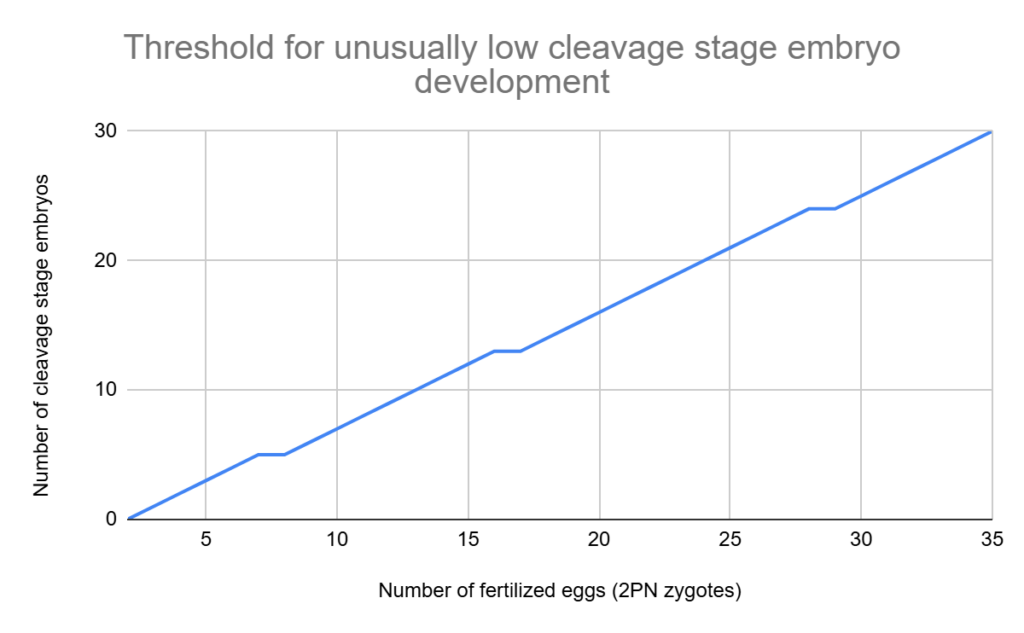
For example, if 10 normally fertilized eggs are obtained, 7 or fewer cleavage stage embryos would meet the proposed threshold for zygote arrest. The study excluded patients with fewer than 4 normally fertilized eggs (2PN zygotes), since poor outcomes can occur by chance when numbers are very small.
Embryo arrest
Embryo arrest is when embryos stop developing before reaching the blastocyst stage.
Early embryo arrest was linked to variants (mutations) in 14 genes involved in early embryo development: FBXO43, KHDC3L, KPNA7, LHX8, MOS, NLRP2, NLRP5, NLRP7, NLRP14, OOEP, PADI6, SYCP4, TLE6, and TUBB8.
Most patients with these variants (89%) produced fewer blastocysts than expected.
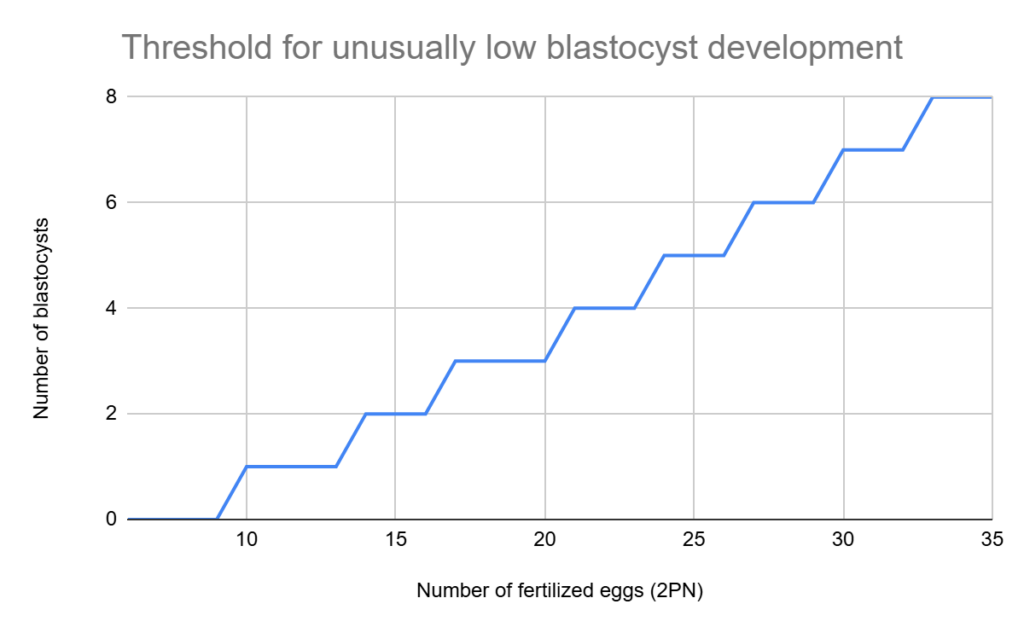
For example, if 10 normally fertilized eggs are obtained, producing 1 or fewer blastocysts would meet the proposed threshold. The study excluded patients with fewer than 4 normally fertilized eggs (2PN zygotes), since poor outcomes can occur by chance when numbers are very small.
Although the embryo arrest thresholds may seem very strict, the researchers weren’t trying to identify embryos that developed below average. Instead, they were looking for results that were so poor that they were unlikely to happen by chance alone. For example, based on the study’s expected blastocyst rate of 40%, 10 normally fertilized eggs would be expected to produce about 4 blastocysts. Getting 2 blastocysts would be lower than expected, but it wouldn’t meet the study’s threshold. The thresholds were intentionally conservative so that only the most unusual results could be flagged for further investigation.
IVF development calculator
🔒 Subscriber tool: Wondering whether your fertilization or blastocyst rates are unusually low? Use the calculator below to compare your IVF results against the thresholds proposed in this study. The calculator uses the same statistical approach described in the study and compares your results against the proposed thresholds.
Tip: If you’ve had multiple IVF cycles with similar outcomes, you can enter your combined totals across all cycles. Larger numbers provide a more reliable estimate than a single cycle.
Conclusion
This study attempts to answer a question many IVF patients ask: when do poor IVF outcomes become unusually poor?
The thresholds proposed in this study may help identify patients who could benefit from additional evaluation. This could include genetic testing, but could also involve evaluating other possible causes of poor fertilization or embryo development.
Although these thresholds were developed using patients with female genetic causes of developmental arrest, poor fertilization and embryo development can result from genetic factors coming from either the egg or the sperm. More studies are needed to better understand the role of male genetic factors in these outcomes.
Overall, the study helps distinguish between IVF results that may be part of normal variation and those that could point to an underlying problem.
Limitations include that the study only looked at patients with known genetic variants, the results may not apply to all IVF patients, and poor fertilization or embryo development can have causes other than the genes studied here.
Want to read more about developmental arrest?
Embryo arrest is when an embryo stops developing, usually before reaching the blastocyst stage. This post explains possible causes, including embryonic genome activation, maternal effect genes, the subcortical maternal complex, aneuploidy, mitochondrial dysfunction, oxidative stress, lab conditions, and sperm DNA fragmentation. Read more.
A 2025 study introduces the term “oocyte and early embryo competence defects” to describe younger IVF patients who repeatedly have no transferable embryos due to low quality eggs, finding that about 13–23% had genetic changes. Read more.
A 2025 study of women with repeated IVF failure and unexplained infertility found that about 13% had mutations affecting egg or embryo development, mostly in the TUBB8 and PATL2 genes, suggesting that many “unexplained” cases may have underlying genetic causes. Read more.

A large 2025 study of donor egg cycles found that poor fertilization in IVF is uncommon, but when it does occur it’s usually caused by sperm rather than the egg. Most cases of low fertilization were sperm-related, while only a minority were linked to eggs or other factors. Read more.
Reference
Annelore Van Der Kelen, Özlem Okutman, Munevver Serdarogullari, Bart J H Dequeker, Elodie Javey, Antonio Capalbo, Cecile Lang, Georgia Kakourou, Efthymia Konstantinou, Francesca Mulas, Karen Sermon, Willem Verpoest, Stéphane Viville, A comprehensive review for defining cut-off values of oocyte, zygote, and embryo maturation arrest (OZEMA) due to maternal-effect genes: towards the establishment of clinical criteria, Human Reproduction, 2026;, deag072, https://doi.org/10.1093/humrep/deag072

About Embryoman
Embryoman (Sean Lauber) is a former embryologist and the founder of Remembryo, an IVF research and fertility education website. After working in an IVF lab in the US, he returned to Canada and now focuses on making fertility research more accessible. He holds a Master’s in Immunology and launched Remembryo in 2018 to help patients and professionals make sense of IVF research. Sean shares weekly study updates on Facebook, Instagram, and Reddit regularly. He also answers questions on Reddit or in his private Facebook group.