

Researchers in a 2022 study found no benefit in using ICSI for non-male factor patients over conventional IVF, in cycles that either did or did not use PGT-A.
Many clinics utilize intracytoplasmic sperm injection (ICSI) as a way to overcome male factor issues, however it’s not clear if this is beneficial to patients without male factor infertility.
Iwamoto et al. (2022) used US clinic data from the Society for Assisted Reproductive Technology (SART) to include non-male factor IVF patients who did or did not use ICSI between 2014 and 2015. Transfers were followed up until 2016 to measure cumulative live births, and a separate analysis of those using PGT-A, as well as those with 3 or fewer eggs retrieved, were included.
In terms of demographics, there were a number of minor differences between the groups that they adjusted for in their statistical analysis, including age, race, BMI and others.
🔗 Original studies are referenced in this post or within the linked Remembryo posts.
💡 Reminder: Terms underlined with a dotted black line are linked to glossary entries. Clicking these does not count toward your paywall limit.
Non-male factor conventional IVF vs ICSI (without PGT-A)
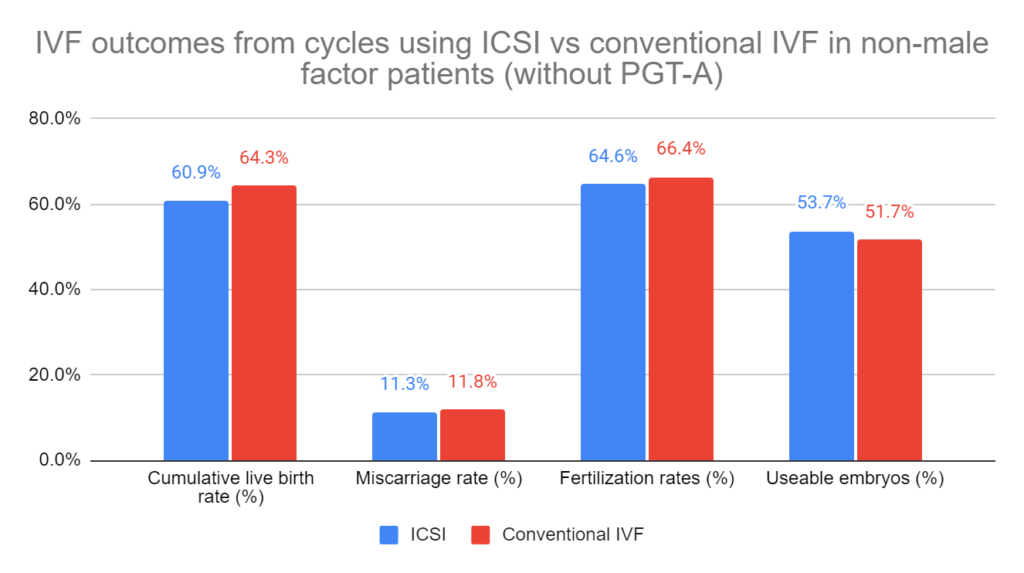
In patients without PGT-A, there were a total of 24,984 patients who used ICSI and 16,533 who used conventional IVF.
The cumulative live birth rate for those who used ICSI was 60.9% vs 64.3% for conventional IVF which was found to not be statistically significant after adjustment (adjusted relative risk [95% CI]: 0.99 [0.99-1.00]). There were also no differences in miscarriage rates for ICSI vs conventional IVF (11.3% vs 11.8%, adjusted relative risk [95% CI]: 1.00 [0.94-1.06]). Those who did ICSI had a slightly lower 2PN to oocyte ratio (essentially the fertilization rate) vs conventional IVF (64.6% vs 66.4%), although they had a slightly higher proportion of useable embryos that were eligible for freezing or transfer (53.7% vs 51.7%).
In a subgroup analysis, the researchers compared ICSI and conventional IVF outcomes for women who retrieved 3 or fewer eggs (551 women).
For cumulative live birth rates, there was a decrease in those who used ICSI vs conventional IVF (25.2% vs 29.8%), however the sample size was too low to do an adjusted analysis so it’s not clear if this result is significant or not. There was no difference in miscarriage rate (7.8% vs 6.7%, adjusted relative risk [95% CI]: 1.05 [0.75-1.48]). There were no differences in the fertilization rate or the number of eligible embryos.
Non-male factor conventional IVF vs ICSI (with PGT-A)
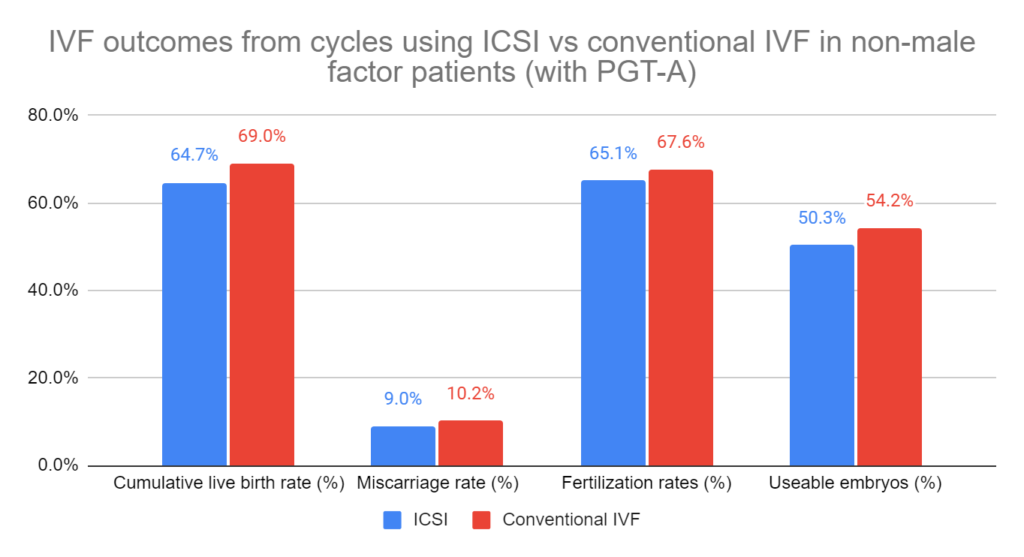
In patients who performed PGT-A, there were a total of 4762 patients who used ICSI and 688 who used conventional IVF.
The cumulative live birth rate for those who used ICSI was 64.7% vs 69.0% for conventional IVF which was found to not be statistically significant after adjustment (adjusted relative risk [95% CI]: 0.97 [0.93-1.01]). There were also no differences in miscarriage rates for ICSI vs conventional IVF (9.0% vs 10.2%, adjusted relative risk [95% CI]: 0.95 [0.72-1.24]). Those who did ICSI had a slightly lower 2PN to oocyte ratio (essentially the fertilization rate) vs conventional IVF (65.1% vs 67.6%), and a lower proportion of useable embryos that were eligible for freezing or transfer (50.3% vs 54.2%).
In a subgroup analysis, the researchers compared ICSI and conventional IVF outcomes for women who retrieved 3 or fewer eggs (94 women).
For cumulative live birth rates, there was an increase in those who used ICSI vs conventional IVF, but this was not significant after adjustment (49.4% vs 46.7%, adjusted relative risk [95% CI]: 1.45 [0.63-3.35]). There was an increase in miscarriage rate in those who used ICSI vs conventional IVF, however the sample size was too low to do an adjusted analysis (10.1% vs 6.7%). There were no differences in the fertilization rate or the number of eligible embryos.
Cost of ICSI vs conventional IVF
The authors reported an estimated cost of about $1500 for ICSI. This means that the approximately 30,000 non-male factor patients who performed ICSI in this study contributed a total of $45 million.
Conclusions
Overall this study found no benefit in using ICSI over conventional IVF for non-male factor patients. This is corroborated by other studies on the subject (Wang et al. 2018, Isikoglu et al. 2021, Bhattacharya et al. 2001).
Although this study found no benefit in using ICSI over conventional IVF, there is always a risk for total fertilization failure. This is when no eggs are fertilized in a cycle and is due to errors in how the sperm binds to the egg (which can be related to issues in either the sperm or the egg). It occurs in about 5-10% of conventional IVF cycles and 2-3% of ICSI cases, and may be more common in male-factor cases (Mahutte et al. 2003). This must be considered when patients and their doctors are deciding on ICSI vs conventional IVF.
Reference

About Embryoman
Embryoman (Sean Lauber) is a former embryologist and the founder of Remembryo, an IVF research and fertility education website. After working in an IVF lab in the US, he returned to Canada and now focuses on making fertility research more accessible. He holds a Master’s in Immunology and launched Remembryo in 2018 to help patients and professionals make sense of IVF research. Sean shares weekly study updates on Facebook, Instagram, and Reddit regularly. He also answers questions on Reddit or in his private Facebook group.
Related posts:
 2022 meta-analysis compares ICSI vs IVF in couples without male-factor
 How many failed embryo transfers is too many?
 An Italian consensus on key performance indicators for assessing IVF clinics
 Meta-analysis combines 74 studies to examine factors linked to euploid transfer success
 Sperm DNA fragmentation associated with lower embryo quality and implantation
 Aneuploid-only first PGT-A cycle has no impact on future PGT-A outcomes
 No differences in IVF outcomes when using fresh or frozen donor eggs
 Multiple embryo freeze/thaw for PGT-A doesn’t affect pregnancy or neonatal outcomes