

Researchers in a 2022 study found that patients who only get aneuploid embryos during a first PGT-A cycle can still obtain euploids in subsequent cycles, with good outcomes.
PGT-A can be used to determine which embryos are euploid, and these may have a higher chance of success. Occasionally, first time PGT-A cycles will only produce aneuploid embryos, and it isn’t clear if this is just a case of bad luck or if subsequent cycles have a reduced potential.
Check my complete guide to PGT-A to get more background on PGT-A (aka PGS testing).
Herlihy et al (2022) evaluated outcomes in 538 patients who had a second PGT-A (NGS) cycle after the first one only produced aneuploids, between 2016 and 2020 at a single center in New Jersey. Day 5, 6 or 7 embryos that were ≥3CC were eligible in their “modified” Gardner scale (which may indicate that they used grading that included a “D” designation, although this isn’t clear).
From the 538 patients that only had aneuploids in their first cycle, 300 (56%) had at least one euploid in their second cycle and 238 (44%) didn’t. Those who had a euploid in the second cycle were younger (38.1 vs 41.0), had a higher AMH (1.6 vs 1.2), had more mature eggs (7.5 vs 5.0) and had more blastocysts that were biopsied (3.0 vs 1.0).
🔗 Original studies are referenced in this post or within the linked Remembryo posts.
💡 Reminder: Terms underlined with a dotted black line are linked to glossary entries. Clicking these does not count toward your paywall limit.
Those with all aneuploids from 1st cycle still can get euploids in 2nd cycle
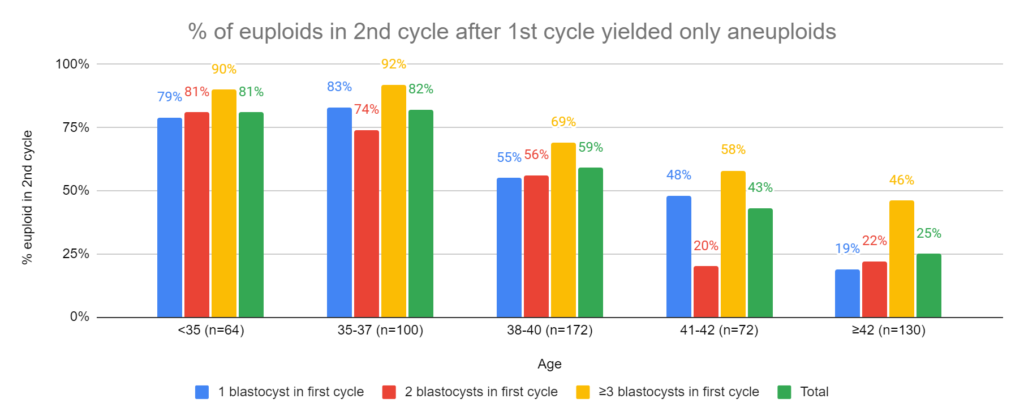
They grouped the 538 patients based on their age and how many blastocysts were biopsied and aneuploid in their first cycle. From patients <35 there was an 81% chance of obtaining a euploid in the second cycle, down to 25% in patients who were ≥42. Patients who had 3 or more aneuploids in the first cycle had a higher chance of getting euploids compared to patients who only got 1 or 2 aneuploids, and this was statistically significant for patients >40.
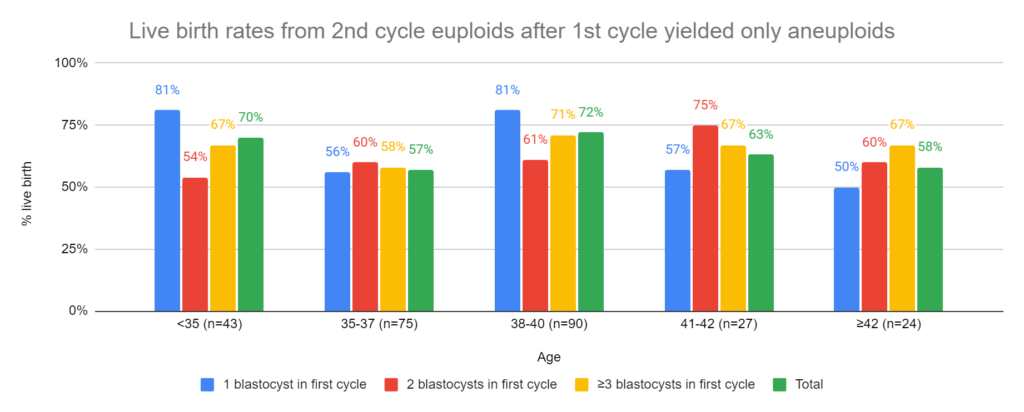
Live birth rates ranged from 70% for patients <35 and 58% for patients ≥42. There were no differences between those who had 3 or more aneuploids in their first cycle, and patients who had 1 or 2 aneuploids.
Euploids from the 2nd cycle have similar outcomes to euploids from a 1st cycle
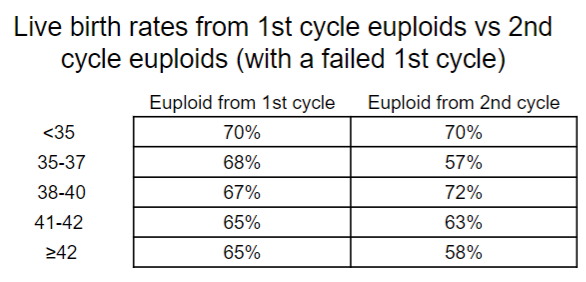
Next they wanted to ensure that these euploids from the second cycle (after a failed first cycle) were equivalent to euploids from a first cycle. They compared outcomes to 4,348 patients who had euploids from their first cycle and found no differences between the groups.
Conclusions
This study found that 56% of patients with a failed first cycle were able to produce euploid embryos in their second cycle. After grouping patients by age, they found that the chance of obtaining a euploid decreased with age. Live birth rates were greater than 50% for all ages when transferring these 2nd cycle euploids. Live birth rates of these 2nd cycle euploids were comparable to euploids from 1st cycles.
Based on these results, the authors concluded that those with aneuploid-only first cycles shouldn’t be discouraged to try a second cycle.
Note: for those referring to the original paper, you might notice that I omitted their “cumulative live birth” data, which is essentially showing the data on a “per retrieval” or cycle start basis, rather then on a “per transfer” basis. The outcomes for the 2nd euploid group are essentially diluted because they’re dividing the live births by a larger number (by including all the aneuploid-only cycles), while the 1st euploid group, which didn’t have any aneuploid-only cycles, is divided by a smaller number and therefore the live birth rate is higher. There’s nothing wrong with showing it this way, but I feel like it’s confusing when all we’re really trying to see is if the euploids are equivalent (which is accomplished by the per transfer data).
Reference

About Embryoman
Embryoman (Sean Lauber) is a former embryologist and the founder of Remembryo, an IVF research and fertility education website. After working in an IVF lab in the US, he returned to Canada and now focuses on making fertility research more accessible. He holds a Master’s in Immunology and launched Remembryo in 2018 to help patients and professionals make sense of IVF research. Sean shares weekly study updates on Facebook, Instagram, and Reddit regularly. He also answers questions on Reddit or in his private Facebook group.
Related posts:
 Meta-analysis combines 74 studies to examine factors linked to euploid transfer success
 Study examines potential of day 7 euploid transfers
 IVF outcomes following aneuploid embryo transfer
 Impact of delayed treatment on IVF outcomes
 How many failed embryo transfers is too many?
 Multiple embryo freeze/thaw for PGT-A doesn’t affect pregnancy or neonatal outcomes
 A look at how PGT-A results change with age, using data from over 86,000 biopsies
 Examining live birth rates in IVF cycles with 5 or less follicles