
Researchers in a 2023 study found that retained embryos had comparable pregnancy outcomes to matched controls and were associated with the transferring doctor’s technique.
During embryo transfer, the embryo can become stuck in the catheter and require a retransfer. It’s not clear what the pregnancy outcomes are for these retained embryos.
Zhang et al. (2023), in their retrospective study, compared outcomes of retained embryos to matched controls at a single IVF center in China between 2016 and 2021. There were 95 transfers involving retained embryos and 190 matched controls.
Key points:
- The control group was matched for age, female BMI, fresh/frozen transfer, diagnosis and type of ovarian stimulation and endometrial preparation protocol. Researchers were blinded to the outcome of these matched controls to reduce bias.
- Only high quality embryos were transferred.
- Retained embryos were immediately retransferred.
- Embryos in transfer catheters were flanked with air bubbles to help with ultrasound visualization (this is standard in many clinics).
- There were 8 doctors who performed the transfers.
Baseline characteristics for all patients were similar for age, BMI, diagnosis, duration of infertility, number of previous transfers, day 3 serum FSH, AMH, ovarian stimulation protocol, number of eggs collected, number of good quality embryos, endometrial preparation protocol, and cleavage vs blastocyst stage transfer.
🔗 Original studies are referenced in this post or within the linked Remembryo posts.
💡 Reminder: Terms underlined with a dotted black line are linked to glossary entries. Clicking these does not count toward your paywall limit.
Low overall incidence of retained embryos
In total, the center performed 29,160 embryo transfers between 2016 and 2021 with only 95 retained embryos (0.33%). Five of these cycles required a third attempt at transfer.
They compared the incidence of retained embryos in fresh vs frozen transfers and cleavage vs blastocyst stage transfers and found no differences.
No differences in pregnancy outcomes with retained embryos
After transfer of a retained embryo compared to matched controls, there were no statistically significant differences in clinical pregnancy rates (47.4% vs 54.7%, p=0.240), live birth rate (41.1% vs 48.9%, p=0.208) or miscarriage rates (11.1% vs 9.6%, p=0.781).

Between retained embryo transfers and matched controls, they found no differences in ectopic pregnancy rates (2.2% vs 1.9%), gestational age of the baby (37.8 vs 38.6 weeks) and the baby’s birth weight (3029 vs 3175 g). There were no congenital defects in the retained embryo group, while there was a single event in the matched group (not statistically significant).
Some doctors more likely to cause a retained embryo during transfer, unrelated to experience level
The IVF center had 8 doctors who performed embryo transfers, each with a statistically significant difference in retained embryo rates ranging from 0.10% to 1.21% (p<0.001). The average was 0.49%.
Below you can see the retained embryo rates (first graph) along with the corresponding number of transfers for each doctor (second graph). The amount of time these doctors have been performing transfers varied, with doctor 1 starting the earliest in 2016 and doctor 8 starting the latest in 2019.
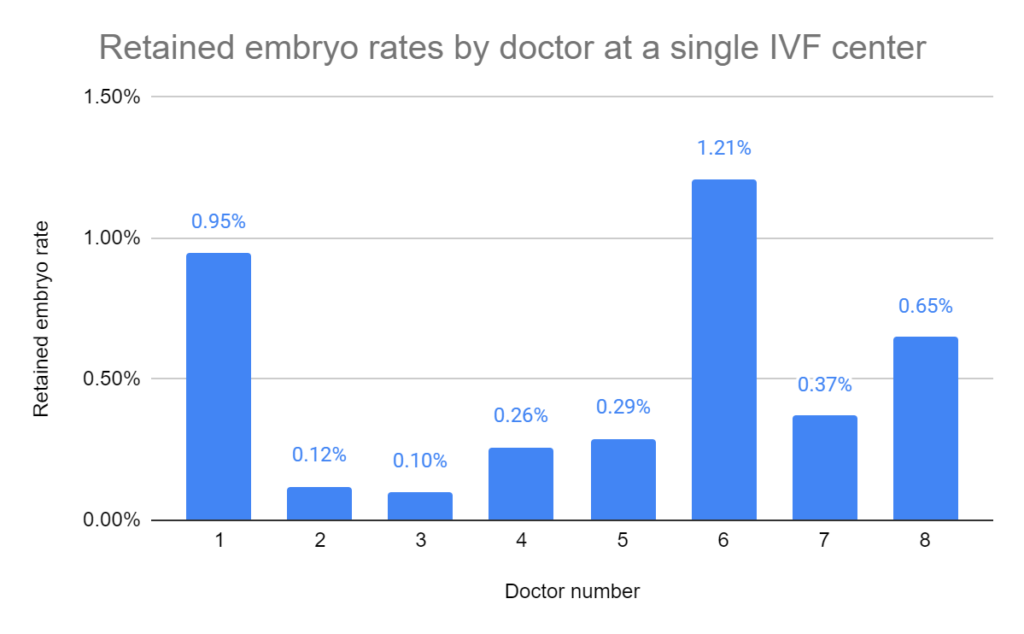
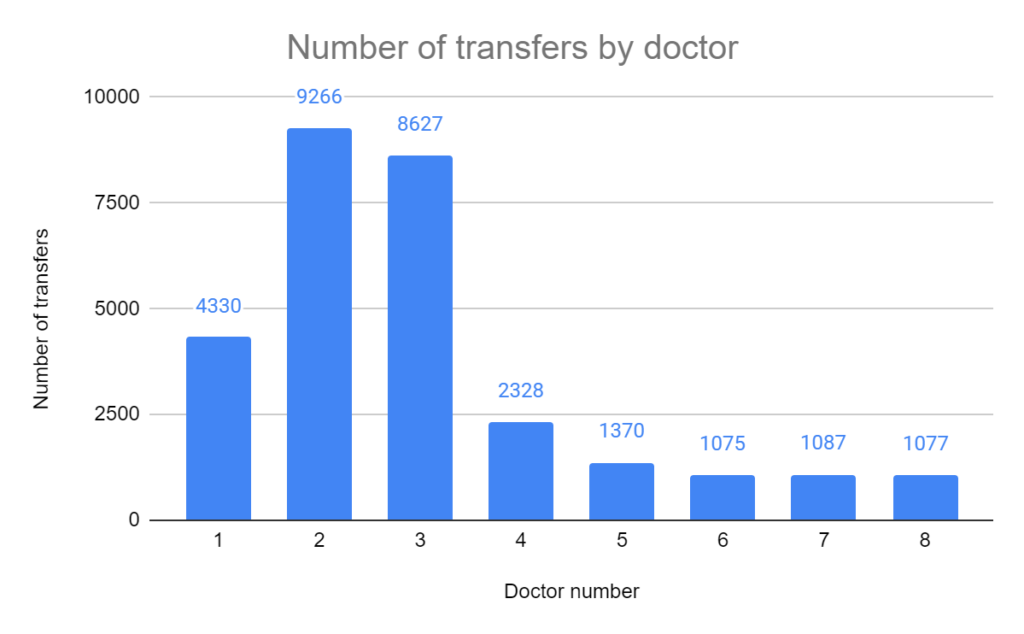
Doctor 1 had been performing transfers for the longest time, and had the third highest number transferred, yet showed the second highest retained embryo rate. Doctors 2 and 3 also had a high level of experience but showed the lowest rates.
To further examine the association with experience level and retained embryo rate, the researchers compared rates by grouping doctors who performed <600 and ≥600 transfers a year and found no differences. This suggests that doctor experience is unrelated to retained embryo rates, and that some doctors may just be more likely to cause a retained embryo due to their technique.
Conclusions
This study found that retained embryos are a rare event and have comparable pregnancy, live birth and miscarriage rates. There were also no differences in gestational age or birth weights of babies born from retained embryos.
They found that individual doctors have significantly different retained embryo rates, which seems to be unrelated to experience level.
The authors suggest that given the variability in retained embryo rate by individual doctor, “it may be necessary for operators to have periodic re-training or reassessment of their professional skills.”
While a strength of this study is that they matched the control group to eliminate bias, a limitation is that they didn’t match the doctors between the two groups. Doctors themselves can have an impact on pregnancy rates (see here).
Reference

About Embryoman
Embryoman (Sean Lauber) is a former embryologist and the founder of Remembryo, an IVF research and fertility education website. After working in an IVF lab in the US, he returned to Canada and now focuses on making fertility research more accessible. He holds a Master’s in Immunology and launched Remembryo in 2018 to help patients and professionals make sense of IVF research. Sean shares weekly study updates on Facebook, Instagram, and Reddit regularly. He also answers questions on Reddit or in his private Facebook group.
Related posts:
 Pregnancy outcomes unaffected by catheter-retained embryos
 Risk of poor ovarian response with repeat IVF cycles
 How many failed embryo transfers is too many?
 Comparing frozen embryo transfer/FET protocols
 Improved IVF outcomes when embryos are cultured in groups
 Embryologist and physician success rates variable, not related to experience
 Study finds poor ovarian responders have no further live births after 4 cycles
 Identifying the optimal timing for embryo transfer in modified natural and natural FETs