
Researchers in a 2023 study used a procedure called “rescue in vitro maturation” to culture immature eggs collected after retrieval overnight, and found that a high proportion became mature and had comparable fertilization to sibling mature eggs, with many going on to form euploids.
Many IVF cycles result in immature eggs and are normally discarded, but continued culture of these immature eggs by rescue in vitro maturation (rescue IVM), may be a viable way to maximize the number of mature eggs in an IVF cycle.
Shani et al. (2023) compared IVF outcomes of rescue IVM eggs, which were immature at retrieval and then matured overnight, and mature sibling eggs. The study involved 182 patients and 2,288 eggs, and took place at an IVF center in Canada between 2019 and 2021.
Key information:
- Women ranged in age from 18-45 (average age was 37). Women who did PGT-A were on average 36.93.
- Rescue IVM was used in cases with inadequate egg maturity, low egg count or poor fertilization history.
- Mature eggs were used for ICSI shortly after retrieval, while immature eggs were cultured in standard culture media for 17-24 hours to assess maturity before ICSI.
- All comparisons were done with mature sibling eggs (mature eggs from the same cycle).
- Good quality blastocysts had A or B grades, while poor quality blastocysts had C grades.
As a reminder, immature eggs come as two types: germinal vesicle (GV) or metaphase 1 (M1). Eggs mature starting from a GV, then to M1, then to M2. So a GV is less mature than an M1. For more background on egg quality and maturity, check out my Complete guide to egg quality.
🔗 Original studies are referenced in this post or within the linked Remembryo posts.
💡 Reminder: Terms underlined with a dotted black line are linked to glossary entries. Clicking these does not count toward your paywall limit.
Rescue IVM leads to a high proportion of mature eggs
In total, there were 2,288 eggs that were collected among the 182 patients, with 1,056 that were immature (46%): 375 were M1 (16%) and 688 were GV (30%). The egg maturity for the population was low because that was their criteria for rescue IVM.
These immature eggs were cultured overnight for a period of 17-24 hours since the retrieval, with 89% of M1 eggs and 54% of GV eggs becoming mature.

Embryology outcomes of rescue IVM and sibling mature eggs
All of the rescue IVM mature eggs from M1 and GV immature eggs were inseminated by ICSI.
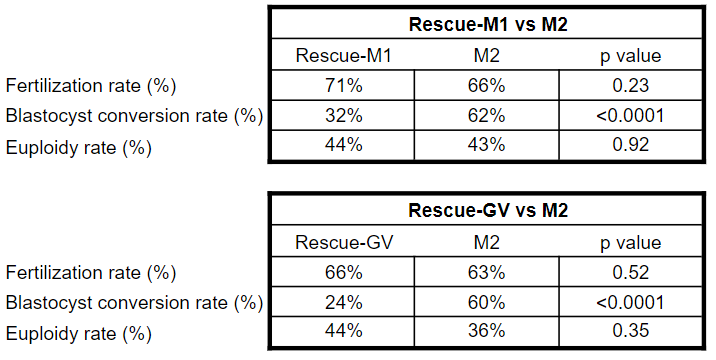
You can see below that these eggs had comparable fertilization rates and euploidy rates, but rescue IVM eggs were less likely to produce blastocysts.
Let’s look at some related data that isn’t captured in the above table.
There was no difference in the abnormal fertilization rate, including 1PN and 3PN embryos, for either rescue-M1 and rescue-GV vs sibling mature eggs (10% vs 8%, p= 0.50; 6% vs 9%, p= 0.16).
There were no differences in good quality blastocyst rates between rescue-M1 and rescue-GV eggs compared to sibling mature eggs (41% vs 61%, p= 0.09; 32% vs 61%, p< 0.32).
Morphokinetic properties of rescue IVM embryos altered
About half of rescue-M1 and rescue-GV embryos were assessed by time-lapse, allowing the researchers to look at the morphokinetics of their development.
In general, rescue IVM eggs took longer to have their first and second cell division but reached blastocyst more quickly compared to sibling mature eggs.
Rescue IVM embryos also had a higher level of multinucleation at the 2- and 4-cell stages, and showed higher rates of direct cleavage.
Limited pregnancy outcomes for embryos from rescue IVM
Unfortunately, there was limited data on transfer outcomes using embryos from rescue IVM eggs, as these were transferred secondary to eggs that were mature at retrieval.
In total, 20 rescue IVM embryos were transferred:
- 9 were day 3 embryos from a rescue-GV/M1: 2 pregnancies, 2 deliveries at 21 weeks (late miscarriage).
- 3 were euploids from rescue-GVs: 1 pregnancy, 1 live birth.
- 4 were euploids from rescue-M1s: 3 pregnancies, 1 miscarriage, 1 term live birth.
- 1 was a mosaic from a rescue-M1: 1 pregnancy, 1 term live birth.
- 3 untested embryos from a rescue-GV/M1: 1 pregnancy, 1 miscarriage.
Conclusions
This study found that a high proportion of immature eggs that were cultured overnight by rescue IVM became mature eggs. These rescue IVM eggs had comparable fertilization rates to sibling mature eggs, but they were less likely to convert to blastocyst (more of them arrested).
These rescue IVM embryos showed abnormal morphokinetics, like an increased rate of direct cleavage and multinucleation, which may predispose the embryo to arrest before becoming a blastocyst.
Despite this, once a rescue IVM embryo became a blastocyst, there were no differences in euploidy rates compared to embryos from sibling mature eggs.
The authors explain that the increase in embryo arrest seen after rescue IVM is likely due to compromised cytoplasmic maturation, which may result in defects in cellular processes like cell division.
Due to the clinic’s policy of prioritizing the transfer of embryos from normally matured eggs, it was difficult to make comparisons with pregnancy outcomes. Out of 20 embryos transferred, there were 3 live births and 4 miscarriages (2 were late at 21 weeks).
Based on the blastocyst conversion rates from unfertilized eggs, about 5 M1 and 4.5 GV immature eggs would be needed to make one blastocyst by rescue IVM. For fertilized rescue IVM eggs, about 3.1 rescue-M1 and 4.2 rescue-GV eggs would be needed per blastocyst.
Reference

About Embryoman
Embryoman (Sean Lauber) is a former embryologist and the founder of Remembryo, an IVF research and fertility education website. After working in an IVF lab in the US, he returned to Canada and now focuses on making fertility research more accessible. He holds a Master’s in Immunology and launched Remembryo in 2018 to help patients and professionals make sense of IVF research. Sean shares weekly study updates on Facebook, Instagram, and Reddit regularly. He also answers questions on Reddit or in his private Facebook group.