
A new case report adds to evidence that zona-free eggs, often discarded, can still fertilize and develop after ICSI, prompting the authors to urge embryologists not to discard them.
The zona pellucida, or zona, is a glycoprotein shell that surrounds the egg and plays key roles in fertilization and early development. It helps to bind sperm, prevent multiple sperm from fertilizing the egg (polyspermy), and in stabilizing early cells of the embryo to hold it together.
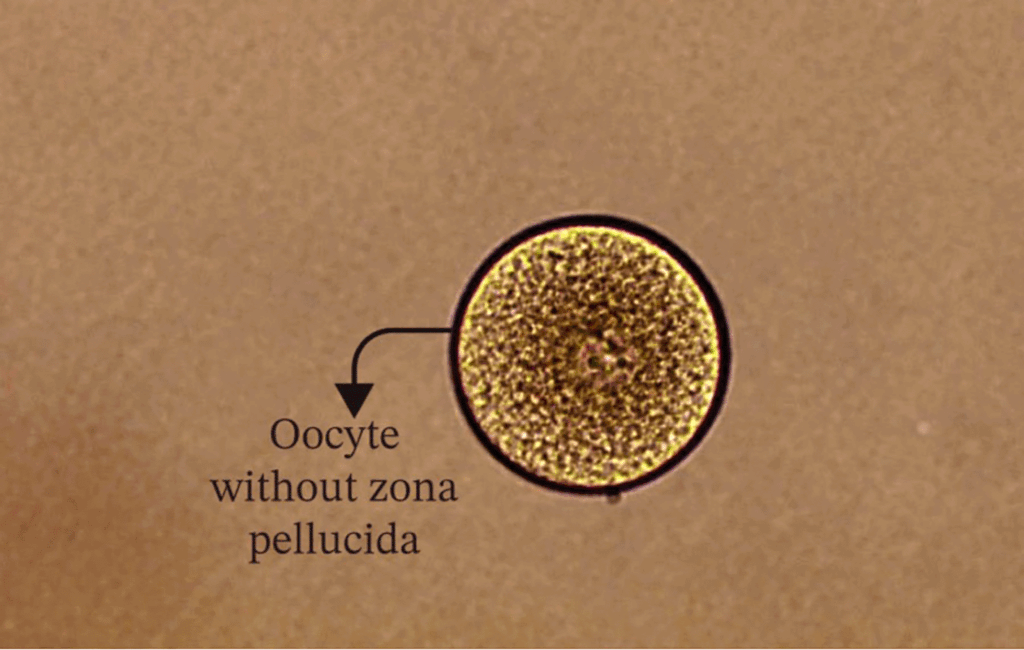
In rare cases, an egg can lose its zona and these zona-free eggs are often discarded due to concerns about its fragility or poor embryo development. However, a small number of case reports suggest that zona-free eggs may still be viable.
You can see a zona-free egg below:
🔗 Original studies are referenced in this post or within the linked Remembryo posts.
💡 Reminder: Terms underlined with a dotted black line are linked to glossary entries. Clicking these does not count toward your paywall limit.
A new case report by Faizah et al. (2025) documents a case of a 44-year-old woman whose oocyte spontaneously lost its zona during denudation. This was the only egg that she retrieved after IVF. The egg showed a visible polar body, confirming it was mature before ICSI was performed.
Despite lacking a zona, the egg was successfully fertilized via ICSI and developed into a cleavage-stage embryo by day 3. The embryo was transferred, but unfortunately didn’t result in a pregnancy.
While this case report didn’t show a successful live birth, other studies have, including Shu et al. (2010), Stanger et al. (2001) and Hu & Trolice (2016). Shrivastava et al. (2023) showed that a high quality embryo can result from a zona-free egg.
Because of this, the authors of this case study write that zona-free eggs have “the potential for fertilisation, cleavage and successful live birth outcomes…and should therefore not be discarded.”
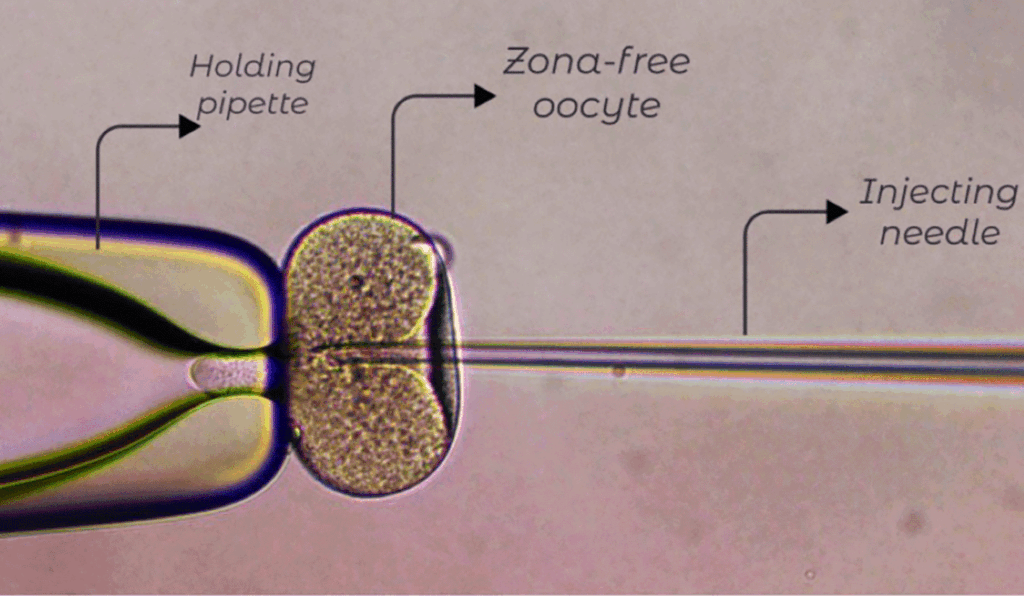
Handling zona-free eggs during ICSI can be challenging, since the zona normally protects the egg. Without it, the holding pipette must be used very carefully to avoid applying too much suction to the delicate egg. The image below shows a zona-free egg being stabilized with a holding pipette during ICSI.
Because of the fragility of zona-free eggs, the authors of this case report offer several tips for the embryology lab:
- Only inject if a polar body is visible to confirm maturity.
- Use polarized light microscopy if available to check spindle position for ICSI (to avoid damaging the egg’s DNA).
- Handle with minimal mechanical force to avoid damage.
- Culture embryos individually to prevent fusion of the embryo’s cells (the cells can separate and stick together if multiple embryos from zona-free eggs are cultured together).
- Replace only 90 percent of the media to avoid disturbing the embryo.
- Consider re-encapsulation if the empty zona is intact (the egg can carefully be placed back in the zona).
Reference

About Embryoman
Embryoman (Sean Lauber) is a former embryologist and the founder of Remembryo, an IVF research and fertility education website. After working in an IVF lab in the US, he returned to Canada and now focuses on making fertility research more accessible. He holds a Master’s in Immunology and launched Remembryo in 2018 to help patients and professionals make sense of IVF research. Sean shares weekly study updates on Facebook, Instagram, and Reddit regularly. He also answers questions on Reddit or in his private Facebook group.