

Researchers in a 2023 study found that subcutaneous and intramuscular progesterone for medicated FETs had similar clinical pregnancy, ongoing pregnancy and miscarriage rates.
There is an ongoing debate over the best route, duration and dosage for progesterone (P) administration in medicated frozen embryo transfer (FET) cycles, including vaginal P, intramuscular (IM)-P, and subcutaneous (SC)-P, with limited data examining the use of SC-P during FETs.
Boynukalin et al. (2023) compared ongoing pregnancy rates in medicated FETs that used SC-P or IM-P for endometrial preparation.
🔗 Original studies are referenced in this post or within the linked Remembryo posts.
💡 Reminder: Terms underlined with a dotted black line are linked to glossary entries. Clicking these does not count toward your paywall limit.
Study details
- This was a nonrandomized prospective study, and patients chose IM-P or SC-P.
- IM-P was administered daily at 50 mg (in oil), SC-P was administered twice a day at 25 mg (in water).
- All cycles were freeze-all. Medicated FETs only. Only the first FET was considered.
- Key exclusions: Women >35, PGT-A cycles, cleavage-stage transfers, uterine issues, surplus embryos for FET, thin endometrium (<7 mm).
- The primary outcomes was ongoing pregnancy rate between SC-P and IM-P.
In terms of baseline characteristics, there were no differences in any of the characteristics they measured: female age, BMI, attempts, duration of infertility, diagnosis, endometrial thickness, P levels on day of transfer, embryo quality, the day the embryo was frozen and more.
The median serum levels of progesterone on the day of transfer was similar: 19.92 ng/ml and 21 ng/ml for the SC-P and IM-P groups, respectively.
Comparable transfer outcomes with subcutaneous and intramuscular progesterone
For SC-P vs IM-P, there were comparable rates for clinical pregnancy (64.7% vs 62.6%, p= 0.757), miscarriage (24.4% vs 17.5%, p= 0.328) and ongoing pregnancy (48.9% vs 51.6%, p= 0.683). The miscarriage rate was high for SC-P, although not significantly different from IM-P.

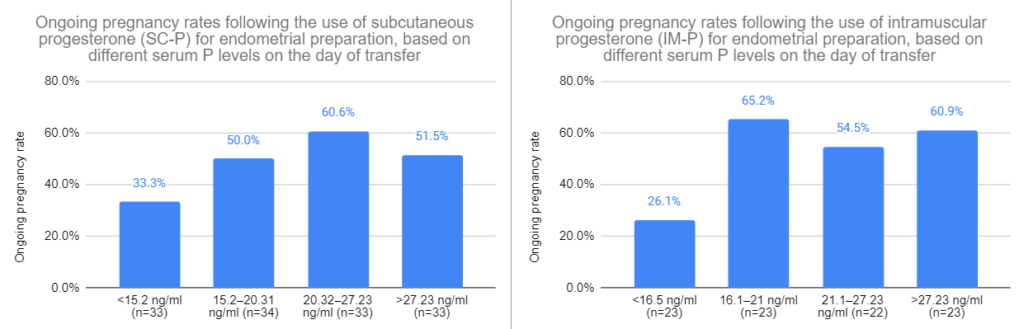
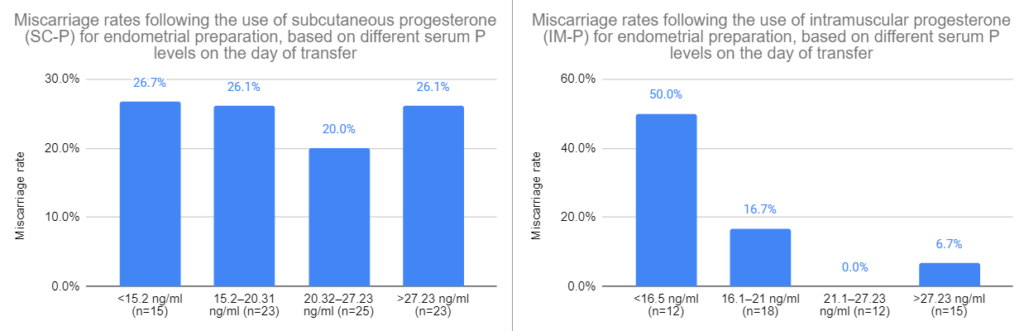
They also broke up the SC-P and IM-P transfer day serum P levels by four (into quartiles) and compared ongoing pregnancy and miscarriage rates.
For ongoing pregnancy rates, there was no difference between any of the quartiles for SC-P (p= 0.163), but the lowest quartile for IM-P (<16.5 ng/ml) had lower ongoing pregnancy rates compared to the higher P levels (p= 0.031).
For miscarriage, there was no difference between any of the quartiles for SC-P (p= 0.945), but the lowest quartile for IM-P (<16.5 ng/ml) had higher miscarriage rates compared to the higher P levels (p= 0.03).
Conclusions
This study found no difference in clinical pregnancy, ongoing pregnancy and miscarriage rates when SC-P or IM-P were used for endometrial preparation.
The patient’s’ serum P levels were similar on the day of transfer.
Ongoing pregnancy rates didn’t vary with increasing serum progesterone levels on transfer day in the SC-P group. However, the IM-P group had lower rates, especially when levels were below 16.5 ng/ml. SC-P showed consistent miscarriage rates, while IM-P had higher rates at the lowest level.
The authors note that IM-P and SC-P have different properties that affect how they’re absorbed and metabolized, so it’s possible that SC-P might raise progesterone levels faster than IM-P. The twice-daily SC-P administration may also play a role in raising progesterone levels more quickly.
A number of limitations were mentioned, including that only a single blood sample was used and no obstetric outcomes, or side effects, were reported.
The authors state that further studies are needed, particularly those that address miscarriage and obstetric outcomes, while also including a wide range of patients with varying age and BMI.
Reference

About Embryoman
Embryoman (Sean Lauber) is a former embryologist and the founder of Remembryo, an IVF research and fertility education website. After working in an IVF lab in the US, he returned to Canada and now focuses on making fertility research more accessible. He holds a Master’s in Immunology and launched Remembryo in 2018 to help patients and professionals make sense of IVF research. Sean shares weekly study updates on Facebook, Instagram, and Reddit regularly. He also answers questions on Reddit or in his private Facebook group.