
Researchers in a 2024 study measured levels of chlormequat in the US population and US food supply, finding increased levels since 2017. Chlormequat has been linked to reproductive problems in animals, and it’s not clear if this applies to humans.
Chlormequat is a chemical used in agriculture to help plants from growing too tall and bending over. It’s approved for use in Canada, Europe and the UK, and in the US is only allowed to be used on ornamental plants.
However, the US Environmental Protection Agency (EPA) approved the import of crops treated with chlormequat in 2018, with acceptable food tolerance levels in imported oat, wheat, barley and some animal products. These levels were increased in 2020 for products containing oats.
There is some evidence linking chlormequat to reproductive problems in animals:
- Pig farmers noted declined fertility in pigs that ate grains treated with the chemical, which was linked to disrupted estrous cycling (Sørensen et al. 2006).
- Male mice exposed to the chemical showed decreased fertilization capacity (Torner et al. 1999).
- Various rat studies have shown delayed puberty onset, reduced sperm motility and decreased testosterone levels (Hou et al. 2020, Xiao et al. 2021, Hou et al. 2018).
- Rat embryos exposed to the chemical show disrupted embryonic growth (Xiagedeer et al. 2020).
- Not all studies have found effects on reproductive health (Sørensen et al. 2009, Liu et al. 2019).
🔗 Original studies are referenced in this post or within the linked Remembryo posts.
💡 Reminder: Terms underlined with a dotted black line are linked to glossary entries. Clicking these does not count toward your paywall limit.
Temkin et al. (2024) did a study and measured chlormequat levels in the US population and US food supplies. Since the 2020 decision to allow higher levels of chlormequat in important food products, they wanted to see if this had any effect.
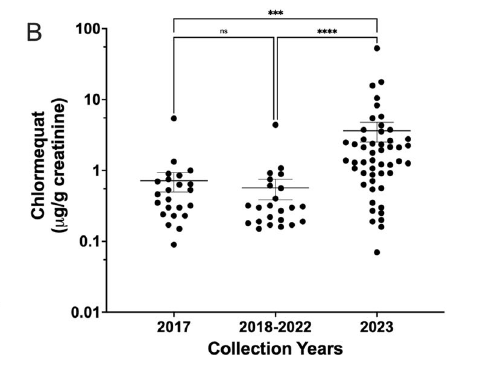
Between 2017 to 2023, they were able to detect chlormequat in 77 of 96 (80%) of urine samples from US individuals. From 2017 to 2023, the detection frequency increased from 69% to 90%. This means that more people had chlormequat in their urine in 2023 compared to 2017.
Concentrations of chlormequat also increased from 2017 to 2023, from about 0.9 ug/g of creatine to 5 ug/g of creatine (average). You can see the concentrations below. Note that “per g creatine” is used to normalize the urine measurements, since some urine might be more or less diluted.
They also examined common food products to see if chlormequat could be detected, with concentrations ranging from non-detectable to 291 ug/kg. Higher levels were detected in oat products and there were lower levels in wheat products. Organic oat-based products were mostly free of chlormequat.
You can check out all the products they tested below. Note that “ppb” refers to “parts per billion” and is the same as 1 ug per 1 kg, and “ND” means “not detected.”
| Brand | Product | Food Type | Production Type | Collection Date | Chlormequat (ppb) |
| General Mills | General Mills Cheerios | oats | Conventional | June 2022 | 107 |
| General Mills | General Mills Honey Nut Cheerios | oats | Conventional | June 2022 | 30 |
| Kellogg’s | Kellogg’s Special K Fruit & Yogurt | oats | Conventional | June 2022 | ND |
| Quaker | Quaker Oatmeal Squares Honey Nut | oats | Conventional | June 2022 | 160 |
| Quaker | Quaker Old Fashioned Oats | oats | Conventional | June 2022 | 291 |
| 365 Whole Foods Market | 365 Whole Foods Market Organic Raisin Granola | oats | Organic | August 2022 | ND |
| General Mills | General Mills Cheerios Oat Crunch Oats n’ Honey | oats | Conventional | August 2022 | 90 |
| General Mills | General Mills Frosted Cheerios | oats | Conventional | August 2022 | 40 |
| Target | Good & Gather French Vanilla Almond Granola | oats | Conventional | August 2022 | 90 |
| Quaker | Quaker Chewy Dark Chocolate Chunk | oats | Conventional | August 2022 | 80 |
| Quaker | Quaker Instant Oatmeal Maple & Brown Sugar | oats | Conventional | August 2022 | 170 |
| Quaker | Quaker Oatmeal Squares Brown Sugar | oats | Conventional | August 2022 | 90 |
| Quaker | Quaker Simply Granola Oats Honey & Almonds | oats | Conventional | August 2022 | 70 |
| Walmart | Walmart Great Value Oats & Honey Granola | oats | Conventional | August 2022 | 180 |
| 365 Whole Foods Market | 365 Whole Foods Market Fruit & Nut Muesli | oats | Conventional | May 2023 | ND |
| 365 Whole Foods Market | 365 Whole Foods Market Organic Chocolate Chip Chewy Granola | oats | Organic | May 2023 | ND |
| 365 Whole Foods Market | 365 Whole Foods Market Organic French Vanilla Granola | oats | Organic | May 2023 | ND |
| 365 Whole Foods Market | 365 Whole Foods Market Organic Old Fashioned Rolled Oats | oats | Organic | May 2023 | ND |
| General Mills | General Mills Cheerios | oats | Conventional | May 2023 | 123 |
| General Mills | General Mills Cheerios Oat Crunch Oats n’ Honey | oats | Conventional | May 2023 | 104 |
| General Mills | General Mills Frosted Cheerios | oats | Conventional | May 2023 | 122 |
| General Mills | General Mills Honey Nut Cheerios | oats | Conventional | May 2023 | 116 |
| Kellogg’s | Kellogg’s Special K Fruit & Yogurt | oats | Conventional | May 2023 | 12 |
| Quaker | Quaker Chewy Dark Chocolate Chunk | oats | Conventional | May 2023 | 60 |
| Quaker | Quaker Instant Oatmeal Maple & Brown Sugar | oats | Conventional | May 2023 | 112 |
| Quaker | Quaker Instant Oatmeal Organic Maple & Brown Sugar | oats | Organic | May 2023 | ND |
| Quaker | Quaker Oatmeal Squares Brown Sugar | oats | Conventional | May 2023 | 199 |
| Quaker | Quaker Oatmeal Squares Honey Nut | oats | Conventional | May 2023 | 189 |
| Quaker | Quaker Old Fashioned Oats | oats | Conventional | May 2023 | 209 |
| Quaker | Quaker Simply Granola Oats Honey & Almonds | oats | Conventional | May 2023 | 69 |
| Simple Truth (Harris Teeter) | Simple Truth Organic Instant Oatmeal Maple & Brown Sugar | oats | Organic | May 2023 | ND |
| Simple Truth (Harris Teeter) | Simple Truth Organic Oats & Honey Granola Clusters | oats | Organic | May 2023 | ND |
| Simple Truth (Harris Teeter) | Simple Truth Organic Toasted Oats Cereal | oats | Organic | May 2023 | 17 |
| Arnold | Arnold Whole Grains Healthy Multi-Grain Bread | wheat | Conventional | February 2023 | 12.6 |
| Band of Bakers | Band of Bakers Harvest Loaf | wheat | Conventional | February 2023 | ND |
| General Mills | General Mills Cinnamon Toast Crunch | wheat | Conventional | February 2023 | ND |
| Gold Medal | Gold Medal Premium Quality All Natural Whole Wheat Flour for Baking, 5 lb. | wheat | Conventional | February 2023 | ND |
| Great Value (Walmart) | Great Value Half-Length Spaghetti | wheat | Conventional | February 2023 | ND |
| Kellogg’s | Kellogg’s Frosted Mini Wheats | wheat | Conventional | February 2023 | ND |
| King Arthur | King Arthur Flour All-Purpose Unbleached Flour | wheat | Conventional | February 2023 | ND |
| Nabisco | Nabisco Ritz Crackers | wheat | Conventional | February 2023 | ND |
| Nature’s Own | Nature’s Own 100% Whole Grain Bread | wheat | Conventional | February 2023 | 3.5 |
So is this anything to be worried about?
The data on the negative effects of chlormequat are based on animals studies, and have mixed results. It’s hard to draw conclusions based on this, because the reproductive system of pigs and rodents are very different from humans.
This study is also simply showing higher levels of the chemical, without any association to infertility in humans. These higher levels might not have any impact at all.
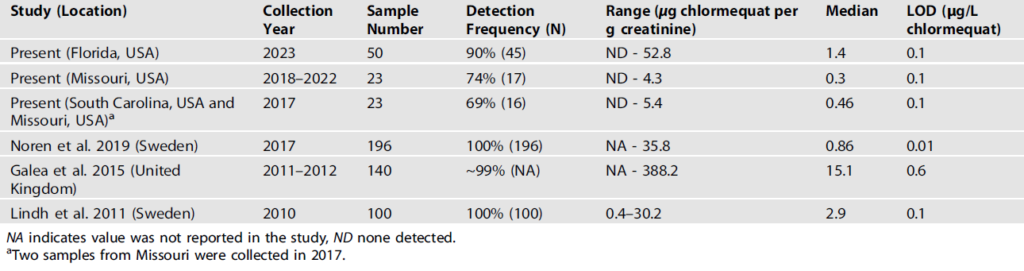
There’s been biomonitoring studies done in other countries, specifically Sweden (Lindh et al. 2011, Noren et al. 2020) and the UK (Galea et al. 2015) where chlormequat is permitted to be used on crops. The UK in particular has shown high median levels of chlormequat in the urine in 2011/2012, at 15.1 ug/g of creatine. These concentrations are much higher than in the US, at 1.4 ug/g of creatine.
You can see the median (middle) levels of chlormequat from these studies below, along with the “limit of detection” (LOD) that indicates the lowest accurate measurement.
Again, it’s not clear if any of this has any impact on human fertility and more studies are needed to see the effects. For those concerned, it may be best to eat organic products as these seem to have lower levels of the chemical.
Given the toxicological concerns associated with chlormequat exposure in animal studies, and widespread exposure to the general population, in European countries, and now also likely in the U.S., monitoring of chlormequat in foods and people, in conjunction with epidemiological and animal studies, is urgently needed to understand the potential health harms of this agricultural chemical at environmentally relevant exposure levels, particularly during pregnancy.
Reference

About Embryoman
Embryoman (Sean Lauber) is a former embryologist and the founder of Remembryo, an IVF research and fertility education website. After working in an IVF lab in the US, he returned to Canada and now focuses on making fertility research more accessible. He holds a Master’s in Immunology and launched Remembryo in 2018 to help patients and professionals make sense of IVF research. Sean shares weekly study updates on Facebook, Instagram, and Reddit regularly. He also answers questions on Reddit or in his private Facebook group.
Related posts:
 Small study finds comparable IVF outcomes with marijuana smokers
 Study examines impact of coffee on IVF outcomes
 Mediterranean diet and IVF – a clinical trial
 Oocyte quality and IVF outcomes linked to maternal lifestyle and diet
 Sleep quality and its impact on IVF outcomes
 Endocrine disruptors and their impact on fertility
 Study evaluates interventions that lower endocrine disruptor levels
 Study examines impact of increasing BMI on euploid transfer outcomes