
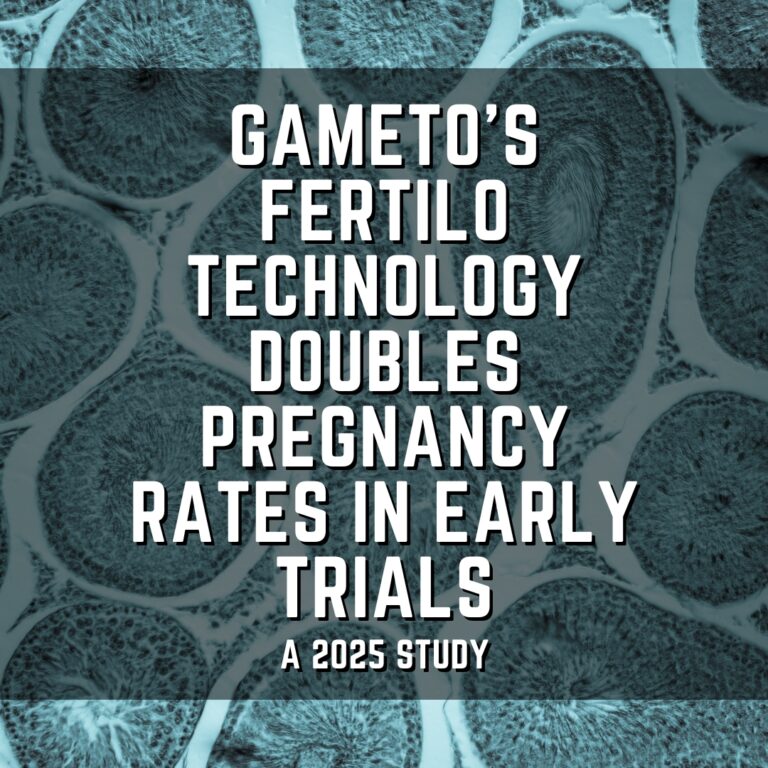
Early clinical trials suggest that Fertilo, a novel in vitro maturation technique, may improve outcomes compared to traditional methods, demonstrating higher embryo quality and pregnancy rates. This technique could change the way IVF is performed, by enabling ovarian stimulation with fewer medications and in just a few days.
In vitro maturation (IVM) is a process where immature eggs are retrieved and matured in the lab for fertilization. This method, which is often seen as experimental, usually requires less medication and offers an alternative to full ovarian stimulation protocols.
One of the newer ways to perform IVM uses ovarian support cells, or OSCs, which are similar to the natural cells in the follicle that help the egg grow. Fertilo, a treatment being developed by the biotech company Gameto, makes these OSCs from human stem cells that are used to help immature eggs mature after a mild ovarian stimulation cycle. This approach could reduce or even eliminate the typical 10–14 days of hormone injections used in IVF, shortening the process to just 2–3 days. Recently, Fertilo announced the first healthy live birth from this technology.
A new preprint published on medRxiv by Paulsen et al. (2025) details the results of both Phase 1 and Phase 2 clinical trials. Phase 1 focused on evaluating the safety of the approach in 20 patients, while Phase 2 compared Fertilo to traditional IVM in 20 patients to assess how well it works.
In the Phase 1 trial, 20 women under age 37 with normal hormone levels used Fertilo after a mild ovarian stimulation cycle. About 69% of their retrieved eggs matured, 84% of those fertilized after ICSI, and 96% of fertilized eggs cleaved by day 3. By days 5 to 7, 43% developed into blastocysts, 38% were high quality (3BB or higher), and 65% were euploid based on PGT-A. After embryo transfer, the clinical pregnancy rate was 57%.
Based on these positive results, the group conducted a Phase 2 clinical trial to compare Fertilo and traditional IVM (20 patients in total). The Fertilo group was superior to traditional IVM, with:
- more mature eggs (70% vs 52%, p= 0.0047)
- higher fertilization per retrieved egg (50% vs 32%, p= 0.0004)
- more high quality blastocysts per retrieved egg on day 7 (14% vs 7%, p= 0.0135)
- more euploid embryos per retrieved egg (10% vs 2%, p= 0.004) — 80% of Fertilo patients had a euploid embryo vs only 30% of traditional IVM patients.
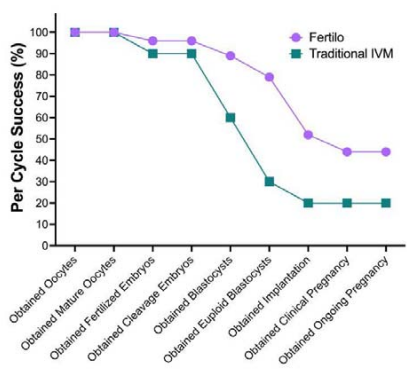
They combined the results from both Phase 1 and Phase 2 (below) to evaluate success on a per-cycle basis, looking at the % of treatment cycles that had obtained blastocysts, euploid embryos, etc. The most important measure, the ongoing pregnancy rate, was around 40% per cycle with Fertilo, compared to about 20% with traditional IVM.
Fertilo is now moving into a larger US Phase 3 clinical trial, with the first site open in California and more than a dozen additional locations expected to follow in states such as New York, Texas, and Florida, according to a recent press release.
While early results are very encouraging, researchers are still studying exactly how OSCs work and are continuing to monitor patient outcomes. The upcoming Phase 3 trial will be key in confirming Fertilo’s safety and effectiveness on a larger scale.
Reference

About Embryoman
Embryoman (Sean Lauber) is a former embryologist and the founder of Remembryo, an IVF research and fertility education website. After working in an IVF lab in the US, he returned to Canada and now focuses on making fertility research more accessible. He holds a Master’s in Immunology and launched Remembryo in 2018 to help patients and professionals make sense of IVF research. Sean shares weekly study updates on Facebook, Instagram, and Reddit regularly. He also answers questions on Reddit or in his private Facebook group.
Related posts:
 Immature eggs matured in-lab for 2-6 h show acceptable IVF outcomes
 New in vitro maturation (IVM) technique from stem cell-derived ovarian support cells
 First birth reported using ovarian support cell technology
 Risk of poor ovarian response with repeat IVF cycles
 Pregnancy outcomes unaffected by catheter-retained embryos
 How many failed embryo transfers is too many?
 Comparing frozen embryo transfer/FET protocols
 Improved IVF outcomes when embryos are cultured in groups