

A 2025 case report describes two IVF patients who conceived triplets from a single embryo transfer and offers insight into just how rare this is.
Single embryo transfer (SET) has become the standard approach in IVF to lower the risk of multiple pregnancies, which can lead to complications like preterm birth and maternal health risks.
However, even SETs can occasionally lead to more than one baby. This happens through embryo splitting, where one embryo divides into two or more genetically identical embryos. You can read more about how embryos split in my post How embryos split during IVF and lead to twins.
Twin pregnancies occur in about 1-2% of SET pregnancies, but triplet pregnancies are much more rare.
A new case report by Woods et al. (2025) details two patients who had a triplet pregnancy after transferring a single blastocyst.
🔗 Original studies are referenced in this post or within the linked Remembryo posts.
💡 Reminder: Terms underlined with a dotted black line are linked to glossary entries. Clicking these does not count toward your paywall limit.
Two cases of triplets from a single embryo transfer
In the first case, a 29 year old with PCOS underwent PGT-A and had a single euploid transferred in a medicated FET. Six weeks later, ultrasound confirmed the presence of three gestational sacs. By week 8, one of the gestational sacs failed to develop, and the patient opted for selective reduction to carry a singleton, which was delivered at 36 weeks.
In the second case, a 34 year old underwent IVF for severe male factor infertility. She had a modified natural cycle FET with transfer of a single untested blastocyst. Early ultrasound revealed a triplet pregnancy — monochorionic diamniotic (MoDi) twins in one sac, and a singleton in a separate sac. She carried all three to term and delivered by cesarean section.
In both cases, the authors ruled out unassisted conception as the cause of the triplet pregnancies:
- In the first case, the PCOS patient underwent a fully medicated FET cycle with GnRH agonist downregulation, so ovulation was suppressed, making it highly unlikely for a spontaneous pregnancy to occur.
- In the second case, the couple explicitly abstained from intercourse throughout her FET until pregnancy was confirmed.
How common are triplets from a single embryo transfer in IVF?
A Japanese ART registry study (Ikemoto et al. 2018) found that among nearly 280,000 single embryo transfers, twins occurred in 1.56% of pregnancies and triplets in just 0.04%, or 1 in 2500 pregnancies.
How did these embryos split to form triplets?
Biological mechanisms that may explain embryo splitting include a loose inner cell mass (ICM in the blastocyst, which can divide into separate clusters. The ICM goes on to form the fetus, and blastocysts with two ICMs may lead to twins.
In some cases, this may occur through an unusual “8-shaped” hatching pattern, where the embryo partially exits the zona with the ICM positioned in the hatching area, allowing the embryo to split into two separate blastocysts, each with its own ICM.

A third blastocyst could potentially form by forming a 8-shaped hatching pattern again. In case 1, this mechanism may have led to the formation of three separate blastocysts (and three separate gestational sacs).
In case 2, 8-shaped hatching may have produced two blastocysts: one of which led to a singleton, and another that had a loose ICM that later split internally, resulting in monochorionic diamniotic (MoDi) twins.
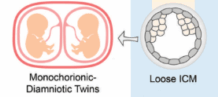
While SET remains the safest and most effective way to reduce multiple pregnancies in IVF, these cases show that even a single blastocyst can sometimes lead to more than one baby. Twin pregnancies from a single embryo are rare but well documented, and triplet pregnancies, while extraordinarily uncommon, are biologically possible.
To learn more about how embryos split for form twins, and the different types of twins, check out this post on Remembryo:

This post explains how embryos can split during IVF, especially at the blastocyst stage. It covers the timing of splitting, the different types of identical twins, the factors that make splitting more likely, and how IVF labs can reduce the risk of twins after single embryo transfer. Read more.
Reference

About Embryoman
Embryoman (Sean Lauber) is a former embryologist and the founder of Remembryo, an IVF research and fertility education website. After working in an IVF lab in the US, he returned to Canada and now focuses on making fertility research more accessible. He holds a Master’s in Immunology and launched Remembryo in 2018 to help patients and professionals make sense of IVF research. Sean shares weekly study updates on Facebook, Instagram, and Reddit regularly. He also answers questions on Reddit or in his private Facebook group.
Related posts:
 How embryos split during IVF and lead to twins
 2 embryos or 1? The risks of a double embryo transfer for women under 35
 Researchers examine factors associated with preterm birth risk in IVF
 ESHRE 2023 guidelines on the number of embryos to transfer
 Study explores if transferring two embryos puts one at risk
 Risk of poor ovarian response with repeat IVF cycles
 How many failed embryo transfers is too many?
 Meta-analysis compares medicated and natural FET adverse pregnancy and birth outcomes