
This post explains how embryos can split during IVF, especially at the blastocyst stage. It covers the timing of splitting, the different types of identical twins, the factors that make splitting more likely, and how IVF labs can reduce the risk of twins after single embryo transfer.
How embryos split is a common question among IVF patients, especially when a single embryo transfer results in twins. Identical, or monozygotic, twins form when one fertilized egg divides into two embryos. In natural conception this is rare, happening in about 0.4% of pregnancies, but the rate is higher in IVF and ranges from 0.72% to 5%.
Twin pregnancies carry higher risks for both mother and babies, including preterm birth and, in rare cases, conjoined twins. Learning why embryos split can help patients understand these risks and how certain IVF procedures may influence the chance of twins.
This post summarizes a review by Jin et al. (2024), which examined the cellular mechanisms behind embryo splitting in IVF and how it can lead to identical twins. It explores when and how embryos divide and what this means for IVF patients.
For more background on how embryos develop, check out my Complete guide to embryo grading and success rates.
🔗 Original studies are referenced in this post or within the linked Remembryo posts.
💡 Reminder: Terms underlined with a dotted black line are linked to glossary entries. Clicking these does not count toward your paywall limit.
Table of Contents
Overview of twin types
Embryos can split at different points in development, and the timing determines the type of identical twins that form and how they share their support structures. Monozygotic (identical) twins develop from a single fertilized egg that splits into two embryos, while dizygotic (fraternal) twins usually come from two separate eggs. This post is exclusively about monozygotic twins!


Identical, or monozygotic, twins form when a single embryo splits. These twins are classified by how they share the chorion (which goes on to form the placenta) and the amnion (which goes on to form the amniotic sac).

Here’s a quick breakdown of the different types of identical twins:
- Single fetus: The embryo doesn’t split. One fetus, one placenta, one amniotic sac.
- Monochorionic-monoamniotic twins (MoMo): The embryo splits and twins share both the placenta (chorion) and the amniotic sac.
- Monochorionic-diamniotic twins (MoDi): The embryo splits and twins share a placenta but each has their own amniotic sac.
- Dichorionic-diamniotic twins (DiDi): The embryo splits and each twin has their own placenta and their own sac.
How embryos split to form monochorionic twins
In IVF, splitting usually happens during the blastocyst stage around day 5 or 6. At this stage, the embryo has a fluid-filled cavity called the blastocoel, an inner cell mass (ICM) that will become the fetus, and a trophectoderm that will form the chorion and eventually the placenta.

Studies have shown that transferring blastocysts leads to higher rates of monozygotic twins compared to earlier-stage embryos (Busnelli et al. 2019), suggesting that the blastocyst stage is a key point when embryos are vulnerable to splitting.
It’s now well accepted that if the ICM — the group of cells that will become the fetus — splits during the blastocyst stage or just after implantation, it can lead to monochorionic twins, meaning twins that share a single placenta. This idea is backed by studies showing embryos with two separate ICMs inside one blastocyst (Meintjes et al. 2001; Mio and Maeda 2008; Noli et al. 2015). In very rare cases, embryos have even had three ICMs, which were linked to pregnancies with monochorionic triplets (Lee et al. 2008).
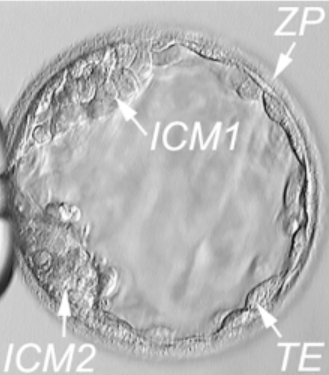
So what causes the ICM to split? There are a few possible explanations. These include how tightly the ICM cells stick together, the pressure that builds up during blastocyst development, and the way the embryo hatches out of its shell.
Looseness of the ICM
One reason an embryo might split is how tightly the cells in the ICM stick together. When the ICM is tightly packed, the cells stay together and develop into a single fetus. But if the ICM is loosely organized, it may separate into two separate ICMs that can lead to identical twins that share a placenta. Depending on how fully the ICM separates, the twins may be MoMo or MoDi, as shown in the image below:

Studies have shown that transferring embryos with lower quality ICMs, meaning the cells are less compact and loosely organized, can increase the chance of identical twins. In one study, the rate of monozygotic twinning rose from 0.38% to 1.38% when embryos with looser ICMs were transferred (Otsuki et al. 2016).
You can see how the tightness of the ICM changes by looking at its grade. Below are images of blastocysts with different ICM grades, from A (highly compact) to C (very loose):

All of this may be related to cell adhesion, or how strongly the cells stick to each other. One important molecule for this is E-cadherin, and researchers have suggested that when this molecule isn’t working properly, it makes the ICM more likely to fall apart. In mouse experiments, when genes involved in cell adhesion were disrupted, embryos often developed two ICMs inside one blastocyst (Landeira et al. 2015).
Blastocyst expansion and cavitation
As the blastocyst forms, it fills with fluid to create a cavity called the blastocoel. This cavity can grow, collapse, and re-expand several times, as you can see in the video below (from Iwasawa et al. 2019, CC by 4.0):
If the ICM is already loosely connected, the pressure from this re-expansion process might push the cells apart and cause them to separate into two ICM clusters that could form twins (Mio and Maeda 2008).
Besides blastocyst expansion, the ICM can also split during cavitation, the stage when the embryo starts forming a fluid-filled cavity called the blastocoel.
Cavitation begins with the buildup of tiny fluid pockets between the cells (see the image below). These small spaces form due to water being pumped between cells, creating local pressure points. Over time, these small pockets merge together into a single, larger cavity known as the blastocoel.

As the blastocoel grows, it pushes outward and creates physical pressure inside the embryo. This pressure can separate clusters of cells, especially if the ICM isn’t tightly compacted. In a recent human embryo model, researchers actually observed the ICM splitting during this phase (Luijkx et al. 2024), supporting the idea that cavitation is one possible trigger for embryo splitting.
This form of embryo splitting can result in either MoMo or MoDi twins, depending on how separated the ICM becomes.
8-shaped hatching
During normal development, the blastocyst hatches from its zona (protective shell) so the cells of the trophectoderm can stick to the endometrium for implantation.

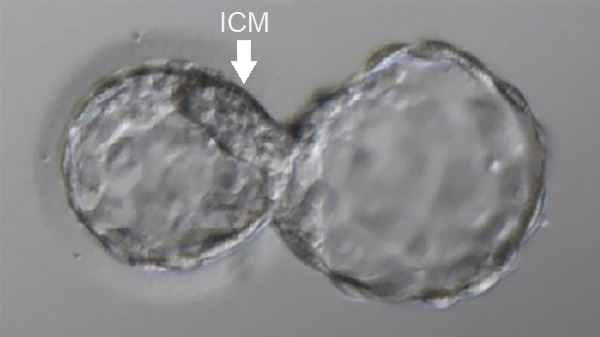
As the embryo hatches from the zona, sometimes it can happen in a way that creates a narrow opening. If part of the ICM is near this opening, it may get pulled through, creating an “8-shape” with cells on both sides. This can physically divide the ICM into two or more parts, potentially leading to twinning (MoDi twins).

Live imaging of human embryos has shown this happen. In one case, a single blastocyst formed three separate ICMs as it hatched through a small slit in the zona, leading to a monochorionic triamniotic pregnancy (Sutherland et al. 2019).
Mouse studies also back this up. They’ve shown that 8-shaped hatching can be fairly common, and when the ICM is located near the hatching point, splitting is more likely (Yan et al. 2015).
This kind of hatching seems to happen more often in the lab, where embryos hatch through small artificial openings by assisted hatching, compared to the uterus where the zona breaks down more naturally. A recent meta-analysis showed that assisted hatching increased the chance of multiples (reviewed in my post Meta-analysis examines the use of assisted hatching on IVF outcomes).
How embryos split to form dichorionic twins
Dichorionic twins each have their own chorion/placenta and amniotic sac. While they’re often assumed to be fraternal (non-identical), in IVF they can also come from a single embryo that splits into two separate embryos. Unlike monochorionic twins, where one embryo contains two ICMs within a shared trophectoderm, dichorionic twins result when the embryo splits completely, forming two individual embryos — each with its own ICM and trophectoderm.
Classically, this happens if the embryo splits very early, within the first three days, when it is just a few cells. Each half can then form its own blastocyst. In nature this is extremely rare and is mostly supported by animal studies or laboratory embryo-splitting studies.

IVF has revealed other ways embryos can split to form dichorionic twins:
- One is atypical 8-shaped hatching, where the embryo divides into two smaller blastocysts that continue developing separately. This can happen through assisted hatching in the lab (Jundi et al. 2021). It differs from the typical 8-shaped hatching seen in monochorionic twins, where a single blastocyst forms two ICMs within a shared trophectoderm.
- Another rare scenario involves frozen-thawed blastocysts, which sometimes re-expand after thawing in a way that separates the ICM and surrounding cells into two independent embryos. There has only been one reported case of this happening (Shibuya and Kyono 2012).

When does embryo splitting occur?
Embryo splitting can happen at several stages during early development, and the timing affects whether the twins share a placenta, an amniotic sac, or both. The earlier the split, the more separate the twin structures tend to be.

- Before the morula stage (day 1–3): If the embryo splits very early (before the cells compact into a morula), it can form two completely separate embryos. Each one develops its own ICM, trophectoderm, chorion, and amnion. This results in dichorionic-diamniotic (DiDi) twins. This is the only scenario where monozygotic twins may be mistaken for fraternal twins without genetic testing.
- Before hatching (day 3-6): If the embryo splits after forming a blastocyst but before hatching from the zona, the result is typically monochorionic-diamniotic (MoDi) twins. These twins share a placenta, but each has its own amniotic sac. This is the most common type of monozygotic twin pregnancy after IVF.
- After hatching (day 6–8): If the ICM separates after the embryo hatches, the twins may end up sharing both the placenta and the amniotic sac. These are monochorionic-monoamniotic (MoMo) twins, which carry higher risks due to the shared sac and potential for cord entanglement.
How to minimize embryo splitting in the IVF lab
Even with single embryo transfer, monozygotic (identical) twinning can still happen in IVF. But based on what we understand about how embryos split, there are steps embryology labs can take to help reduce the risk (according to Jin et al. 2024):
- Closely monitor blastocyst development. One of the most important strategies is to closely monitor blastocyst development, especially using tools like high-resolution time-lapse imaging. This allows the lab to watch how the embryo expands, hatches, and whether the ICM looks loose or begins to divide into two groups. Blastocysts with a very loose or irregular ICM should be avoided when possible, as they may be more likely to split.
- Avoid transferring embryos with 8-shaped hatching. Embryos that show 8-shaped hatching, where the embryo starts squeezing out through a narrow slit in the zona, have also been linked to embryo splitting. If a blastocyst appears to be hatching in this way, or shows signs of forming two separate structures, it may be safer not to choose that embryo for transfer.
- Adjust assisted hatching procedures. In cases where assisted hatching is used, the placement of the opening matters. It’s best to create the artificial opening away from the ICM, to avoid putting pressure on that region during hatching. Some researchers also suggest using techniques that more closely mimic natural zona breakdown, rather than creating a single sharp slit, which may reduce the risk of abnormal hatching.
While these steps can’t eliminate embryo splitting entirely, they may help reduce the chances. This is important because twins carry a higher risk of complications for both mother and babies, and some pregnancies (like MoMo) may be particularly high risk. You can read more about the risks of twin pregnancies in my post ESHRE 2023 guidelines on the number of embryos to transfer.
Conclusion
Understanding how embryos split gives insight into why identical twins are more common in IVF than in natural conception. The ICM can divide at different stages of development, often influenced by how tightly the cells stick together, the pressures from blastocyst expansion or cavitation, or the way the embryo hatches. These physical and cellular processes are more likely to occur in the IVF lab, especially with extended culture to the blastocyst stage or techniques like assisted hatching.
While monozygotic twinning can’t be entirely avoided, IVF labs can take steps to reduce the risk, such as carefully selecting embryos, monitoring blastocyst development, and refining hatching methods.
For patients, it’s important to know that twin pregnancies can still happen even with single embryo transfer. Ongoing research into how and when embryos split will help improve embryo selection and safety, and may one day make the outcome of IVF more predictable.
Reference

About Embryoman
Embryoman (Sean Lauber) is a former embryologist and the founder of Remembryo, an IVF research and fertility education website. After working in an IVF lab in the US, he returned to Canada and now focuses on making fertility research more accessible. He holds a Master’s in Immunology and launched Remembryo in 2018 to help patients and professionals make sense of IVF research. Sean shares weekly study updates on Facebook, Instagram, and Reddit regularly. He also answers questions on Reddit or in his private Facebook group.
Related posts:
 Meta-analysis examines the use of assisted hatching on IVF outcomes
 Comparing frozen embryo transfer/FET protocols
 2 embryos or 1? The risks of a double embryo transfer for women under 35
 Researchers examine factors associated with preterm birth risk in IVF
 ESHRE 2023 guidelines on the number of embryos to transfer
 Study explores if transferring two embryos puts one at risk
 Risk of poor ovarian response with repeat IVF cycles
 How many failed embryo transfers is too many?