
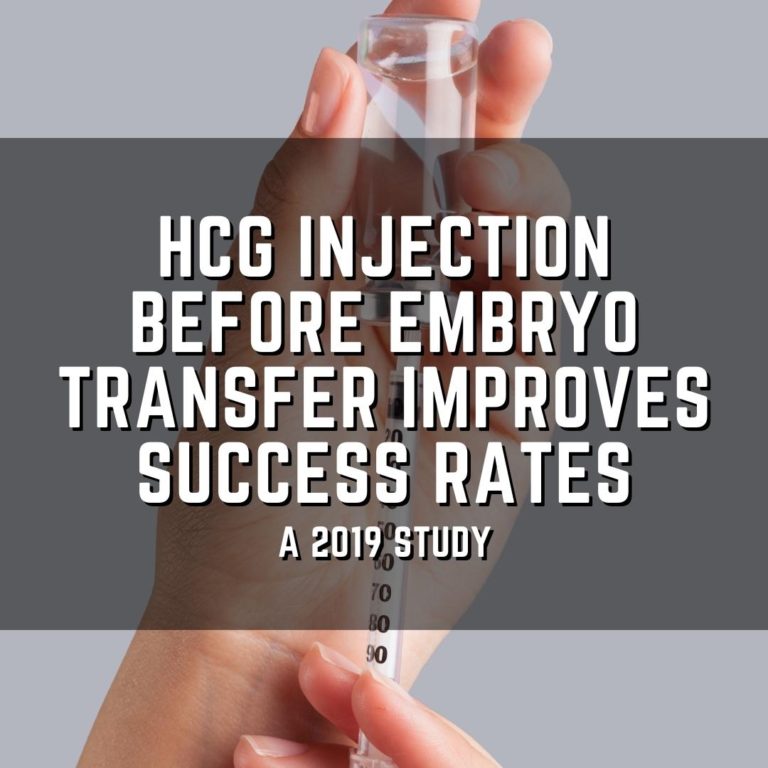
Gao (2019), in their Fertility and Sterility study, performed a meta-analysis to combine the results of 15 studies and found that intrauterine hCG administration improved live birth and pregnancy rates, while decreasing miscarriage rates.
Embryo implantation is a complex process that depends on embryo quality, embryo receptivity, and hCG! hCG is a hormone produced by early placental cells that can promote embryo implantation. Certain proteins can be activated by hCG to help in this process. So hCG is definitely a good thing!
Besides being good for implantation, hCG is also what you measure to see if you’re pregnant (or not).
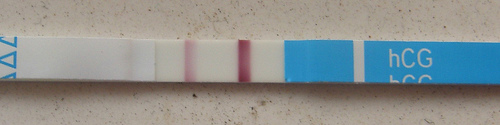
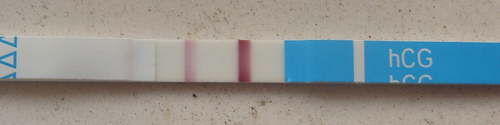
Measuring your “beta” is measuring your hCG levels (“beta” refers to the Greek symbol β, and hCG’s full name is β-hCG).
🔗 Original studies are referenced in this post or within the linked Remembryo posts.
💡 Reminder: Terms underlined with a dotted black line are linked to glossary entries. Clicking these does not count toward your paywall limit.
Intrauterine injection of hCG – where hCG is injected into the uterus using a catheter – is a popular add-on for IVF and is thought to help embryo implantation. But the evidence has been inconsistent.
Gao (2019) did a meta-analysis on the available data and summarized 15 randomized controlled studies (RCTs, including a total of 2763 participants):
- Live birth rate increased: 44.89% with hCG vs 29.76% without (6 studies, odds ratio [95% CI]: 2.02 [1.61-2.55], I2= 41%)
- Pregnancy rate increased : 47.80% with hCG vs 32.78% without (13 studies, odds ratio [95% CI]: 2.02 [1.70-2.41], I2= 20%)
- Miscarriage rate decreased : 12.45% with hCG vs 18.56% without (5 studies, odds ratio [95% CI]: 0.57 [0.33-0.99], I2= 23%)
The best results came from hCG injections that were done <15 minutes before embryo transfer using a dose of 500 IU.
Pretty positive results it seems but the authors point out some of the limitations of their study. Mainly in heterogeneity – or how different these 15 studies were to one another:
- Different volumes of injection (0.2 – 0.5 ml)
- Different doses of hCG (500, 700 or 1000 IU)
- Different timing of injection (ranged from 3 minutes to 72 hours before transfer)
- Fresh vs frozen embryo transfers
- Blastocyst vs cleavage stage
Without consistency it’s hard to draw strong conclusions. Still, this paper does suggest a benefit so it may be worth discussing with your doctor.
Reference

About Embryoman
Embryoman (Sean Lauber) is a former embryologist and the founder of Remembryo, an IVF research and fertility education website. After working in an IVF lab in the US, he returned to Canada and now focuses on making fertility research more accessible. He holds a Master’s in Immunology and launched Remembryo in 2018 to help patients and professionals make sense of IVF research. Sean shares weekly study updates on Facebook, Instagram, and Reddit regularly. He also answers questions on Reddit or in his private Facebook group.
Related posts:
 Evidence-based recommendations from ESHRE for 27 IVF add-ons
 Meta-analysis examines the use of embryo glue on IVF outcomes
 Clinical trial finds no benefit with time-lapse (embryoscope)
 Meta-analysis of commonly used IVF immunotherapies shows no benefit
 Meta-analysis shows benefit of acupuncture on frozen embryo transfer outcomes
 Meta-analysis finds no difference in pregnancy outcomes when using the ERA
 RCT finds no change in birth rates for standard or ERA-timed euploid transfer
 Growth hormone (omnitrope) increases number of eggs retrieved in updated meta-analysis