

Researchers in a 2019 study compared euploid transfer outcomes for day 5, 6 or 7 euploids, finding that day 7 embryos have good potential.
In the lab, an embryo grows in about a week.
After fertilization, the single cell of the egg cleaves to form 2 cells, then 4 cells, then 8 cells.
Then…the cells start to stick together and eventually a blastocyst forms. Ideally this whole process of becoming a blast takes about 5 days. Sometimes longer.

You hear a lot about day 5 blastocysts. But as far as success rates go, embryos that take 6 days to make a blastocyst (aka a day 6 blastocyst), are comparable in success to day 5: similar euploidy, pregnancy rates, etc.
And then we have the day 7 blasts. These take 7 days to make it to blastocyst.
So how do they do as far as success rates go? Not too bad it turns out – but many clinics won’t grow embryos to day 7. It’s not clear why this is, but it may be because some believe that embryos can’t be cultured past day 6 because they degenerate (die), or because they have very low success rates and just aren’t worth it.
Whatever the case – embryos cultured to day 7 do have a chance, and the evidence for their use is growing.
Check my complete guide to PGT-A to get more background on PGT-A (aka PGS testing).
🔗 Original studies are referenced in this post or within the linked Remembryo posts.
💡 Reminder: Terms underlined with a dotted black line are linked to glossary entries. Clicking these does not count toward your paywall limit.
Hernandez-nieto (2019) looked at a total of 25772 blasts from 4136 patients between 2012 to 2018. Among all women of all ages, about 50% of day 5 and day 6 embryos were euploid, with about 40% of day 7 embryos being euploid. That’s not bad at all!
Those numbers start to drop with increased maternal age which isn’t surprising, from 51.08% at 35 and younger, 37.41% at age 38-40, to 9.46% for women 43 and older.
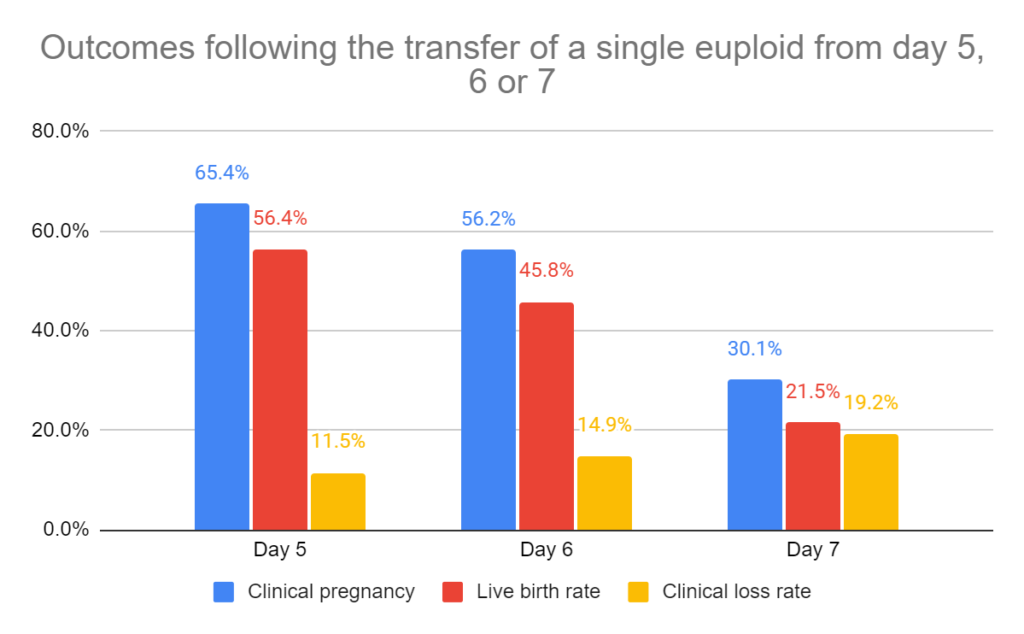
So what about the success rates for day 7 euploids? After transferring a single euploid, for live birth rates, day 7 euploids came in at about 20% compared to 56%/45% for day 5/day 6. Or roughly half. You can see the outcomes below.
So how does this relate to the grades of the day 7 embryos?
They used a modified grading system that included A-D instead of the standard A-C. It can be difficult to compare this system with the standard system, but a D is definitely a C and an A is definitely an A. The trouble is figuring out how B and C relate to the standard system.
Regardless, they reported outcomes based on good quality (4BB or higher), moderate quality (4BC or 4CB) and fair quality (4CC) day 7 euploids. There were 68, 28 and 20 transfers, respectively.
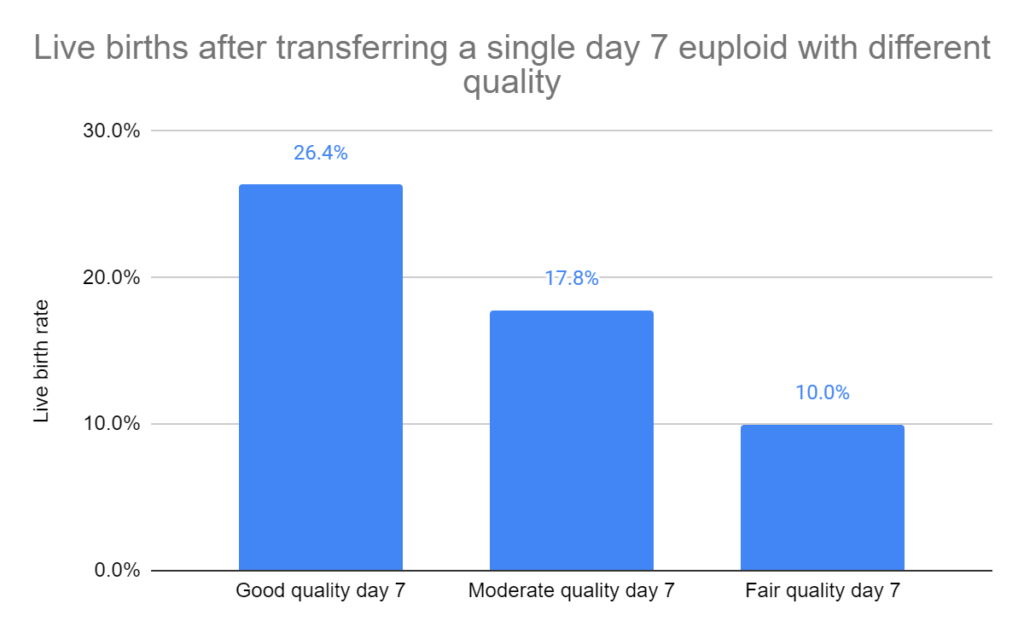
So, at least based on this study, day 7 embryos have a pretty good chance of working! Embryos can be grown to day 7 and be biopsied, with fairly high euploidy rates, and decent live birth rates (as high as 25% with good quality day 7s)!
Reference

About Embryoman
Embryoman (Sean Lauber) is a former embryologist and the founder of Remembryo, an IVF research and fertility education website. After working in an IVF lab in the US, he returned to Canada and now focuses on making fertility research more accessible. He holds a Master’s in Immunology and launched Remembryo in 2018 to help patients and professionals make sense of IVF research. Sean shares weekly study updates on Facebook, Instagram, and Reddit regularly. He also answers questions on Reddit or in his private Facebook group.
Related posts:
 Transfer of day 7 embryos a viable option
 Meta-analysis combines 74 studies to examine factors linked to euploid transfer success
 Complete Guide to Embryo Grading and Success Rates
 Predicting live birth rates, multiples based on 223,377 transfers
 Comparable outcomes with good quality day 6 and poor quality day 5 embryos
 Study evaluates factors affecting pregnancy outcomes after euploid transfer
 Study evaluates the potential of day 4, 5, 6 and 7 blastocysts
 Poor quality blastocysts show acceptable live birth rates, no change in perinatal outcomes