
Researchers in a 2023 study share the distribution of euploid, mosaic and aneuploid PGT-A results from the biopsy of over 86,000 embryos across age groups (using data from CooperSurgical).
This study compared PGT-A results among 21,345 PGT-A cycles and 86,208 embryos, and involved data from the PGT-A lab, CooperSurgical, and 289 international clinics (mainly in the US) between 2019 and 2021.
Check my complete guide to mosaic embryos to learn more about mosaics, or my complete guide to PGT-A to get more background on PGT-A (aka PGS testing).
🔗 Original studies are referenced in this post or within the linked Remembryo posts.
💡 Reminder: Terms underlined with a dotted black line have glossary definitions. Hover or tap to see a short definition, or select “Read full definition” in the pop-up to view the complete glossary entry. Viewing glossary entries does not count toward your paywall limit.
Study details
- Euploids had <20% aneuploid cells and aneuploids had >80% aneuploid cells.
- Aneuploids were grouped as having a single chromosome affected, or 2 or more.
- Mosaics were grouped as low level (20-40% aneuploid cells), high level (40-80%), and whether or not they had whole chromosomes affected or segments of a chromosome.
Distribution of PGT-A results by age
With increasing age, the median number of embryos available for PGT-A decreased:
- <35: 5.0 embryos for PGT-A
- 35-37: 4.0
- 38-40: 3.0
- 41-42: 3.0
- >42: 2.0
Of the 86,208 embryos biopsied, 44% were euploid, 40.2% were aneuploid (27.9% with 1 chromosome and 12.3% with 2 or more) and 15.9% were mosaic (8% were low-level and 7.9% were high-level). They also compared the outcomes across different age groups, as shown below:

In general, mosaic results were about half low level and half high level, with a higher proportion of mosaic results in younger patients (18.9% for <35) than in older patients (8.5% for >42).
Distribution of PGT-A mosaic results by age
They also looked at the different types of mosaic results. Of the 26,745 mosaics, 39.2% were segmental (33.4% with 1 chromosome and 5.8% with 2 or more) and 60.9% were whole chromosome (32.8% with 1 chromosome and 28.1% with 2 or more).

In general, whole chromosome abnormalities increased with age, while segmental abnormalities decreased.
They also found that the chance of getting a mosaic wasn’t influenced by having a history of mosaic PGT-A results. In other words, a patient who got mosaic results in cycle 1 wasn’t more likely to have mosaic results in cycle 2.
Including mosaics increases the proportion of transferable embryos at any age
The percentage of cycles that had no euploids available for transfer increased with age, from 7.4% at age <35 to 36.7% at >42:

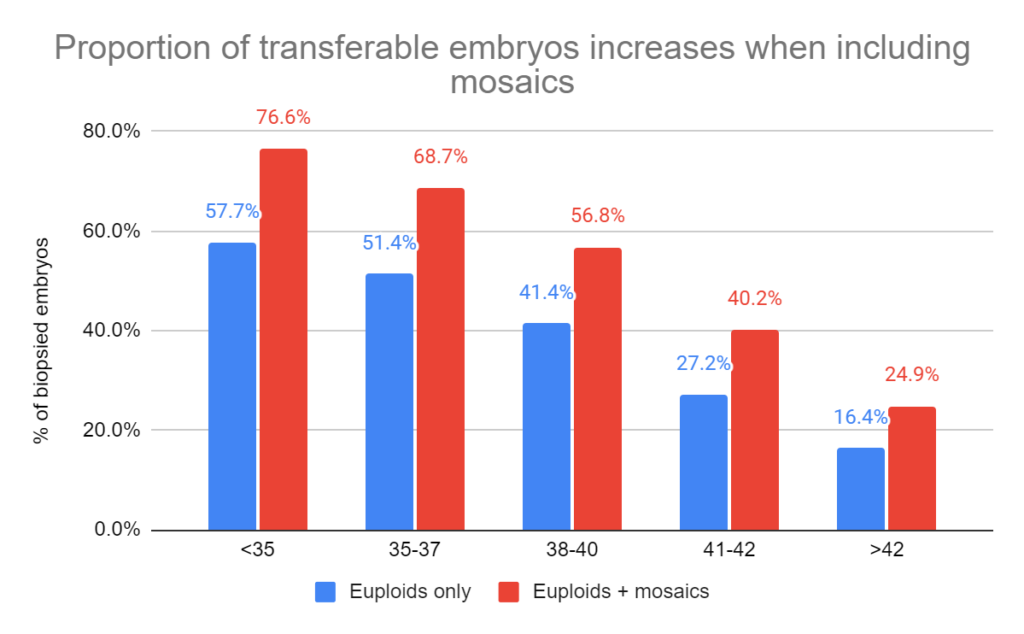
Some centers only transfer euploids, so the above chart can be discouraging for older patients. However, by considering euploids, low level and high level mosaics as transferable, the proportion of transferable embryos increases. In the graph below, I’ve combined the rates for euploid, low level and high level mosaics by age, from the data in the first graph. To be clear, the graph below shows the % of biopsied embryos that are either euploid, or euploid and mosaic, for different age groups.
Conclusions
In general, as age increased, euploid and mosaic rates dropped, while aneuploid rates increased.
For both high and low-level mosaic results, each age group had roughly an equal 50:50 split.
Older patients had more whole chromosome mosaics, and younger patients had more segmental mosaics.
Having mosaic results in one cycle didn’t increase the chance of having mosaic results in subsequent cycles.
By including both mosaics and euploids, there are more embryos available for transfer. This is important for older patients, who have a higher chance of having a PGT-A cycle without a euploid.
Reference
About Embryoman
Embryoman (Sean Lauber) is a former embryologist and the founder of Remembryo, an IVF research and fertility education website. After working in an IVF lab in the US, he returned to Canada and now focuses on making fertility research more accessible. He holds a Master’s in Immunology and launched Remembryo in 2018 to help patients and professionals make sense of IVF research. Sean shares weekly study updates on Facebook, Instagram, and Reddit regularly. He also answers questions on Reddit or in his private Facebook group.