
Researchers found that blastocysts that re-expand quickly — about 10 minutes after thaw — have higher live birth rates.
Blastocysts have a water-filled cavity called a blastocoel. This water could form sharp ice crystals during freezing that could damage the embryo. So before blastocysts are frozen, they’re typically “collapsed” by making a tiny hole in the embryo to allow this water to escape from the blastocoel.
After thawing, the embryo begins to take up water so it can re-expand. You can see an embryo below that has 54% re-expansion and 100% re-expansion. How much the blastocyst re-expands has been linked to success rates. Re-expansion is a sign of a healthy embryo. It’s a normal process that helps the embryo build pressure against the zona to aid in hatching.

Typically, studies look at embryo re-expansion 2 or more hours after thawing. In this post, we’ll look at a study by Yoneyama et al. (2025) who evaluated pregnancy outcomes for blastocysts that expanded quickly (9-11 minutes after thaw).
A re-expansion threshold of 90.2% was chosen because, when the researchers analyzed the data, that was the point that best separated embryos that led to pregnancy from those that didn’t.
For more background on embryo development, check my Complete guide to embryo grading and success rates.
🔗 Original studies are referenced in this post or within the linked Remembryo posts.
💡 Reminder: Terms underlined with a dotted black line are linked to glossary entries. Clicking these does not count toward your paywall limit.
Study details
- This is a retrospective study that took place between 2017 and 2022 at an IVF center in Japan.
- Exclusions: No PGT-A, no early blastocysts (expansions 1 or 2)
- Frozen blastocysts were thawed and then evaluated for expansion 9-11 minutes afterwards.
- While it’s not explicitly stated, it’s likely they only transferred a single blastocyst.
In terms of sample size:
- <90.2% re-expansion: 360 cycles
- ≥90.2% re-expansion: 433 cycles
- Hatching: 210 cycles (not discussed in this post because they didn’t find any differences in the clinical outcomes with this group and the ≥90.2% re-expansion group)
Blastocysts that quickly re-expand showed improved pregnancy outcomes
Patients were grouped based on whether their blastocysts did or did not reach the 90.2% re-expansion threshold within 9–11 minutes after thawing.
You can see the pregnancy outcomes below. Blastocysts that re-expanded quickly had higher clinical pregnancy and live birth rates (p< 0.001). There were no differences in miscarriage rates.

They also performed a statistical test (logistic regression analysis) to identify factors associated with clinical pregnancy. They found that ≥90.2% re-expansion was associated with clinical pregnancy (odds ratio [95% CI]: 2.13 [1.47–3.09]) and live birth.
Blastocysts that re-expand quickly are better quality
The researchers also reported on the grades of the embryos that re-expanded quickly. They found that blastocysts with ≥90.2% re-expansion were more likely to have an ICM and trophectoderm (TE) with “A” quality (p< 0.05 for all comparisons below).
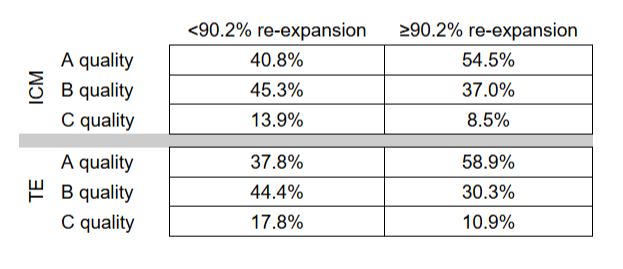
They also found that blastocysts with ≥90.2% re-expansion were more likely to have an expansion of 4 (86.6% vs 76.1%, p< 0.01) rather than an expansion of 3 (13.4% vs 23.9%, p< 0.001).
Embryos that had ≥90.2% re-expansion were more likely to come from younger patients (average age 36.5 vs 38.3) and have a lower BMI (21.8 vs 22.3).
Conclusions
This study found that blastocysts that re-expand to 90.2% or more after thaw have a higher chance of achieving a pregnancy and live birth.
The embryos that re-expanded quickly were likely to be higher quality.
This study is interesting because they relate pregnancy outcomes with a quick blastocyst re-expansion, while other studies typically wait several hours. Based on the results of this study, the authors note that the embryologist can do a quick check on re-expansion after thaw to help decide if another embryo should be thawed for certain patients.
One limitation is that re-expansion was only assessed at 9–11 minutes after thawing, without a baseline measurement taken immediately after thaw. Including that initial measurement would have allowed the researchers to evaluate embryos that failed to re-expand or showed only minimal expansion. The authors suggest that incorporating additional measurements—such as blastocyst size before freezing and immediately after thawing, possibly using time-lapse imaging—could offer valuable insights to help embryologists better identify embryos with the highest implantation potential. Future studies!
Generally, this study agrees with other research — embryos that fail to re-expand after thaw have lower chances of success. I review much of the data in my post What is embryo compaction?
Reference

About Embryoman
Embryoman (Sean Lauber) is a former embryologist and the founder of Remembryo, an IVF research and fertility education website. After working in an IVF lab in the US, he returned to Canada and now focuses on making fertility research more accessible. He holds a Master’s in Immunology and launched Remembryo in 2018 to help patients and professionals make sense of IVF research. Sean shares weekly study updates on Facebook, Instagram, and Reddit regularly. He also answers questions on Reddit or in his private Facebook group.
Related posts:
 Complete Guide to Embryo Grading and Success Rates
 What is embryo compaction?
 Embryos that change grade after thaw show different success rates
 Day 3 or Day 5 embryo transfer?
 Study examines potential of day 7 euploid transfers
 Predicting how many day 3 embryos make it to blastocyst
 Blastocyst and pregnancy rates of day 3 embryos based on cell number, fragmentation
 Day 3 quality of a blastocyst is not linked to its chance of live birth