

Researchers in a 2023 study found that live birth rates depend on a blastocyst’s grade, and not their day 3 grade, while miscarriage rates were affected due to day 3 cell number.
Sometimes an embryo’s quality on day 3 can change as it develops into a blastocyst, and what was a poor quality day 3 embryo might turn out to be a fair/good quality blastocyst. Does a blastocyst’s day 3 grade matter?
Qiu et al. (2023) wanted to answer this question by comparing live birth and miscarriage rates for transferred blastocysts that had different day 3 embryo grades. This was a retrospective study that involved 6,906 single blastocyst transfers at an IVF center in China between 2011 and 2020.
Check out my complete guide to embryo grading and success rates to learn more about embryo development, grading and success rates.
🔗 Original studies are referenced in this post or within the linked Remembryo posts.
💡 Reminder: Terms underlined with a dotted black line are linked to glossary entries. Clicking these does not count toward your paywall limit.
Study details
- Good quality blastocysts were 3BB or higher
- This clinic’s policy is to freeze up to 6 of the best quality day 3 embryos for future transfers, and any excess are grown to blastocyst. These excess blastocysts are what was used in this study.
- Exclusions: Cycles with incomplete information, severe male factor, recurrent pregnancy loss, uterine malformations.
- Miscarriage was defined as a clinical pregnancy loss before 24 weeks, early miscarriage was before 12 weeks.
A single blastocyst was transferred from one of four groups:
- Good quality blastocyst from a good quality day 3 embryo (n= 873)
- Good quality blastocyst from a poor quality day 3 embryo (n= 3,460)
- Poor quality blastocyst from a good quality day 3 embryo (n= 241)
- Poor quality blastocyst from a poor quality day 3 embryo (n= 2,332)
For baseline characteristics, there were differences in maternal age, BMI, history of failed cycles, type of FET performed, day of embryo transfer, and more. These were statistically adjusted using a GeneraliSed estimated equation regression model.
Good quality blastocysts show similar transfer outcomes, regardless of day 3 grade
Good quality blastocysts from good quality day 3 embryos showed comparable live birth rates to good quality blastocysts from poor quality day 3 embryos (43.2% vs 40.0%). However, this was lower for poor quality blastocysts from both good quality or poor quality day 3 embryos (43.2% vs 26.1% vs 28.0%, adjusted odds ratio [95% CI]: 0.64 [0.46-0.89]; 0.69 [0.58-0.82]). So good quality blastocysts had a higher live birth rate than poor quality blastocysts, regardless of their day 3 grade.

There were no statistical differences for the miscarriage rates (which ranged from 17.1% to 22.8%).
Higher chance of early miscarriage with blastocysts that develop from day 3 embryos with 5 or less cells
Besides the quality of the day 3 embryo, which is mainly due to the amount of fragmentation, the number of cells also has an impact on day 3 success rates. So they compared live birth rates for blastocysts that developed from day 3 embryos with ≤5, 6-7, 8 or >8 cells.
They found that the live birth rates didn’t change for these groups, but the chance of early miscarriage with ≤5 cells was higher compared to 8 cells (20.9% vs 13.2%, adjusted odds ratio [95% CI]: 1.50 [1.09-2.05]). There was no statistical difference with the other groups.
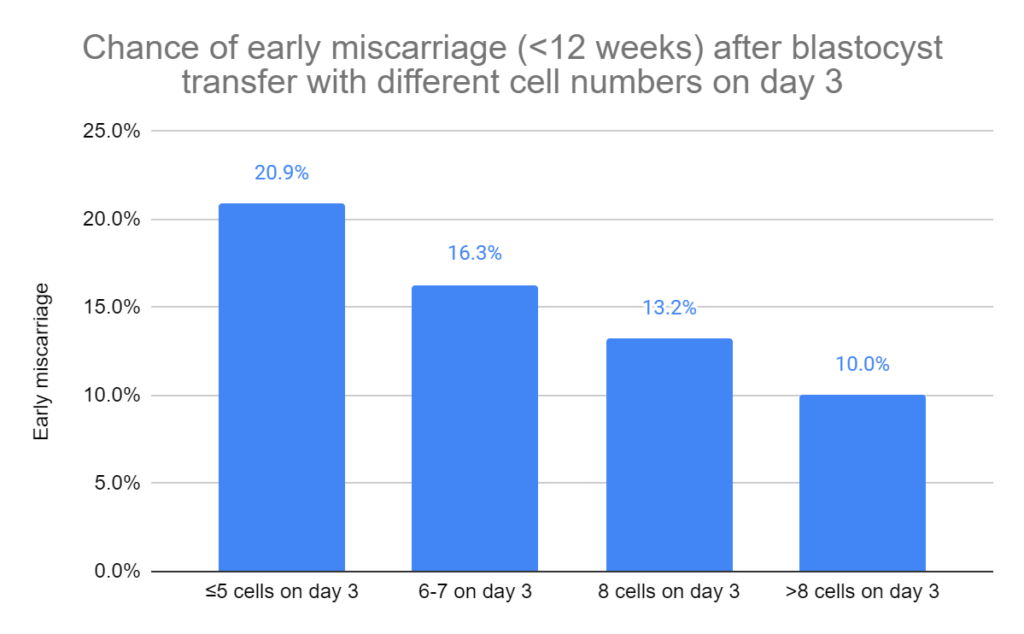
They performed another analysis that was based on age (<35 and 35 and older). In this subgroup analysis, these differences in early miscarriage only applied to the <35 group and not the older patients.
Conclusions
This study found that the good quality blastocysts had a higher live birth rate than poor quality blastocysts, regardless of their day 3 grade.
So good quality blastocysts, that developed from either a good or poor quality day 3 embryo, had equivalent live birth rates.
When they looked at day 3 cell numbers, they found that blastocysts that came from day 3 embryos with 5 or less cells had a higher chance of early miscarriage (<12 weeks).
A limitation of this study is the IVF clinic’s policy, where they froze all the best quality day 3 embryos for future transfers, and cultured the remaining to blastocyst (which were included in this study). It would be nice to see a study where all embryos were cultured to blastocyst, and first transfers were considered. Women with a history of failed transfers may show different outcomes, so these results might not generalizable.
The authors conclude that blastocysts with a similar grade should be selected for transfer based on their day 3 cell number, and not day 3 quality.
Reference

About Embryoman
Embryoman (Sean Lauber) is a former embryologist and the founder of Remembryo, an IVF research and fertility education website. After working in an IVF lab in the US, he returned to Canada and now focuses on making fertility research more accessible. He holds a Master’s in Immunology and launched Remembryo in 2018 to help patients and professionals make sense of IVF research. Sean shares weekly study updates on Facebook, Instagram, and Reddit regularly. He also answers questions on Reddit or in his private Facebook group.
Related posts:
 Complete Guide to Embryo Grading and Success Rates
 Day 3 or Day 5 embryo transfer?
 Increased risk factors with blastocyst transfer vs cleavage stage
 Predicting how many day 3 embryos make it to blastocyst
 Predicting live birth rates, multiples based on 223,377 transfers
 Meta-analysis compares cleavage stage (day 3) and blastocyst (day 5) transfer outcomes
 Fewer embryos give better results when transferred on day 3, not day 5
 Initial and doubling beta-hCG linked to embryo development and quality