
Researchers in a 2019 study found that biopsying small embryos led to a dramatic reduction in live birth rate compared to larger embryos, suggesting that small embryos may not tolerate the biopsy procedure as well.
PGT-A (formerly known as PGS testing) is a technique used to select embryos for transfer. Embryos that have the correct number of chromosomes (46, or 23 pairs of chromosomes) are “euploid” and thought to have a higher chance of producing a pregnancy/live birth.
Check my complete guide to PGT-A to get more background on PGT-A (aka PGS testing).
PGT-A relies on a biopsy of the trophectoderm cells of a blastocyst. This biopsy sample is then frozen and sent to a testing lab where the DNA in the cells is extracted and assessed to determine the number of chromosomes.
For a reminder on the different parts of a blastocyst, including the trophectoderm, see below:

Before the biopsy (which is usually done on Days 5-7, when the embryo becomes a blastocyst), embryos are often assisted hatched on Day 3. This involves using a laser to make a small hole in the zona. Now, when the embryo grows into a blastocyst on days 5-7, cells can emerge from this hatched area. This makes the biopsy process much simpler, and avoids having to manipulate the embryo too much.
You can see an overview of an embryo biopsy below. Notice how the embryo is assisted hatched on Day 3 (arrow), so by Day 5 the cells are able to hatch out of the zona.

When doing a biopsy, it’s nice when the embryo is hatching out and ready to go. This is why we do the assisted hatching on Day 3. But even with the assisted hatching on Day 3, the embryo isn’t always hatching out. This is because the embryo might not be big enough yet.
As a reminder, the expansion of the embryo is the number in front of the grade. So a 3AA has an expansion of “3”. A “1” and “2” are early blasts – these embryos are pretty tiny. Once it gets to a “3” and especially a “4”, the embryo is larger. You can see this below:

So in this post, let’s just forget about how a “5” is hatching. This whole post involves embryos that have been assisted hatched on Day 3 – so by the time they’re a blastocyst they should be “hatching out” from the assisted hatched hole. I’ll be using the term “hatching out” to describe a blastocyst that was assisted hatched on Day 3 and is now hatching from the assisted hatched hole – wow, what a mouthful! – so keep this in mind.
🔗 Original studies are referenced in this post or within the linked Remembryo posts.
💡 Reminder: Terms underlined with a dotted black line are linked to glossary entries. Clicking these does not count toward your paywall limit.
Singh et al. (2019) wanted to know if biopsying smaller embryos that weren’t hatching out had different pregnancy outcomes compared to those that were hatching out. All transfers were done using euploids. This study was a retrospective, single center, study done between 2013 and 2016.
They looked at three groups of embryos:
- Non-expanded embryos – these were tiny and expansion “2” or early “3” that weren’t hatching out
- Expanded – these were expansion “3” that were expanding but still a bit small and not hatching out
- Hatching out – these were larger embryos (probably expansion “4” or higher) that were hatching out from the assisted hatched hole

This wasn’t a huge study. For the non-expanded group there were 35 euploid transfers; for the expanded group there were 68 euploid transfers; and for the hatching group there were 259 euploid transfers.
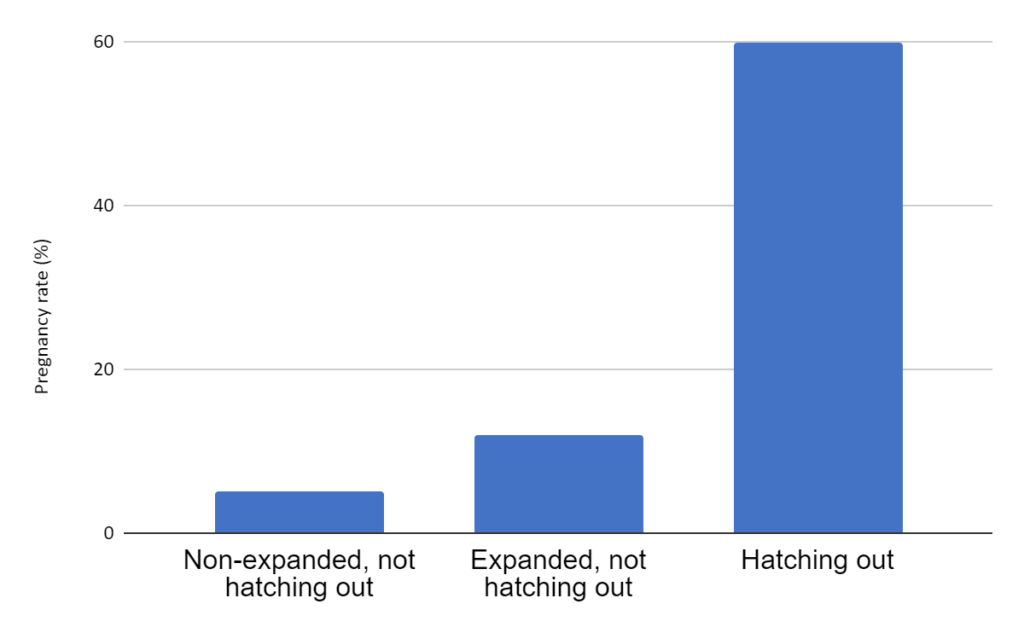
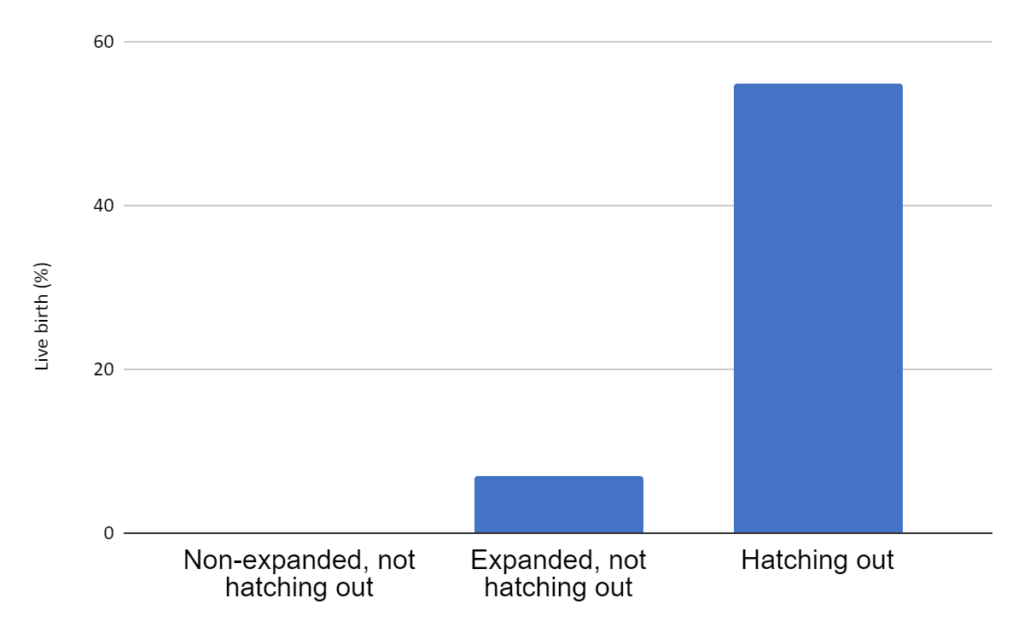
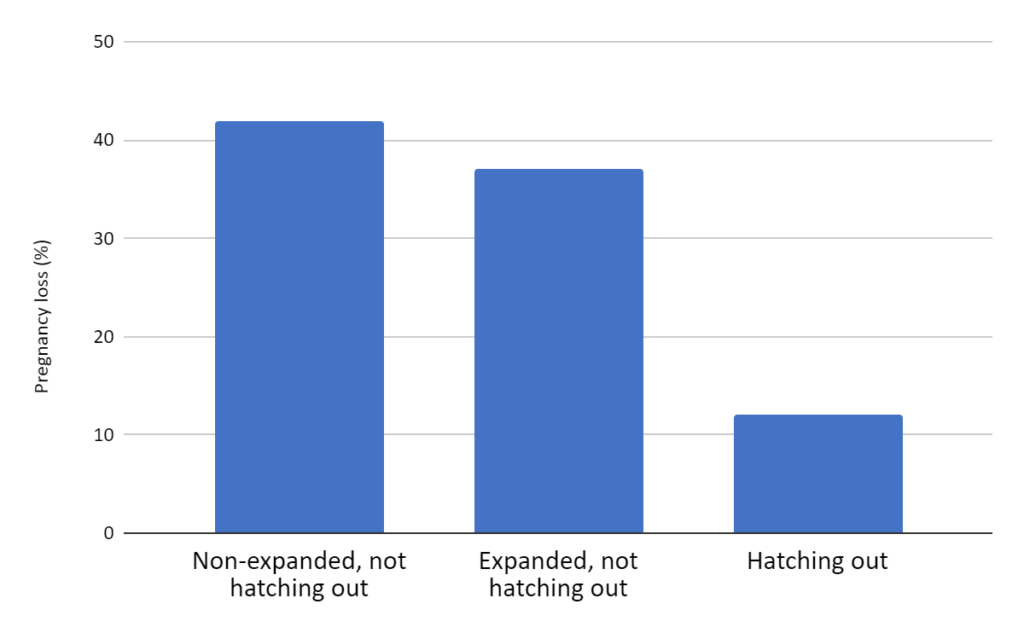
They found that embryos that were hatching out before biopsy did much better than embryos that weren’t. Unfortunately the authors didn’t include the raw data (and only had charts, so I did my best to estimate the numbers).
The clinical pregnancy rates were about 5% for non-expanded embryos, about 12% for expanded embryos, and about 60% for hatching out embryos (p<0.001).
The live birth rates were 0% for the non-expanded group, about 7% for the expanded embryo group, and about 55% for the hatching out group (odds ratio 25.12, p<0.001).
Pregnancy losses (including both biochemical losses and miscarriages) were about 42% in the non-expanded group, about 37% in the expanded group, and about 12% with the hatching out group (p<0.001).
Embryos at the same stage that weren’t biopsied had better outcomes – so it was the biopsy procedure that had an impact.
Overall this study found that embryos that were too tiny to hatch out (after assisted hatching on Day 3) have dramatically worse outcomes compared to larger (and hatching out) embryos. Based on this, embryos should only be biopsied once they’re large enough to be hatching out of the zona.
So why is this? It’s possible that smaller embryos are damaged by the process – maybe they don’t have enough trophectoderm cells to compensate for what’s lost. Or maybe the manipulation of the embryo at this stage is too much for the embryo to handle, and cells die or become compromised in some way.
It needs to be said that this is a small study. There were only 35 euploids in the non-expanded group and 68 euploids in the expanded group. This study should be repeated with a larger sample size. Performing this study in different centers would also help account for differences in biopsy technique, or levels of experience of the embryologist. This particular study used a single (highly trained) embryologist.
Based on this study, when biopsying it may be better to simply wait until Day 6 to perform the biopsy. Embryos will typically be larger so any negative impact of damaging the embryo can be avoided. And Day 7 is nothing to be shy about either! They may have a reduced chance of working, but this is still a chance for the patient to take a baby home – and that’s what this is all about!
Reference

About Embryoman
Embryoman (Sean Lauber) is a former embryologist and the founder of Remembryo, an IVF research and fertility education website. After working in an IVF lab in the US, he returned to Canada and now focuses on making fertility research more accessible. He holds a Master’s in Immunology and launched Remembryo in 2018 to help patients and professionals make sense of IVF research. Sean shares weekly study updates on Facebook, Instagram, and Reddit regularly. He also answers questions on Reddit or in his private Facebook group.
Related posts:
 Repeated freezing and thawing impacts IVF outcomes in PGT-A cycles
 Meta-analysis examines the use of assisted hatching on IVF outcomes
 New “STORK” method makes PGT-A faster and cheaper
 Study finds differences in euploid, live birth rates among PGT-A testing labs
 IVF outcomes following aneuploid embryo transfer
 Aneuploid-only first PGT-A cycle has no impact on future PGT-A outcomes
 Can a mosaic embryo result in a normal baby?
 Multiple embryo freeze/thaw for PGT-A doesn’t affect pregnancy or neonatal outcomes