
Researchers in a 2022 study compared four different PGT-A testing labs and found differences in euploid, mosaic and live birth rates among the embryos submitted.
PGT-A can be performed after submitting an embryo biopsy to a PGT-A testing lab to determine its ploidy. It’s not clear if different PGT-A labs have different euploid rates, and if these embryos can result in differences in IVF outcomes.
Check my complete guide to PGT-A to get more background on PGT-A (aka PGS testing).
Bardos et al. (2022) compared the outcomes of 2,633 biopsied embryos among 4 different (and unidentified) PGT-A testing labs in the US between 2016 and 2020. Since egg quality (ie. maternal age) can lead to differences in euploid rates, the embryos that were examined in this study were created from 895 egg donors <34 from the national Donor Egg Bank (DEB). Over 200 IVF clinics across the US use DEB.
Key information:
- All PGT-a labs used next-generation sequencing (NGS)
- NGS platforms included Illumina (MiSeq or NovaSeq) or the ThermoFisher Ion Torrent system. One lab used aCGH for a part of the study.
- Proprietary bioinformatics software was used by each company to identify euploid embryos.
- The PGT-A labs identified mosaics using their own thresholds, which was not shared with this study.
- Patients were excluded if they had uterine factors, male factor, or if they were performing PGT-M.
- Donors from DEB were between 21 and 33, had a BMI<30 kg/m2 and followed other strict guidelines to ensure high egg quality.
In terms of baselines characteristics of the patients, there were no differences in the egg donor’s age or ethnicity and the recipient’s age.
🔗 Original studies are referenced in this post or within the linked Remembryo posts.
💡 Reminder: Terms underlined with a dotted black line are linked to glossary entries. Clicking these does not count toward your paywall limit.
PGT-A labs have different euploid, aneuploid, mosaic and no call rates
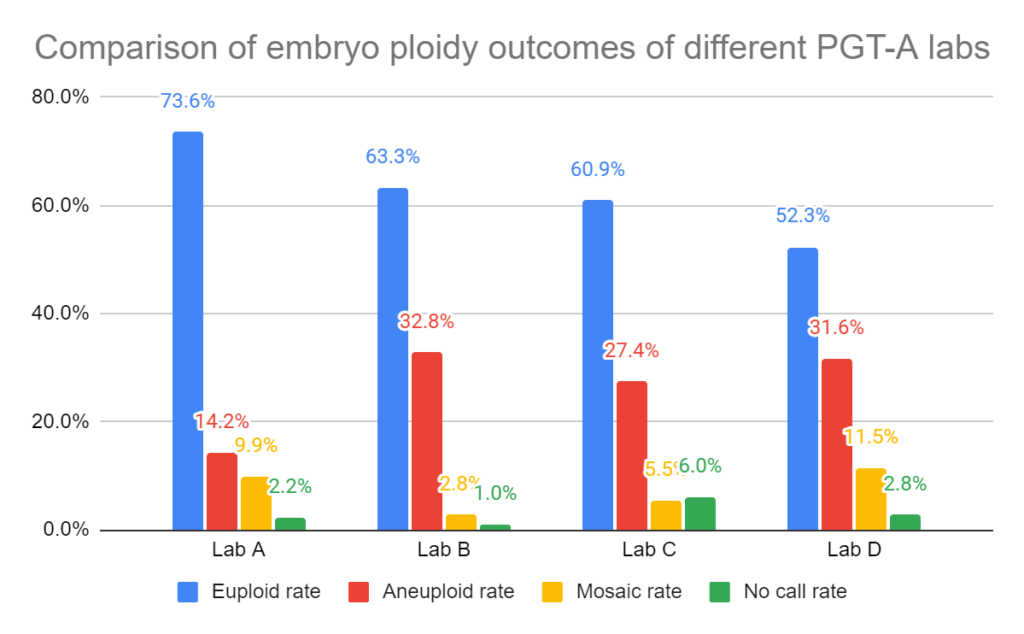
PGT-A labs A-D showed differences in euploidy rates, with lab A being significantly higher vs lab B, C or D (73.6% vs 63.3%, 60.9%, 52.3%, p<0.001). Lab A had significantly lower aneuploidy rates vs lab B, C or D (14.2% vs 32.8%, 27.4%, 31.6%, p<0.001).
Mosaic rates were significantly different between labs A and D (9.9% vs 11.5%, p<0.001) and between labs B and C (2.8% vs 5.5%, p<0.001).
No call rates (presumably “no result” or “inconclusive” PGT-A results) were significantly different between labs B vs A, C and D (1.0% vs 2.2%, 6.0%, 2.8%, p<0.001).
Possible decrease in live birth rates depending on the PGT-A lab used
Among the 2,633 embryos biopsied there were 704 euploid transfers.
A single euploid embryo was transferred and rates for live births, biochemical losses, miscarriages, and induced abortions were compared. There was a significant decrease in live birth rates between labs A and D (57.8% vs 47.3%, p=0.04). There were no differences in the other outcomes examined.

Conclusions
This study found differences in euploid, aneuploid, mosaic, no-call (no result) and live birth rates between certain PGT-A testing labs. In one case, the difference between euploid rates was 21% between two labs.
This may be due to a number of factors.
It’s the lab’s policy to dictate what thresholds are used for mosaic embryos. Generally, embryos that have <20% aneuploid cells are euploid, 20-40% are low level mosaics, 40-80% are high level mosaics and >80% are aneuploid. Instead of <20% for euploids, some labs might use a higher threshold (eg. <30%). This would give them a higher euploidy rate but may lower their live birth rates. But this isn’t what was seen – lab A had the highest euploid rates and live birth rates, so the there may be other factors involved.
Each lab may have different rules for establishing an embryo’s ploidy. When an embryo’s DNA is sequenced, the embryo’s DNA sequence is matched to a reference human genome sequence, and any differences (variants) from the reference are evaluated using a bioinformatics pipeline. Variants are “called” by the pipeline to establish if they’re truly different from the reference genome, and this is based on rules and settings that can be unique to a PGT-A lab.
The authors suggest that IVF clinics should request data from the PGT-A lab (euploid rates) and compare it to other labs, and that this should be combined with ongoing results from the IVF clinic.
Reference

About Embryoman
Embryoman (Sean Lauber) is a former embryologist and the founder of Remembryo, an IVF research and fertility education website. After working in an IVF lab in the US, he returned to Canada and now focuses on making fertility research more accessible. He holds a Master’s in Immunology and launched Remembryo in 2018 to help patients and professionals make sense of IVF research. Sean shares weekly study updates on Facebook, Instagram, and Reddit regularly. He also answers questions on Reddit or in his private Facebook group.
Related posts:
 Complete guide to PGT-A (PGS testing)
 Complete guide to mosaic embryos
 Ranking 1,000 mosaic embryo transfers
 No difference in euploid and mosaic embryo transfers: a clinical trial
 A look at how PGT-A results change with age, using data from over 86,000 biopsies
 IVF outcomes following aneuploid embryo transfer
 PGDIS releases 2021 guidelines for mosaic embryo transfers
 Can a mosaic embryo result in a normal baby?