
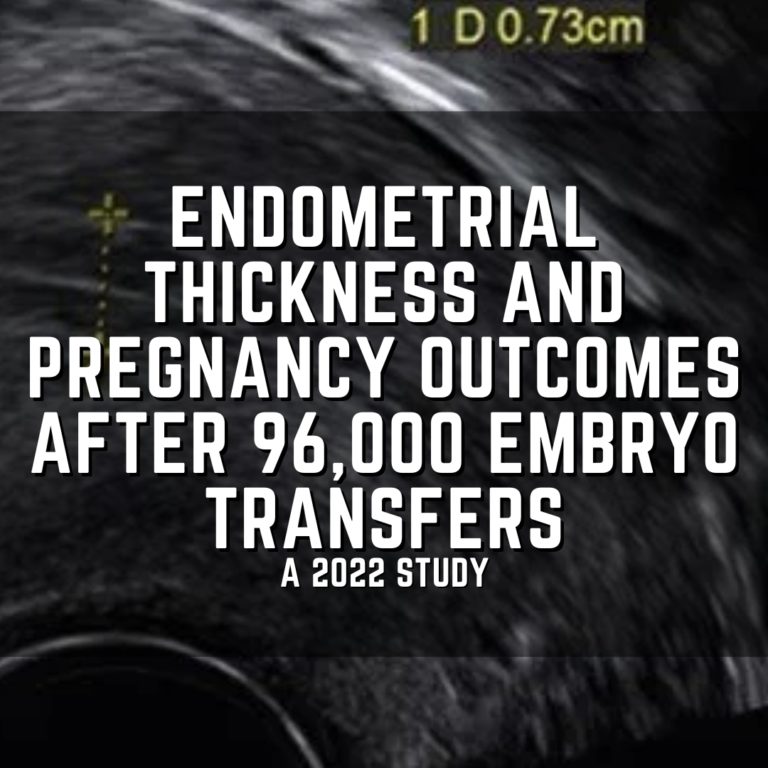
Researchers in a 2022 study compared the impact of endometrial thickness on pregnancy outcomes in fresh and frozen embryo transfer cycles.
Endometrial thickness is often measured before embryo transfer during a fresh or frozen transfer. Generally, a thin endometrium is associated with lower live birth rates, so having a thick endometrium is important.
Here’s an endometrium that measured 7.3 mm (0.73 cm):

The cut off for what’s “too thin” has been examined by different studies:
- Holden et al. (2017), in over 6000 fresh ET cycles, found that live births were higher in women with an endometrial thickness of >11 mm compared to 7-11 mm.
- Yuan et al. (2016), in over 10,000 fresh ET cycles, found that >15 mm was better than 8-11 mm and 11-15 mm.
- Bu et al. (2015), in close to 3000 FET cycles, found that women with thickness of <9 mm had lower live birth rates compared to those with >9 mm
Generally the data has been inconsistent, particularly for frozen embryo transfers.
In a massive study, Mahutte et al. (2022) compared pregnancy outcomes from over 43,000 fresh and 53,000 frozen embryo transfers. This data was collected between 2013 and 2019 from the Canadian Assisted Reproductive Technology Registry (CARTR Plus) database which included 33 Canadian clinics.
In fresh cycles, endometrial thickness was measured on the day of trigger. For frozen cycles, depending on the type of FET performed, it was measured before progesterone was started, or before the LH surge, or before hCG administration. Transfers were done using both cleavage stage or blastocysts, and the average number of embryos transferred was about 1.2.
Now let’s look at the results!
🔗 Original studies are referenced in this post or within the linked Remembryo posts.
💡 Reminder: Terms underlined with a dotted black line are linked to glossary entries. Clicking these does not count toward your paywall limit.
Results
Fresh embryo transfers and endometrial thickness
Let’s first look at fresh transfers. This was based on over 43,000 fresh transfers. The overall data that included all ages and embryo stages (Day 3 and 5) is shown below and includes clinical pregnancy, live birth, and pregnancy loss rates (which includes biochemical losses, miscarriages, and stillbirths). Generally, the best outcomes were seen after 10 mm.

This data included both cleavage and blastocyst stage embryo transfers. Unfortunately, the authors didn’t indicate the % of cycles that used these embryo types so it’s not possible to evaluate their contribution to the data. They did however share how endometrial thickness impacts live birth using cleavage and blastocyst stage embryo transfers. Here, it was significant up to 12 mm for blastocysts, and up to 10 mm for cleavage stage embryos.

Because age has an impact on live birth rates in IVF, the researchers grouped age into categories (below). Each increase in endometrial thickness was statistically significant until 10 mm.

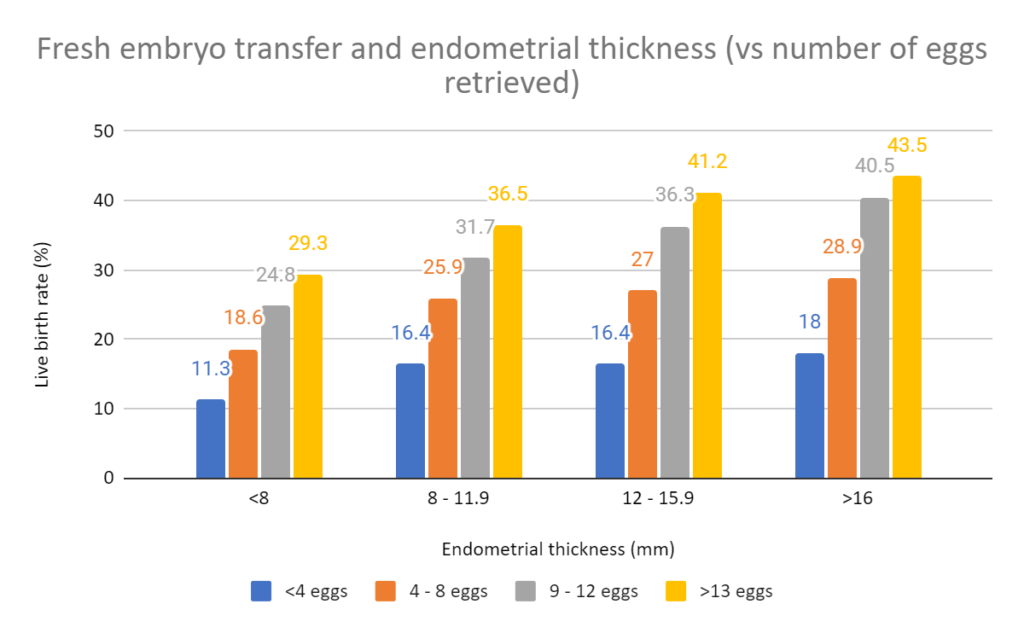
Another element to consider is the number of eggs retrieved. Previous data has shown that the higher the number of eggs retrieved in a single cycle with a fresh ET is associated with higher birth rates. We can also see this here, in addition to the improved birth rate that comes with a thicker lining.
Frozen embryo transfers and endometrial thickness
Next let’s look at the frozen embryo transfer data. This was based on over 53,000 transfers. Generally, endometrial thickness above 10 mm didn’t have any significant impact on outcomes.
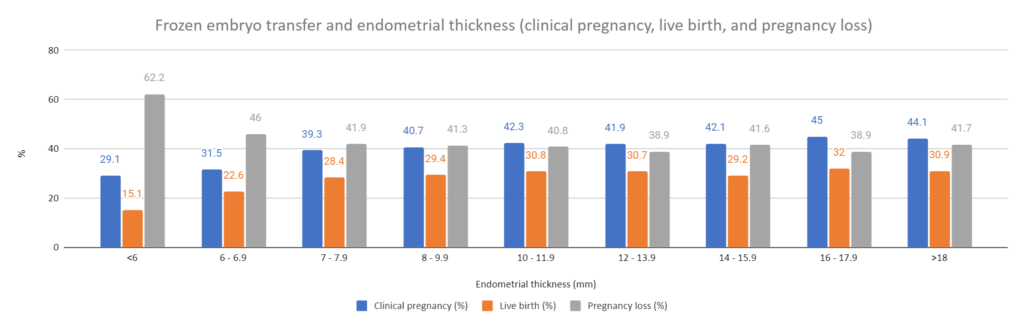
Unfortunately, they didn’t provide the data for how age and endometrial thickness compare. They did mention that for women <40 there was no significant improvement in live birth rates after an endometrial thickness of 7 mm. This was the same for blastocyst transfers – they didn’t see an improvement past 7 mm.
Conclusions
This study showed that an endometrial thickness of <6 mm can have a pretty dramatic impact on live birth rates. For fresh transfers, the benefit of a thick endometrium peaked around 10 mm, and for frozen transfers it peaked around 7 mm.
For women with a thicker endometrium in the fresh transfer group, they were more likely to have a higher number of eggs retrieved, peak estradiol levels, and more useable embryos. But even when they (somewhat) controlled for this by grouping women by number of eggs retrieved, there was still an increase in live birth with endometrial thickness.
It’s not clear why there’s a difference between peak thickness in a fresh or frozen transfer. The authors suggest that this might have to do with the impact of ovarian stimulation on the endometrium. Ovarian stimulation can cause premature luteinization and this might change how the endometrium thickens compared to a frozen transfer.
What about an endometrium that’s too thick? An older study from 1999 found that women with an endometrium >14 mm had reduced implantation and pregnancy rates. However, several other studies, in addition to this one, found no evidence of this (Dietterich et al. 2011, Fang et al. 2015).
One of the limitations of this study is that they were unable to include information about the appearance of the endometrium (ie. trilaminar). This was not included in the database.
Reference

About Embryoman
Embryoman (Sean Lauber) is a former embryologist and the founder of Remembryo, an IVF research and fertility education website. After working in an IVF lab in the US, he returned to Canada and now focuses on making fertility research more accessible. He holds a Master’s in Immunology and launched Remembryo in 2018 to help patients and professionals make sense of IVF research. Sean shares weekly study updates on Facebook, Instagram, and Reddit regularly. He also answers questions on Reddit or in his private Facebook group.
Related posts:
 Complete guide to embryo implantation and implantation failure
 Why do embryos in IVF fail to implant or miscarry?
 Meta-analysis finds no difference in pregnancy outcomes when using the ERA
 RCT finds no change in birth rates for standard or ERA-timed euploid transfer
 Meta-analysis examines impact of small fibroids on pregnancy outcomes
 Meta-analysis combines results of 12 intrauterine, intraovarian PRP studies
 Intrauterine hCG for IVF patients improves pregnancy rates
 Silent insulin resistance is common, linked to lower IVF success rates