
Researchers in a 2023 meta-analysis combined the results of 5 studies and found decreased pregnancy and live birth rates in patients with small non-cavity-distorting intramural fibroids.
Fibroids are benign tumors that grow in the uterus and can vary in number, size and location. Larger fibroids that distort the uterine cavity can lead to worsened clinical outcomes, however even smaller fibroids can have negative effects on the endometrium and implantation.
Below you can see a diagram of the uterus and the different locations fibroids can exist. This summary will focus on a study that looks at small non-cavity-distorting intramural fibroids. These are fibroids that don’t distort the uterine cavity, and are intramural and exist within the muscular uterine wall (“b” in the diagram below).
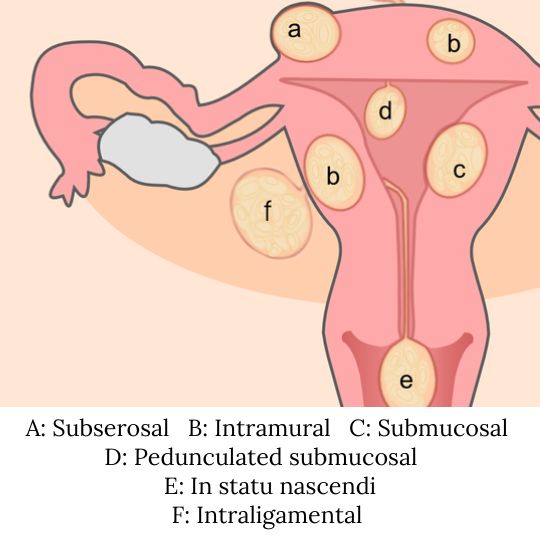
Erden et al. (2023) performed a systematic review and meta-analysis and combined the results of 5 studies that examined pregnancy outcomes in women with non-cavity-distorting intramural fibroids ≤6 cm in diameter. These 5 studies were filtered out from 1,196 studies they originally identified, and included 2 prospective studies and 3 retrospective studies. The 5 studies consisted of 1,912 women: 520 who had small fibroids and 1,392 who were age-matched controls without fibroids.
Key information:
- Women were aged 20-44 (controls were age-matched)
- Only a single fresh embryo was transferred.
- The patients had a similar infertility diagnosis.
- Only non-cavity-distorting intramural fibroids ≤6 cm in diameter were considered, which were identified using 3D or 2D transvaginal ultrasound.
- Other intrauterine pathologies (ie. cavity-ditorting fibroids, polyps, etc.) were excluded by hysteroscopy, 3D or 2D transvaginal ultrasound.
🔗 Original studies are referenced in this post or within the linked Remembryo posts.
💡 Reminder: Terms underlined with a dotted black line are linked to glossary entries. Clicking these does not count toward your paywall limit.
Pregnancy outcomes with small non-cavity-distorting intramural fibroids of varying size
The researchers combined results from studies that contained patients with non-cavity-distorting intramural fibroids ≤6 cm, ≤4 cm and ≤2 cm, and looked at pregnancy rates, live birth rates and miscarriage rates.
Clinical pregnancy rates of patients with small non-cavity-distorting intramural fibroids
Patients with fibroids ≤6 cm had a statistically significant decrease in clinical pregnancy rates compared to those without fibroids (31.0% vs 39.5%, odds ratio [95% CI]: 0.64 [0.49-0.84], low heterogeneity I2 = 27%; 5 studies, 1,912 participants). The quality of evidence was indicated as very low.
There was also a statistically significant decrease in clinical pregnancy rates in patients with fibroids ≤4 cm (42.5% vs 50.5%, odds ratio [95% CI]: 0.64 [0.43-0.94], no heterogeneity I2 = 0%; 2 studies, 490 participants). The quality of evidence was indicated as very low.
There was no statistically significant difference in clinical pregnancy rates in patients with fibroids ≤2 cm (35.9% vs 45.8%, odds ratio [95% CI]: 0.66 [0.37-1.19]; 1 study, 256 participants).

Live birth rates of patients with small non-cavity-distorting intramural fibroids
Patients with fibroids ≤6 cm had a statistically significant decrease in live birth rates compared to those without fibroids (23.8% vs 36.1%, odds ratio [95% CI]: 0.48 [0.36-0.65], no heterogeneity I2 = 0%; 3 studies, 1,129 participants). The quality of evidence was indicated as low.
There was also a statistically significant decrease in live birth rates in patients with fibroids ≤4 cm (32.0% vs 42.4%, odds ratio [95% CI]: 0.57 [0.36-0.90], low heterogeneity I2 = 24%; 2 studies, 490 participants). The quality of evidence was indicated as very low.
There was no statistically significant difference in live birth rates in patients with fibroids ≤2 cm (29.6% vs 36.5%, odds ratio [95% CI]: 0.74 [0.40-1.36]; 1 study, 256 participants).

Miscarriage rates of patients with small non-cavity-distorting intramural fibroids
There were no statistically significant differences in miscarriage rates in patients with fibroids measuring ≤6 cm (5 studies), ≤4 cm (2 studies) or ≤2 cm (1 study). The quality of evidence was indicated as low.
Pregnancy outcomes for the FIGO type-3 subset of intramural fibroids
Of the 520 women with small non-cavity-distorting intramural fibroids in this meta-analysis, 248 were specified to have FIGO type-3 fibroids. These are types of intramural fibroids that are in contact with the endometrium, and because of this they might have worsened outcomes compared to other intramural fibroids.
Based on 2 studies, there was a statistically significant decrease in live birth and clinical pregnancy rates in patients with FIGO type-3 fibroids compared to patients without fibroids. Only odds ratios were reported for this, which were 0.49 (0.34-0.70) for live birth rates and 0.50 (0.36-0.69) for clinical pregnancy rates. This means that live birth rates were decreased by 1.00 – 0.49 = 0.51 or 51% in patients with FIGO type-3 fibroids. So if the live birth rate of patients without fibroids was 40%, then patients with FIGO type-3 fibroids would be 0.49 x 40% = 19.6%.
There was no difference in miscarriage rates.
Pregnancy outcomes for patients with a different number of small non-cavity-distorting intramural fibroids
The authors report that there were no studies that compared the number of fibroids that used age-matched controls.
However, there were two retrospective studies that examined pregnancy outcomes that weren’t age-matched:
- A study by Lu et al. (2015) study found comparable live birth rates between patients with a single ≤4 cm intramural fibroid and multiple ≤4 cm fibroids.
- A study by Bai et al. (2020) found comparable live birth rates with single <6 cm fibroids compared to no fibroids, but reduced rates with multiple fibroids.
Both studies were small and very low quality, the authors report.
Conclusions
This study found that patients with small non-cavity-distorting intramural fibroids had reduced clinical pregnancy and live birth rates when the fibroids were ≤6 cm and ≤4 cm in size, but not when fibroids were ≤2 cm in size. There was no difference in miscarriage rates.
A subset of intramural fibroids that make contact with the endometrium (called FIGO type-3) were also found to reduce live birth and pregnancy rates, with no effect on miscarriage rates.
The authors report that this data is mostly consistent with other meta-analyses on the subject, however the quality of evidence was very-low to low, indicating that larger and better studies need to be performed. This was the first meta-analysis to include only age-matched controls.
Data involving the surgical removal of these small intramural fibroids and the benefit it has on pregnancy outcomes is scarce. The authors point to a recent randomized controlled trial involving the removal of 2-5 cm FICO type-3 fibroids, which was found to improve cumulative live birth rates (Han et al. 2022), while another smaller RCT found no statistically significant benefit (Metwally et al. 2020).
Reference

About Embryoman
Embryoman (Sean Lauber) is a former embryologist and the founder of Remembryo, an IVF research and fertility education website. After working in an IVF lab in the US, he returned to Canada and now focuses on making fertility research more accessible. He holds a Master’s in Immunology and launched Remembryo in 2018 to help patients and professionals make sense of IVF research. Sean shares weekly study updates on Facebook, Instagram, and Reddit regularly. He also answers questions on Reddit or in his private Facebook group.
Related posts:
 Why do embryos in IVF fail to implant or miscarry?
 Complete guide to embryo implantation and implantation failure
 Endometrial thickness and pregnancy outcomes after 96,000 embryo transfers
 IVF pregnancy outcomes after intrauterine PRP: a 2022 clinical trial
 Meta-analysis finds no difference in pregnancy outcomes when using the ERA
 RCT finds no change in birth rates for standard or ERA-timed euploid transfer
 How many failed embryo transfers is too many?
 “True” recurrent implantation failure is rare after five consecutive euploid embryo transfers