
Researchers in a 2022 study found improved pregnancy outcomes in RIF patients who performed intrauterine PRP before embryo transfer.
Platelet rich plasma (PRP) has been used for different applications in IVF. One way is for it to be administered directly into the ovaries, which is thought to improve egg quality. Another way is to administer it into the uterus (intrauterine administration), which is thought to improve endometrial receptivity and implantation, particularly in women with RIF. If interested, I have more information on embryo implantation and implantation failure.
PRP is prepared by first drawing blood and then centrifuging it. This separates the blood into different layers, one of which is called plasma. Plasma is the liquid part of blood. You can see plasma separated from the red blood cells below:
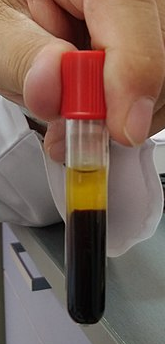
Platelets are cells that can be found in the plasma that primarily function in blood clotting, immune function, and healing of damaged tissue. They can perform these roles because they act as reservoirs for growth factors which can stimulate the growth of different cell types. PRP is a concentrated form of plasma that contains a lot of platelets and these growth factors.
There’s been other studies that have looked at PRP for RIF patients. A meta-analysis by Maleki-Hajiagha (2020) involved 7 studies and 625 patients. They found that clinical pregnancy rates increased with the use of PRP (42.7% vs 23.8%, risk ratio [95% CI]: 1.79 [1.37 – 2.32]), however all of the included studies were small and didn’t include much information on live birth or miscarriage rates.
In this summary, we’ll look at a paper by Nazari et al. (2022) who studied the impact of intrauterine PRP on IVF at a larger scale. They performed a clinical trial between 2018 and 2020 using about 400 patients who either received PRP or didn’t. All women were about 34 years old and had RIF (defined as failure to achieve pregnancy after 3 or more high quality embryo transfers). In this study, 0.5 ml of PRP was administered into the uterus 48 hours before transfer using a catheter. The concentration of platelets was constant between patients.
🔗 Original studies are referenced in this post or within the linked Remembryo posts.
💡 Reminder: Terms underlined with a dotted black line are linked to glossary entries. Clicking these does not count toward your paywall limit.
IVF pregnancy outcomes after intrauterine administration of PRP
PRP was administered into the uterus 48 hours before transferring 1-2 blastocysts. Clinical pregnancies and live birth rates increased with PRP while miscarriages dropped (all p<0.0001). There was no difference in multiple pregnancy rates.

Note on the miscarriage rates – they seem quite high with the “No PRP” group! They didn’t address it in the paper, but it may have something to do with the small sample size.
This study also looked at any pregnancy complications that occurred. They found no difference in:
- Anemia
- Gestational hypertension
- Pre-eclampsia
- Eclampsia
- Gestational diabetes
- Ectopic pregnancy
- Intrauterine growth restriction
- Peripheral edema
- Premature rupture of membranes
- Stillbirth
Conclusions
This study found that intrauterine administration of PRP in IVF significantly increased clinical pregnancy and live birth rates while decreasing miscarriage rates. They also found no differences in pregnancy complications to birth.
It’s not clear how PRP can promote embryo implantation, but it could potentially compensate for reduced growth factors and improve progesterone receptor expression in women with RIF.
A limitation is that they didn’t use a proper control with saline administered instead of PRP. The introduction of fluid, or even the possible scratching of the endometrium during administration, may have had an impact on the results.
And finally they didn’t discuss the very high miscarriage rate in the control group. I suspect the low sample size might have something to do with it, but I’d like to have seen it addressed.
Reference

About Embryoman
Embryoman (Sean Lauber) is a former embryologist and the founder of Remembryo, an IVF research and fertility education website. After working in an IVF lab in the US, he returned to Canada and now focuses on making fertility research more accessible. He holds a Master’s in Immunology and launched Remembryo in 2018 to help patients and professionals make sense of IVF research. Sean shares weekly study updates on Facebook, Instagram, and Reddit regularly. He also answers questions on Reddit or in his private Facebook group.
Related posts:
 Complete guide to embryo implantation and implantation failure
 Meta-analysis finds no difference in pregnancy outcomes when using the ERA
 RCT finds no change in birth rates for standard or ERA-timed euploid transfer
 Why do embryos in IVF fail to implant or miscarry?
 Endometrial thickness and pregnancy outcomes after 96,000 embryo transfers
 Meta-analysis of commonly used IVF immunotherapies shows no benefit
 ERA-timed euploid transfers shows no benefit over standard timing
 Meta-analysis examines impact of small fibroids on pregnancy outcomes