

Researchers in a 2022 study found that women with low β-hCG (<149 mUI/ml) are more likely to have a preterm delivery and abnormal placental pathologies compared to women with higher β-hCG.
The amount of β-hCG in serum is used to establish pregnancy, and lower levels have been linked to biochemical losses. It’s not clear if pregnancies with low β-hCG can lead to adverse outcomes in pregnancy.
Ganer Herman et al. (2022), in their retrospective study, compared perinatal outcomes and placentas of women with low initial β-hCG values on day 16 of embryo age (ie. 11dp5dt or 13dp3dt) at a single hospital-based IVF center in Canada between 2009 and 2017. Low β-hCG was defined as the lowest 10th percentile of initial serum β-hCG among the 1,031 patients that went on to have a singleton delivery (<149 mUI/ml).
Key information:
- There were 1,031 patients in total: 103 from the low β-hCG group and 928 that acted as controls (that had β-hCG ≥149 mUI/ml).
- Single blastocysts or 1 or more cleavage stage embryos were transferred.
- Fresh transfers, medicated or natural frozen transfers were performed.
- After delivery, all placentas from the 1,031 deliveries were examined by the hospital’s pathology department
In terms of baseline characteristics, there were differences in the use of ICSI, the stage of embryo transfer and paternal age. These confounders were adjusted for in their statistical models.
🔗 Original studies are referenced in this post or within the linked Remembryo posts.
💡 Reminder: Terms underlined with a dotted black line are linked to glossary entries. Clicking these does not count toward your paywall limit.
Risk of preterm birth increased with low β-hCG, otherwise no differences
There was a statistically significant increase in women with a preterm delivery in the group with low initial β-hCG compared to those with a higher initial β-hCG (15.5% vs 8.1%, adjusted odds ratio [95% CI]: 2.08 [1.12-3.86]). This means that after adjustment for confounders (the use of ICSI, the stage of embryo transfer and paternal age), the odds of having a preterm delivery in women with a low initial β-hCG was 2.08 times higher that of having a preterm birth with a higher initial β-hCG.
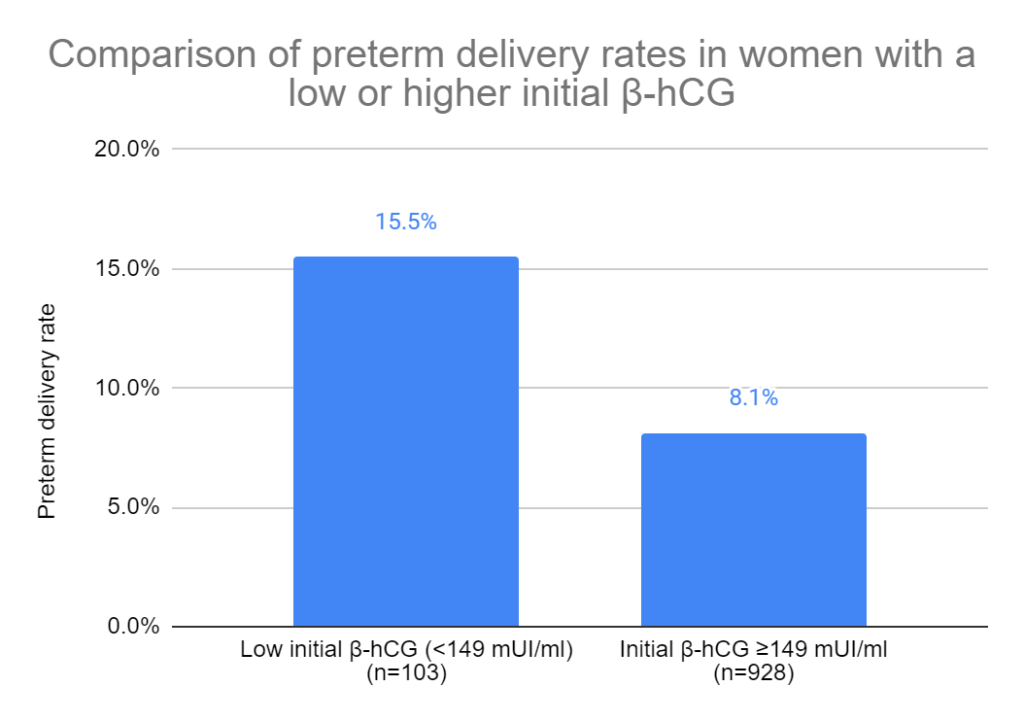
The majority of preterm deliveries were late preterm (34-37 weeks, 75.0% vs 71.0%).
They also found that preterm births were 30% when β-hCG was below 50 mUI/ml, 15.9% when it was below 100 mUI/ml and 13.1% when it was below 200 mUI/ml.
They found no differences in:
- Gestational diabetes
- Preeclampsia
- Low lying placenta
- Placenta Accreta
- Gestational age
- Placental abruption
- Cesarean delivery
Select abnormal placenta findings from women with low β-hCG
All placentas were submitted to the hospital’s pathology department for examination. Placentas from women with a low initial β-hCG were more likely to show placentas with a single umbilical artery (3.8% vs 0.6%, adjusted odds ratio [95% CI]: 9.04 [2.14-38.17]), umbilical velamentous insertion (19.4% vs 7.7%, adjusted odds ratio [95% CI]: 3.11 [1.74-5.56]) and maternal vasculopathy (10.6% vs 4.8%, adjusted odds ratio [95% CI]: 2.80 [1.36-5.75]).
There were no differences in:
- Umbilical marginal insertion
- Umbilical furcate insertion
- Circummarginate insertion
- Circumvallate insertion
- True knot
- Hypercoiling of cord
- Bilobated placenta
- Accessory lobe
- Acute chorioamnionitis (any)
- Acute chorioamnionitis with moderate to severe maternal inflammatory response
- Acute chorioamnionitis with moderate to severe fetal inflammatory response
- Chronic deciduitis
- Villitis of unknown etiology
- Accelerated villous maturation
- Delayed villous maturation
- Distal villous hypoplasia
- Increased syncytial knotting
- Retroplacental hematoma
- Cord thrombosis
- Intervillous thrombosis
- Intramural fibrin
- Villous infarction
- Avascular villi
- Perivillous fibrin deposition
- Fetal vasculopathy
- Chorangiosis
- Fetal vascular malperfusion (one criterion or more)
- Maternal vascular malperfusion (one criterion or more)
- Chorionic plate calcifications
- Maternal surface calcifications
- Parenchymal calcifications
- Nucleated red blood cells
- Chorangioma
Conclusions
This study found that women with low initial β-hCG had an increased risk of preterm delivery and placental pathologies with a single umbilical artery, velamentous cord insertion and maternal vasculopathy.
According to the authors, low β-hCG levels may be due to suboptimal implantation and placentation and this can lead to the indicated placental pathologies and preterm delivery.
Some limitations of this study include that they didn’t look at how β-hCG increased over time, which may result in a normal pregnancy despite low initial levels.
Reference

About Embryoman
Embryoman (Sean Lauber) is a former embryologist and the founder of Remembryo, an IVF research and fertility education website. After working in an IVF lab in the US, he returned to Canada and now focuses on making fertility research more accessible. He holds a Master’s in Immunology and launched Remembryo in 2018 to help patients and professionals make sense of IVF research. Sean shares weekly study updates on Facebook, Instagram, and Reddit regularly. He also answers questions on Reddit or in his private Facebook group.
Related posts:
 Comparing frozen embryo transfer/FET protocols
 β-hCG levels and biochemical pregnancy loss
 Meta-analysis compares impact of endometriosis on IVF, obstetric and perinatal outcomes
 Pregnancy outcomes and complications with medicated, natural and mild stimulated FETs
 Worsened perinatal and obstetric outcomes for medicated FETs vs modified natural FETs
 Mediterranean diet adherence shows reduction in adverse pregnancy outcomes
 Researchers examine factors associated with preterm birth risk in IVF
 POPI-Plus calculator predicts chance of live birth after positive beta-hCG