
Researchers in a 2023 study developed a new sperm selection technique that was able to enrich sperm to produce more embryos of a particular sex, with normal IVF and neonatal outcomes.
The sperm and egg each contain half of the chromosomes needed to make an embryo. For the sex chromosomes, a single copy of X is normally found in the egg cell while a sperm cell contains either an X or Y chromosome. Because of this, sperm dictates the sex of the embryo and child.
There have been mostly unsuccessful attempts to enrich sperm containing X or Y chromosomes for sex selection during IVF.
Cheung et al. (2023), in their non-randomized clinical trial, developed a new sperm selection technique that can inexpensively and easily be performed in the IVF lab to enrich sperm samples for sex selection. This study was performed at an IVF center in the US between 2016 and 2020.
The study involved 105 participants who desired sex selection (59 wanted a female and 46 wanted a male), and 1,212 who didn’t (average female age was 37.1). Both groups had PGT-A performed and euploid embryos were transferred.
Because this is a new technique, they wanted to address a few things in this study:
- That their technique works to enrich sperm for a particular sex
- PGT-A shows a higher proportion of the selected sex in euploid embryos
- IVF and neonatal outcomes aren’t negatively affected by this technique
🔗 Original studies are referenced in this post or within the linked Remembryo posts.
💡 Reminder: Terms underlined with a dotted black line are linked to glossary entries. Clicking these does not count toward your paywall limit.
Overview of the sperm selection technique for sex selection
The researchers developed a technique to enrich X-containing (“female”) and Y-containing (“male”) sperm using density gradients.
Density gradients are often used during sperm preparation during IVF to enrich a sample with live and motile sperm.
This is usually done by using a silica solution (ie. SpermGrad) that can be diluted to give different densities, for example 90% and 40%. The 90% solution is placed on the bottom of a tube, and the 40% solution is layered on top. Because of the different densities of the liquid, they don’t mix together unless forced.
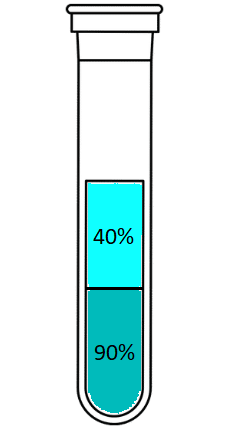
Motile and living sperm have a higher density compared to dead sperm, so once the semen is added to the top of the tube (the 40% layer), the live sperm sink to the 90% layer and the dead sperm stay in the 40% layer. The 40% layer can be removed and discarded, leaving you with an enriched motile sperm sample.
What I just described is a typical density gradient technique (simplified) for enriching motile sperm, as described by Karamahmutoglu et al. (2014).
The authors in the this study build on this by using more layers in their density gradient (20%, 40%, 60% and 90%).
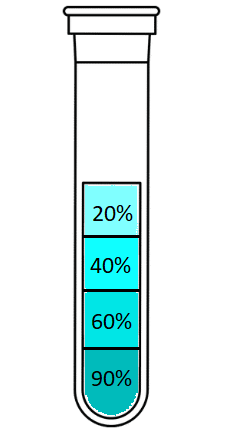
“Male” sperm have a single Y chromosome while “female” sperm have a single X chromosome. The Y chromosome is much smaller than the X chromosome, and so sperm with a Y chromosome have slightly less mass (and density) compared to X-containing sperm.
Using their density gradient, sperm with the X chromosome sink to the bottom to the 90% layer, while sperm with a Y chromosome tend to stay on the top 20% layer.
The full details of the technique and the reagents used can be found in the original paper, which is open source and not behind a paywall.
The sperm selection technique enriched X- and Y-containing sperm and embryos by PGT-A
After semen collection, a technique called FISH (Fluorescence In Situ Hybridization) was used to measure the number of X- and Y-containing sperm.
This technique uses a fluorescently labeled antibody that binds specifically to the X or Y chromosome. The label that binds to the X chromosome was red in color, while the label for the Y chromosome was green. This was used to count the X- and Y-containing sperm to give a proportion.
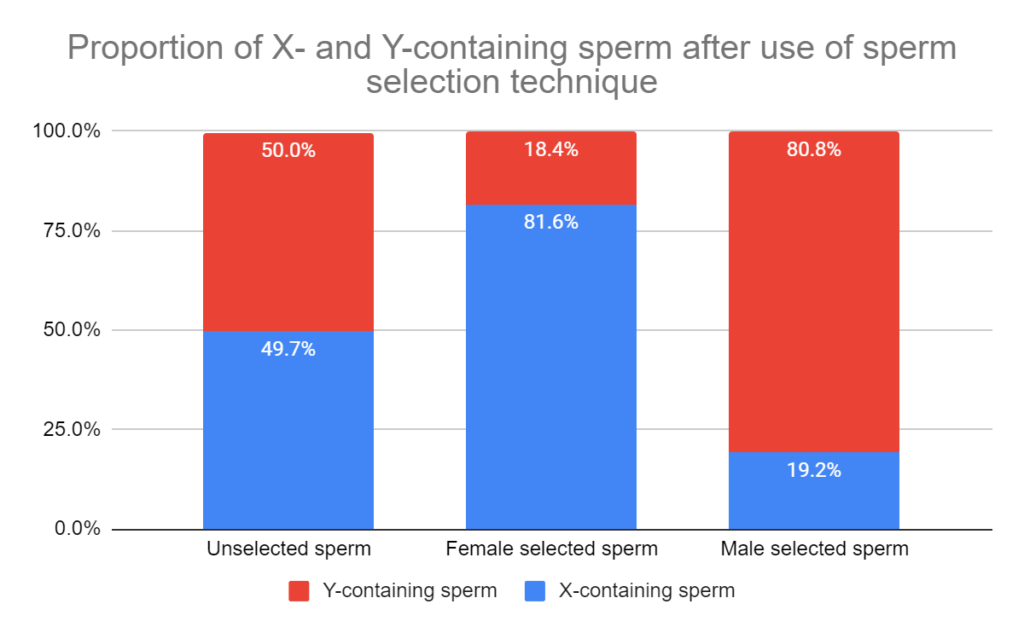
Before sex selection, the proportion of X- and Y-containing sperm was even (49.4% and 50.7%), and remained even in the group that didn’t want sex selection (49.7% and 50.0%).
For the couples that wanted a female, the proportion of X-containing sperm was enriched to 81.6%, and for those desiring a male the proportion of Y-containing sperm was enriched to 80.8%.
This sperm was used in ICSI to create embryos, which were then tested by PGT-A. Euploids from the group without sperm selection had an even proportion (54.6% female and 45.4% male), while the sperm selection group had enriched females (79.1% female, 20.9% male) or males (20.4% female, 79.6% male).
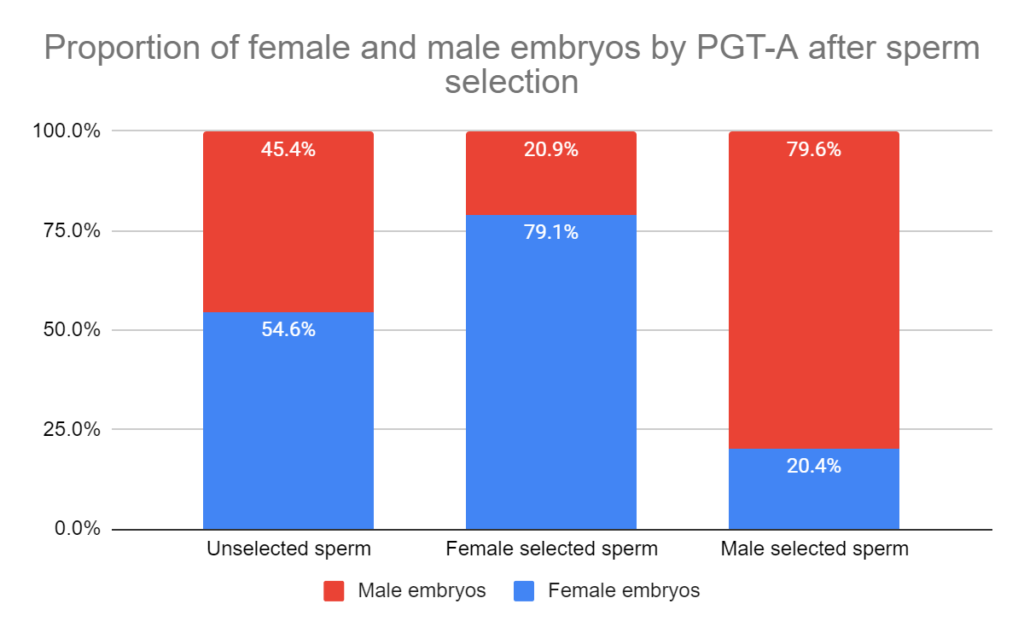
There were no differences in euploid rates between the groups, suggesting that this technique doesn’t cause aneuploidy.
Normal IVF and neonatal outcomes following use of the novel sperm selection technique
The authors reported normal IVF outcomes for those who did and didn’t use the sex selection technique, including rates for fertilization, implanation, clinical pregnancy, live birth and pregnancy loss.
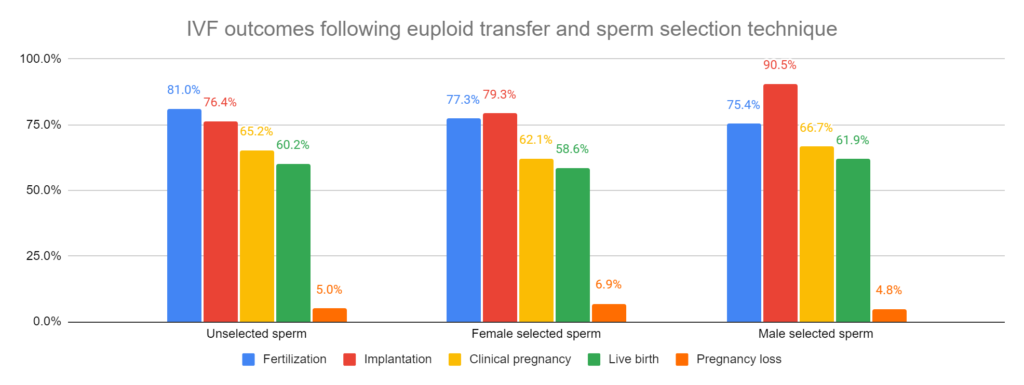
Not surprisingly, after transferring the euploids of the desired sex all the babies born were of that sex (16 females, 13 males).
After 3 years of follow up, all the children have been well and without developmental delays.
Conclusions
This study found that their sperm selection technique was successful in enriching sperm samples to contain over 80% X- or Y-containing sperm, which went on to form a high proportion of euploids of the desired sex after PGT-A. There was no increase in aneuploidy using this technique, suggesting it’s safe for embryos.
Use of this technique resulted in normal IVF outcomes, including fertilization and clinical pregnancy rates. The babies born from this technique grew up normally and showed no developmental delays.
This technique doesn’t guarantee a particular embryo’s sex, but it does enrich the number of embryos with that sex. For couples desiring a particular sex, the use of PGT-A is still necessary, and this technique can increase the number of embryos of a particular sex available for transfer.
The authors recommend another follow-up study be performed to confirm the results.
Reference

About Embryoman
Embryoman (Sean Lauber) is a former embryologist and the founder of Remembryo, an IVF research and fertility education website. After working in an IVF lab in the US, he returned to Canada and now focuses on making fertility research more accessible. He holds a Master’s in Immunology and launched Remembryo in 2018 to help patients and professionals make sense of IVF research. Sean shares weekly study updates on Facebook, Instagram, and Reddit regularly. He also answers questions on Reddit or in his private Facebook group.