

Researchers in a 2023 study found that good quality embryos were more likely to give rise to male births, particularly those with higher quality trophectoderm scores.
The sex ratio at birth, or the ratio of males to females born, is normally around 1 to 1 but can be influenced by different factors associated with IVF, including the quality of the blastocyst’s inner cell mass (ICM) and trophectoderm (TE).
Mao et al. (2023) compared blastocyst quality grades to the sex of the resulting baby to see if blastocyst quality has any impact on the sex ratio. This was a retrospective study that involved 3,041 singletons born following blastocyst transfer between 2017 and 2020 at a single IVF center in China.
Check out my complete guide to embryo grading and success rates to learn more about embryo development, grading and success rates.
Study details
- A single, frozen blastocyst was transferred. No PGT-A. Only blastocysts with an expansion of 3 or more were considered.
- Good quality blastocysts had an ICM and TE quality of A or B and poor quality blastocysts had a C.
- About 90% of embryos were good quality and 10% were poor quality.
The sex ratio was defined as the ratio of male to female (male/female) sex. In this study, the overall sex ratio was 1.24, indicating that there were 24% more males born than female.
The researchers performed a statistical adjustment of their data to account for potential confounders, including age, BMI, main cause of infertility, day of embryo transfer and more.
🔗 Original studies are referenced in this post or within the linked Remembryo posts.
💡 Reminder: Terms underlined with a dotted black line are linked to glossary entries. Clicking these does not count toward your paywall limit.
Good quality embryos are more likely to be male
You can see the sex ratio for the embryos based on their overall quality below. Embryos that were good quality had a higher sex ratio compared to poor quality embryos (1.29 vs 0.88, adjusted odds ratio [95% CI]: 1.466 [1.151-1.868], p= 0.002), so higher quality embryos were more likely to be male.
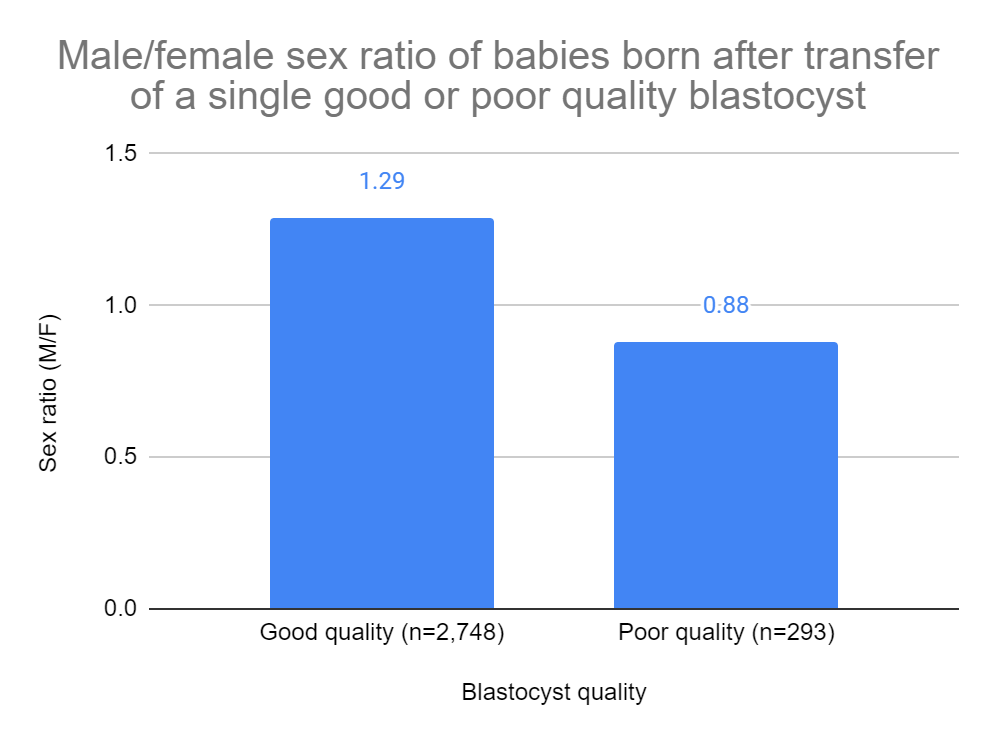
The overall sex ratio was 1.24, which is higher than the 1.0 or so that would be expected. Sex ratios may differ by country (this is in China), but it might also be skewed because more good quality embryos were transferred.
Embryos with higher quality trophectoderm are more likely to be male
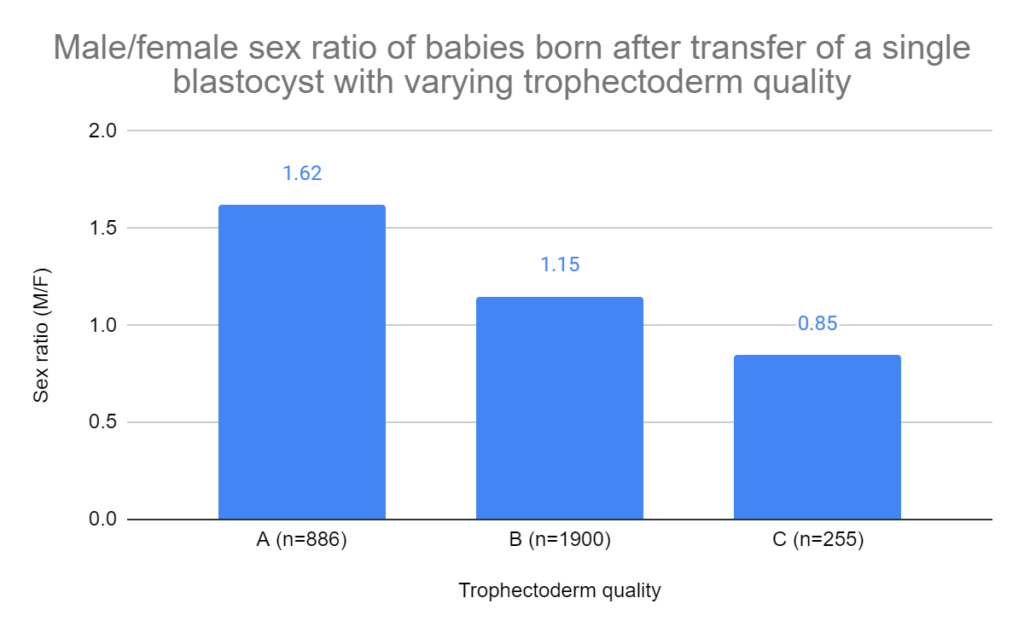
When the researchers compared the sex ratios for embryos with different expansions or ICMs, they found no association (p= 0.330 and p= 0.918 respectively). However, embryos with varying TE quality showed different sex ratios (p< 0.001). You can see this below.
Blastocysts with A quality TE had a higher sex ratio and were more likely to be male compared to C quality (1.62 vs 0.85, adjusted odds ratio [95% CI]: 1.914 [1.445-2.537], p< 0.001); and the same was true for blastocysts with B quality TE compared to C quality (1.15 vs 0.85, adjusted odds ratio [95% CI]: 1.360 [1.046-1.769], p= 0.022).
A look at individual embryo quality grades and male/female ratios
They also reported on the sex ratio outcomes for individual blastocyst quality grades (ie. AA, AB, AC, BA, BB, BC, CA, CB — there were no CC quality embryos). As you can see below, higher quality embryos were more likely to be male and have a higher sex ratio.
There were statistical differences in the blastocysts with ICM quality of A (p< 0.001) and B (p= 0.016), but not for those with ICM quality C (p= 0.344). This is likely due to the smaller sample size. In other words, blastocysts with C quality ICM as shown below didn’t have different sex ratios.

Conclusions
This study found that good quality embryos with ICM or TE grades of A or B were more likely to be male compared to poor quality embryos with C grades. When considering the adjusted odds ratio, this was about a 50% increase (odds ratio was 1.466).
There was no difference in the sex ratio with the expansion grade (the number portion of the embryo grade) or the ICM grade, but higher quality TE grades were more likely to be male.
The authors don’t have a good explanation for why this is, and other studies that look at this show either the opposite or no association. However, the authors point out that their study is the largest to compare embryo quality and the sex ratio, and recognize that future prospective studies should be done to better address this.
Reference

About Embryoman
Embryoman (Sean Lauber) is a former embryologist and the founder of Remembryo, an IVF research and fertility education website. After working in an IVF lab in the US, he returned to Canada and now focuses on making fertility research more accessible. He holds a Master’s in Immunology and launched Remembryo in 2018 to help patients and professionals make sense of IVF research. Sean shares weekly study updates on Facebook, Instagram, and Reddit regularly. He also answers questions on Reddit or in his private Facebook group.
Related posts:
 Complete Guide to Embryo Grading and Success Rates
 Predicting live birth rates, multiples based on 223,377 transfers
 AI model predicts live births from blastocyst images with highest accuracy yet
 Day 3 or Day 5 embryo transfer?
 Study examines transferring a good and poor quality embryo together
 Meta-analysis combines 74 studies to examine factors linked to euploid transfer success
 Study evaluates the potential of day 4, 5, 6 and 7 blastocysts
 Poor quality blastocysts show acceptable live birth rates, no change in perinatal outcomes