

Researchers in a 2023 study found no differences in pregnancy and neonatal outcomes in embryos tested by PGT-A that were frozen and thawed once or twice.
PGT-A is often done using fresh embryos that are then frozen after the biopsy, but occasionally a patient will decide to thaw their frozen blastocysts to do PGT-A, exposing these embryos to a second round of freezing/thawing. It’s not clear if this repeated freeze/thaw cycle is detrimental to pregnancy or neonatal outcomes.
Check my complete guide to PGT-A to get more background on PGT-A (aka PGS testing).
Zhang et al. (2023), in their retrospective study, compared pregnancy and neonatal outcomes after transferring a single euploid that was frozen once (n=97) or twice (n=117). This study took place between 2014 and 2018 at a single IVF center in China.
Key information:
- Average age was 31 in the once-frozen group and 33 in the twice-frozen group.
- A good quality day 5 or 6 blastocyst was required for PGT-A.
- Patients with abnormal karyotypes, uterine abnormalities, using donor sperm/eggs, or undergoing PGT-SR or PGT-M were excluded.
The baseline characteristics were similar for number of criteria in the once-frozen vs the twice-frozen groups, except:
- Those with recurrent miscarriage (2 or more previous miscarriages; 53.61% vs 37.61%, p = 0.019).
- The number of eggs retrieved per cycle (10.00 vs 15.00, p < 0.001).
- Endometrial thickness at transfer (8.5 mm vs 9.5 mm, p = 0.003).
These confounders were statistically adjusted for in their analysis.
There were also differences in IVF vs ICSI between the groups. ICSI was used in all of the once-frozen cycles, but there was only 30% ICSI in the twice-frozen groups (the remaining was conventional IVF). This was assessed separately (shown below).
🔗 Original studies are referenced in this post or within the linked Remembryo posts.
💡 Reminder: Terms underlined with a dotted black line are linked to glossary entries. Clicking these does not count toward your paywall limit.
Similar survival and euploidy rates in once-frozen and twice-frozen euploids
For the once-frozen group, there were a total of 402 fresh blastocysts that were biopsied, of which 232 were euploid (euploidy rate 57.71%). A total of 101 euploids were thawed for transfer and 97 survived (survival rate 96.04%).
For the twice-frozen group, 524 frozen blastocysts were thawed and biopsied, of which 298 were euploid (euploidy rate 56.87%). A total of 129 euploids were thawed for transfer and 121 survived (survival rate 93.80%).
There were no statistically significant differences between the euploidy or survival rates between the once-frozen and twice-frozen embryos.
Similar pregnancy outcomes for once-frozen and twice-frozen euploids
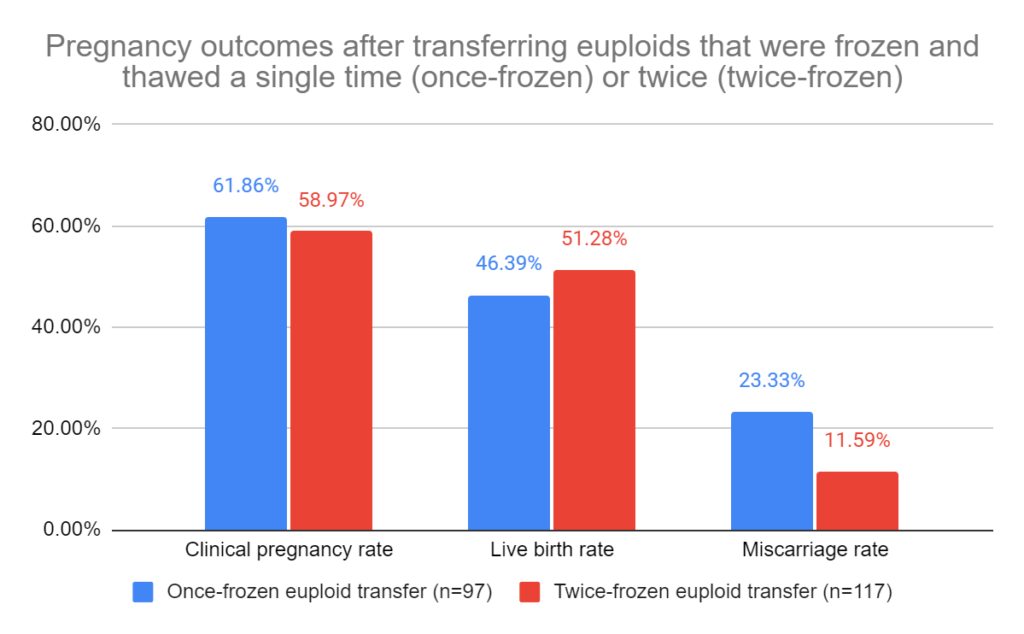
Comparing the once-frozen and twice-frozen euploid transfer groups, there were no differences in clinical pregnancy rates (61.86% vs 58.97%), live birth rates (46.39% vs 51.28%) or miscarriage rates (23.33% vs 11.59%). After statistical adjustment for confounders (recurrent miscarriage, number of eggs retrieved, endometrial thickness, egg age and BMI), there was still no difference.
Similar neonatal outcomes for once-frozen and twice-frozen euploids
They also compared neonatal outcomes for the once-frozen (45 births) and twice-frozen groups (60 births), and found no differences in:
- C-sections
- Male/female sex ratio
- Gestational age
- Birthweight
- Preterm birth
- Low birth weight
- Birth defects
- Still births
Similar outcomes with twice-frozen euploids in terms of IVF and ICSI use
As mentioned above, about 30% of the twice-frozen cycles used ICSI, while all of the cycles in the once-frozen group used ICSI. To make sure this didn’t have any impact on the results, the researchers compared conventional IVF vs ICSI in the twice-frozen group as a separate analysis.
In the IVF group, there were 83 transfers and 39 live births, and in the ICSI group there were 34 transfers and 21 live births.
For IVF vs ICSI, they found no difference in:
- Clinical pregnancies (56.63% vs 64.71%, p = 0.420)
- Live birth (46.99% vs 61.76%, p = 0.147)
- Miscarriage (14.89% vs 4.55%, p = 0.397)
- Neonatal outcomes (same as above)
While some of these values may appear to be very different, they weren’t statistically significant. In other words, the differences can be explained by chance alone.
In these groups there were differences in the age of the eggs (female age at time of retrieval), AMH, sperm concentration, total sperm motility, the number of eggs retrieved and BMI. After statistical adjustment of these confounders they found no differences in pregnancy outcomes for the IVF vs ICSI groups (twice-frozen).
Conclusions
This study found no differences in survival rates of embryos frozen/thawed once or twice, and no differences in clinical pregnancies, live births or miscarriage rates. There were also no differences in neonatal outcomes, such as birthweight and birth defects.
An interesting substudy was also performed that compared pregnancy outcomes for conventional IVF vs ICSI with PGT-A, in which they found no difference. The authors state that there really isn’t much data that evaluates this, and it’s reassuring to see that there is no difference.
Limitations of this study include its retrospective nature and the small sample size, which is typical for studies looking at repeated freeze/thaw. The low sample size makes drawing conclusions difficult. Another drawback that they mentioned is that they didn’t have a large enough sample size to evaluate day 5 vs day 6 euploids, which may have had an impact on the results.
A previous study I reviewed showed a decrease in pregnancy and birth rates. That study was also small, so larger studies are definitely needed. You can read that study here Repeated freezing and thawing impacts IVF outcomes in PGT-A cycles.
Reference

About Embryoman
Embryoman (Sean Lauber) is a former embryologist and the founder of Remembryo, an IVF research and fertility education website. After working in an IVF lab in the US, he returned to Canada and now focuses on making fertility research more accessible. He holds a Master’s in Immunology and launched Remembryo in 2018 to help patients and professionals make sense of IVF research. Sean shares weekly study updates on Facebook, Instagram, and Reddit regularly. He also answers questions on Reddit or in his private Facebook group.
Related posts:
 Meta-analysis combines 74 studies to examine factors linked to euploid transfer success
 Study examines PGT-A outcomes of inconclusive rebiopsied embryos and associated factors
 Complete guide to PGT-A (PGS testing)
 PGS (PGT-A) success rates
 Repeated freezing and thawing impacts IVF outcomes in PGT-A cycles
 Factors associated with euploid survival after thaw
 Preliminary studies examine the rebiopsy and transfer of chaotic embryos by PGT-A
 IVF outcomes following aneuploid embryo transfer