
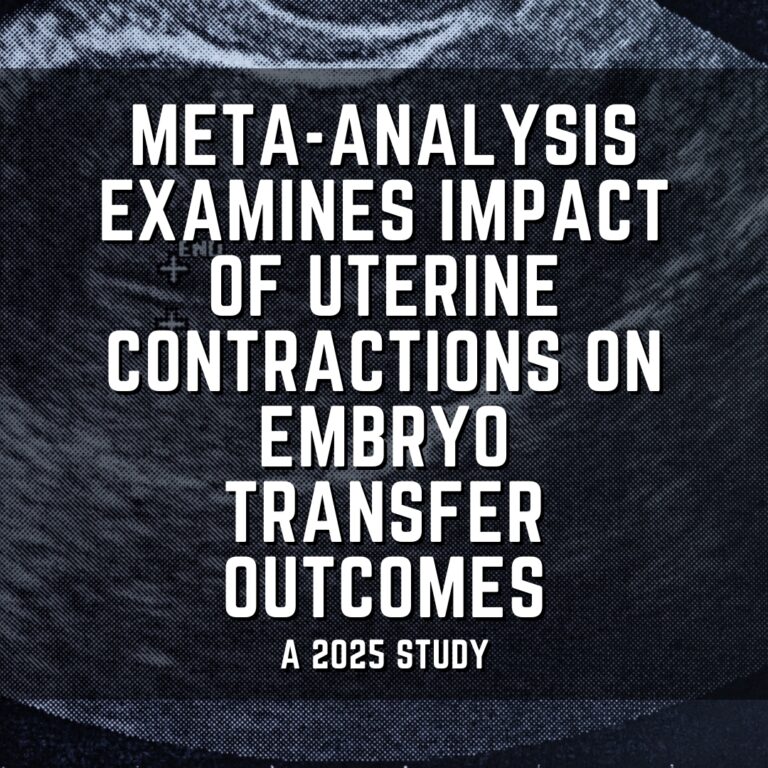
Researchers combined the results of 5 studies involving IVF patients who had low or high uterine contractility before embryo transfer, finding those with more frequent contractions had a lower chance of pregnancy.
Uterine peristalsis consists of rhythmic contractions within the uterus that change with the menstrual cycle to assist sperm travel and embryo implantation. These contractions generally decrease during the luteal phase, providing a stable environment essential for successful embryo implantation.
Uterine peristalsis can be evaluated using transvaginal ultrasound, to measure their frequency, direction and amplitude (strength).
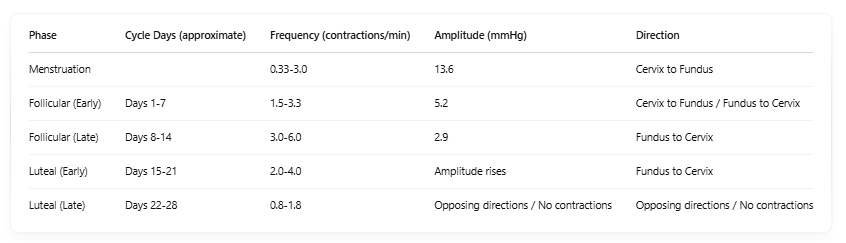
This post is a summary of a study by Vidal et al. (2025), who combined the results of 5 studies involving 1134 IVF patients who had uterine contractility measured before embryo transfer (cleavage stage embryos). These studies evaluated pregnancy rates in women who had high vs low uterine peristalsis (>2 uterine contractions/min vs ≤2 uterine contractions/min).
🔗 Original studies are referenced in this post or within the linked Remembryo posts.
💡 Reminder: Terms underlined with a dotted black line are linked to glossary entries. Clicking these does not count toward your paywall limit.
The five studies they included in their meta-analysis were Fanchin et al. (1998), Zhu et al. (2014a), Zhu et al. (2014b), Chung et al. (2017), and Masroor et al. (2023).
Based on these five studies, the odds of clinical pregnancy was about half in women with high vs low uterine peristalsis (odds ratio [95% CI]: 0.52 [0.38-0.69]), 1134 patients, I2= 55%).
That’s it — that’s the only data they provided! Short and sweet, I guess. This meta-analysis is limited because it only included transfers of day 2-3 embryos, didn’t always exclude patients with uterine pathologies, and older studies may be outdated due to advances in ultrasound technology. The studies here were also generally small and had a high amount of variability (heterogeneity), so newer studies are definitely needed!!
But don’t go yet, there’s more!
They also performed a review on uterine peristalsis that included 17 studies, so let’s take a look at some of the interesting results they found:
- There’s a lack of standardization in measuring uterine peristalsis. Some studies assessed uterine peristalsis on the trigger day, others on the day of oocyte retrieval, many just before embryo transfer, and a few on day 5 post-transfer. These measurements typically involved recording uterine contractions for 3 to 5 minutes to analyze their frequency.
- Contraction amplitude by itself may not affect pregnancy outcomes, although a combination of higher frequency and lower amplitude might lead to successful embryo implantation (Blank et al. 2020).
- The direction of uterine contractions generally doesn’t seem to affect pregnancy outcomes, although a more stable uterus with minimal contractions/direction might improve implantation success (Chung et al. 2017).
- Fanchin et al. (2009) indicate that higher progesterone levels are associated with fewer uterine contractions, although this does not seem to affect the clinical pregnancy rate on the day of embryo transfer.
- Chung et al. (2017) observed that increased uterine peristalsis after embryo transfer is linked to lower pregnancy rates, while Masroor et al. (2023) found that lower uterine peristalsis before transfer boosts pregnancy chances.
- Dong et al. (2023) found that excessive uterine contractions were associated with recurrent implantation failure.
- Uterine contractility differs between fresh and frozen IVF cycles. Hormonal fluctuations in fresh cycles may increase contractility to hinder pregnancy (Chung et al. 2017), while stability in frozen cycles may improve implantation success (Masroor et al. 2023).
- Rees et al. (2023) found that adenomyosis causes dysfunctional uterine contractions, particularly in the luteal phase.
A Cochrane review (Craciunas et al. 2021) has explored the effectiveness of oxytocin antagonists like atosiban in reducing uterine peristalsis around embryo transfer in IVF, finding mixed results on pregnancy outcomes and highlighting the need for more research.
There is limited data on this topic, and the researchers call for more studies to see if routine clinical measurements would be useful, especially for patients with RIF. They also recommend standardizing how uterine peristalsis is measured and using more advanced methods for more reliable data.
Reference

About Embryoman
Embryoman (Sean Lauber) is a former embryologist and the founder of Remembryo, an IVF research and fertility education website. After working in an IVF lab in the US, he returned to Canada and now focuses on making fertility research more accessible. He holds a Master’s in Immunology and launched Remembryo in 2018 to help patients and professionals make sense of IVF research. Sean shares weekly study updates on Facebook, Instagram, and Reddit regularly. He also answers questions on Reddit or in his private Facebook group.
Related posts:
 How many failed embryo transfers is too many?
 Why do embryos in IVF fail to implant or miscarry?
 Meta-analysis of commonly used IVF immunotherapies shows no benefit
 RCT finds no change in birth rates for standard or ERA-timed euploid transfer
 Meta-analysis examines impact of small fibroids on pregnancy outcomes
 “True” recurrent implantation failure is rare after five consecutive euploid embryo transfers
 Study investigates role of intrauterine PRP in improving embryo transfer outcomes
 Study investigates the use of EMMA & ALICE in IVF patients with RIF, RPL