
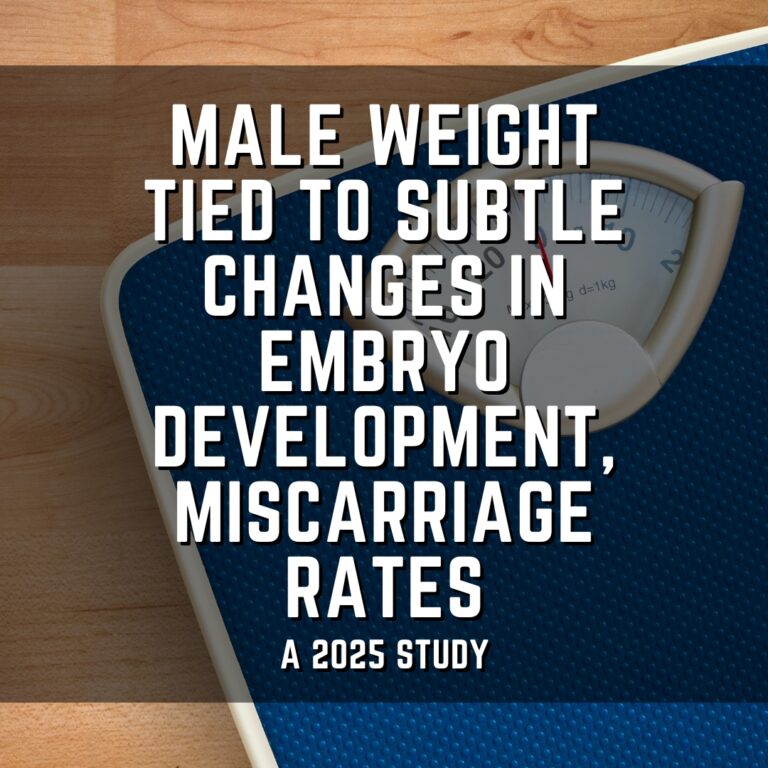
A 2025 study showed that male obesity was linked to slightly slower embryo development, poorer ICM quality, and a higher miscarriage risk in donor egg IVF cycles, suggesting that paternal weight can subtly influence embryo health and pregnancy outcomes.
While the impact of female obesity on IVF success has been studied, it’s less clear how a man’s weight affects outcomes. Some research has found that male obesity may lower sperm quality and increase miscarriage risk, while other studies haven’t shown much effect.
In a new study by Quintana-Vehí et al. (2025), researchers looked only at donor egg cycles to focus on the male side. By using time-lapse monitoring, they tracked how embryos developed over time to see whether higher male BMI affected embryo growth and pregnancy outcomes.
🔗 Original studies are referenced in this post or within the linked Remembryo posts.
💡 Reminder: Terms underlined with a dotted black line are linked to glossary entries. Clicking these does not count toward your paywall limit.
Study details
- Study type: Retrospective cohort study that took place at two IVF centers in Spain between 2018 and 2021.
-
Participants: 1,398 donor egg cycles (7,846 embryos in total), including 1,133 partner sperm samples and 265 donor samples. Male partners were divided into three BMI groups:
- Normal weight (<25 kg/m²): 699 cycles
- Overweight (25–29.9 kg/m²): 561 cycles
- Obese (≥30 kg/m²): 138 cycles
- Eligibility: Excluded severe male factor infertility, cycles with assisted oocyte activation, or PGT-A. Only first fresh or frozen transfer outcomes were considered.
- Embryos: All embryos were cultured in time-lapse incubators (EmbryoScope®) and tracked through development to the blastocyst stage.
- Primary outcome: Timing of preimplantation developmental milestones (morphokinetics) by time-lapse (Embryoscope).
- Statistical adjustment: Analyses were adjusted for IVF center, oocyte and sperm status (fresh/frozen), sperm origin (donor/partner), sperm concentration and motility, recipient female BMI, number of embryos transferred, and day of transfer.
- Funding and disclosure: No external funding; authors reported no conflicts of interest.
Embryos from obese men developed more slowly
Using Embryoscope time-lapse technology, researchers found that embryos created with sperm from men with obesity showed slower early cell divisions compared to those from men with a normal BMI.
On average, embryos from obese men took about 10–15% longer to complete the first few rounds of cell division (when the embryo grew from one cell to two, three, four and five cells; hazard ratio = 0.87–0.90). Embryos from overweight men showed the opposite trend, dividing slightly faster in later stages.
Overall, this data suggests that male obesity can disrupt early embryo division timing.
Blastocysts from obese men were less likely to have strong inner cell masses
By the blastocyst stage (day 5–6), embryos from obese men were about 20% less likely to have a high quality ICM compared with embryos from normal-weight men (odds ratio [95% CI]: 0.80 [0.64–0.99]).
There were no differences in the trophectoderm score, the chance of having high quality day 3 embryos, or in the KIDScore (which combines embryo development speed and quality).
Overall, this suggests that male obesity may have only a subtle effect on embryo quality, since the difference in ICM quality was borderline significant and other quality measures showed no clear differences.
Embryos from obese men have higher miscarriage risk
Most laboratory and clinical outcomes were comparable across BMI groups. Implantation, clinical pregnancy, and live birth rates all trended lower with increasing BMI but were not statistically significant.
| Outcome | Normal BMI | Overweight | Obese | Statistical Significance |
|---|---|---|---|---|
| Fertilization rate | 75.1% | 74.6% | 73.1% | Not significant |
| Blastocyst formation | 65.1% | 63.6% | 63.8% | Not significant |
| Implantation | 64.8% | 64.3% | 58.7% | Not significant |
| Clinical pregnancy | 60.0% | 58.9% | 52.9% | Not significant |
| Miscarriage | 9.5% | 9.6% |
13.5% (OR 1.67, 95% CI 1.27–2.19, p = 0.0002) |
Significant |
| Live birth | 46.7% | 43.7% | 36.5% | Not significant |
The miscarriage rate was significantly higher for couples with obese male partners — the odds of miscarriage were about 1.7 times higher for obese men than for normal-weight men (adjusted OR [95% CI]: 1.67 [1.27–2.19]).
Because the obese group had fewer participants (64 pregnancies and 14 miscarriages compared with about 300 pregnancies and 40 miscarriages in the other groups), the smaller sample size means the miscarriage finding should be interpreted with some caution even though it was statistically significant.
It’s also important to note that the authors reported miscarriage per embryo transfer, not per pregnancy, which makes the rates appear lower than what most IVF studies show. When recalculated per clinical pregnancy, the estimated miscarriage rates rise to ~13% for normal BMI, ~14% for overweight, and ~22% for obese men.
Conclusion
In this study, men with obesity (BMI ≥ 30) had embryos that developed more slowly and had slightly poorer ICM quality. They also had a higher risk of miscarriage, even after accounting for the woman’s BMI, sperm quality, and details of the embryo transfer.
Although early embryo development was slower, this did not affect the number of embryos reaching the blastocyst stage, suggesting that obesity did not increase embryo arrest. There were also no significant differences in the number of high quality cleavage stage embryos, pregnancy rates, or live birth rates.
Overall, these findings suggest that male obesity is linked to subtle changes in embryo development and quality that may slightly increase the risk of miscarriage.
Previous studies have shown mixed results: some reported that embryos from obese men divide faster during early development, while others found no difference in fertilization or early embryo quality but lower blastocyst and pregnancy rates in couples with obese male partners.
The authors suggest that these effects may be related to sperm DNA fragmentation or changes in RNA and metabolism. Larger studies that directly measure sperm DNA damage and report miscarriage rates are needed to clarify how much of this effect is truly due to obesity itself.
While this study used donor eggs to isolate the male contribution, there were several limitations:
- All men in the obese group used their own sperm, while about one-third of the normal-weight group used donor sperm from young, healthy men. This could partly explain the differences despite adjustment for sperm origin.
- Female partners of obese men tended to have slightly higher BMI and older age, which may have affected outcomes even with donor eggs. Higher female BMI has been linked to greater miscarriage risk.
- Using donor oocytes may have reduced the apparent impact of male factors, since donor eggs are from younger women and could repair fragmented DNA more effectively than from older women. Results might differ if patients’ own eggs were used.
Want to read more about obesity or sperm quality and IVF outcomes?
Researchers in a 2023 study found that increasing female BMI resulted in decreased pregnancy and live birth rates after a single euploid transfer, while pregnancy loss rates increased. This effect was reduced in cases of male factor infertility only, suggesting that weight itself may not be responsible. Read more.

A large 2025 study of donor egg cycles found that poor fertilization in IVF is uncommon, but when it does occur it’s usually caused by sperm rather than the egg. Most cases of low fertilization were sperm-related, while only a minority were linked to eggs or other factors. Read more.
Researchers in a 2021 study found that intake of sugar-sweetened beverages was associated with lower sperm concentration and total sperm count. Read more.
Researchers in a 2021 study found that older women showed worsened IVF outcomes using sperm with high DNA fragmentation, possibly due to compromised DNA repair activity in the older egg. Read more.
Related studies
These additional studies were referenced by the authors of the paper and haven’t been covered on Remembryo. They may be helpful if you’re exploring this topic further. This section is available for paid subscribers.

Reference
If you liked this post and want to support what I do, please consider a paid subscription, Patreon or donate through PayPal!

About Embryoman
Embryoman (Sean Lauber) is a former embryologist and the founder of Remembryo, an IVF research and fertility education website. After working in an IVF lab in the US, he returned to Canada and now focuses on making fertility research more accessible. He holds a Master’s in Immunology and launched Remembryo in 2018 to help patients and professionals make sense of IVF research. Sean shares weekly study updates on Facebook, Instagram, and Reddit regularly. He also answers questions on Reddit or in his private Facebook group.
Related posts:
 Complete guide to sperm quality
 Mediterranean diet and IVF – a clinical trial
 Do sperm supplements work? Results from the MOXI trial
 Soft drink/soda consumption associated with lower sperm quality
 Paternal (male) effect on embryo aneuploidy examined
 Study reviews 34 common male fertility sperm supplement brands for safety, efficacy
 Endocrine disruptors and their impact on fertility
 Study evaluates interventions that lower endocrine disruptor levels