
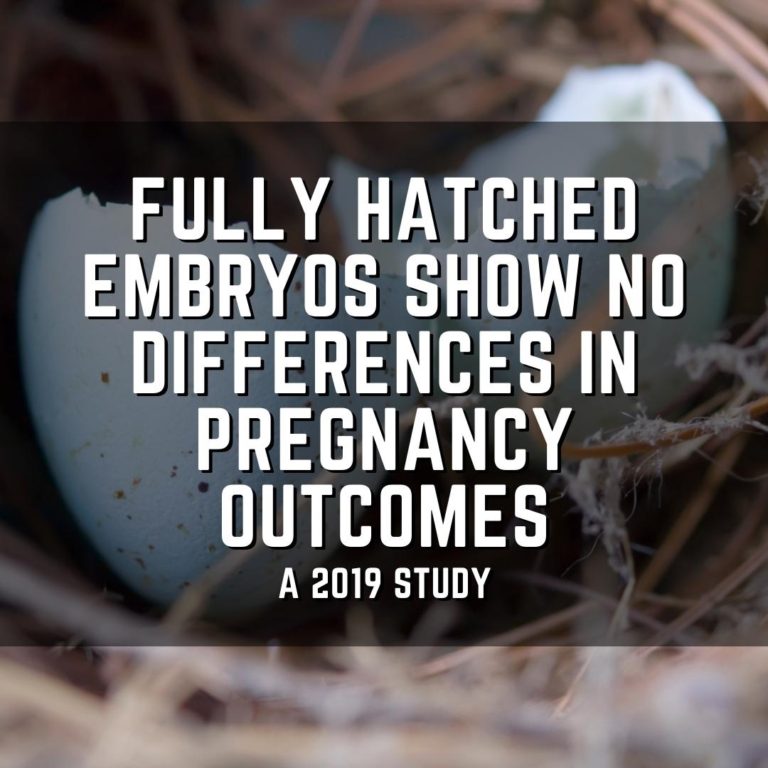
Researchers in a 2019 study found no difference in pregnancy outcomes after transferring embryos that were either fully hatched (artificially) or not.
Check out this amazing embryo, free of its zona prison!

For many people, the actual process of the embryo hatching out from the zona is done after transfer as the embryo continues its development.
However, for some, the embryo can be graded as a “6” (so a 6AA, 6BC, 6AB, etc) – this “6” indicates that the embryo is completely hatched. Rather than being a cause of celebration, some people think it’s a problem.
Check out my complete guide to embryo grading and success rates for more background on embryo development, grading and success rates.
IVF involves a lot of pipetting of embryos. The zona might actually be protecting the embryo as it’s being handled during IVF, and there’s some concern that a fully hatched embryo is more fragile than an unhatched embryo.
🔗 Original studies are referenced in this post or within the linked Remembryo posts.
💡 Reminder: Terms underlined with a dotted black line are linked to glossary entries. Clicking these does not count toward your paywall limit.
So Kirienko et al. (2019) put together an RCT to determine if hatched embryos are inferior to unhatched embryos.
Rather than waiting around for embryos to hatch, they artificially (and completely) hatched them! Immediately after thawing the embryos (because all the embryos in this study were frozen), they mechanically removed the zona from one set of embryos (230 blastocysts), while leaving the zona intact for another set (233 blastocysts).
The embryos were then transferred and there were no differences in:
- Implantation rate (33.9% in the zona-free group vs the 36.4% in the zona-intact group).
- Clinical pregnancies (35.9% vs 39%).
- Ongoing pregnancies (>12 weeks pregnant, 32.1% vs 33.1%).
- Multiple pregnancies (8.0% vs 3.6%).
- Ectopic pregnancies (1.3% vs 1.2%).
- Spontaneous abortions (losses before 20 weeks, 9.3% vs 12.8%).
This suggests that hatched embryos are pretty sturdy and not more fragile compared to unhatched embryos. If they were, we would expect that the hatched embryos would have lower success rates.
From my personal experience as an embryologist, I noticed that there was an increased incidence of embryos getting stuck in the transfer catheter if they were hatched. This never seemed to affect the viability of the embryo, but this data is definitely reassuring!
What this study doesn’t address is the viability of hatched embryos after freezing. All of these embryos were hatched AFTER thawing. It’s possible that they’re more sensitive to the freezing process and this might have an impact on their success rates. I couldn’t find much on this subject however!
- Rodriguez-Purata et al. (2016) found no difference between fresh/frozen euploid embryo transfers, using hatched or unhatched embryos (with close to 1000 embryos).
- James et al. (2018) found that hatched euploid embryos had lower clinical pregnancy rates compared to unhatched euploids (53.45% vs 43.87%).
Both of these studies were done in PGS tested embryos that were biopsied. In the second study there was a reduction in success rates, so this suggests the hatched embryo is more fragile. However, is this because it’s damaged during the biopsy procedure or the freezing procedure? From my experience with doing embryo biopsies, embryos that were hatched were more difficult to biopsy than those with a zona. The zona offered a safe place to “anchor” the holding pipette to perform the biopsy, and without it you’re suctioning pretty hard on trophectoderm cells which can cause damage.
This leads me to think that this is more likely due to sensitivity of the biopsy process, but we can’t be sure without the data!
Reference
If you liked this post and want to support what I do, please consider a paid subscription, Patreon or donate through PayPal!

About Embryoman
Embryoman (Sean Lauber) is a former embryologist and the founder of Remembryo, an IVF research and fertility education website. After working in an IVF lab in the US, he returned to Canada and now focuses on making fertility research more accessible. He holds a Master’s in Immunology and launched Remembryo in 2018 to help patients and professionals make sense of IVF research. Sean shares weekly study updates on Facebook, Instagram, and Reddit regularly. He also answers questions on Reddit or in his private Facebook group.
Related posts:
 Study examines potential of day 7 euploid transfers
 Transfer of day 7 embryos a viable option
 Day 3 or Day 5 embryo transfer?
 Predicting how many day 3 embryos make it to blastocyst
 AI model predicts live births from blastocyst images with highest accuracy yet
 Study examines association with embryo quality and male to female sex ratio
 Study evaluates the potential of day 4, 5, 6 and 7 blastocysts
 Hatching or hatched blastocysts have improved pregnancy outcomes compared to non-hatching blastocysts