
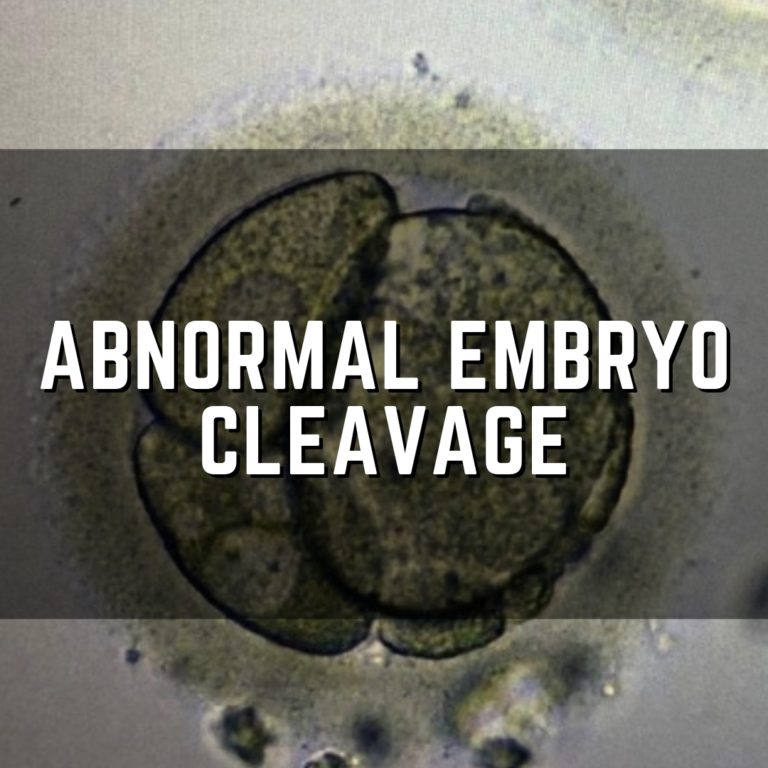
This post covers embryo cell division, or cleavage, including the events that normally occur during the embryo’s first cleavage, and abnormal cleavage events like direct cleavage and reverse cleavage that reduce the chances of success.
🔗 Original studies are referenced in this post or within the linked Remembryo posts.
💡 Reminder: Terms underlined with a dotted black line are linked to glossary entries. Clicking these does not count toward your paywall limit.
In this post, these abnormal embryo cleavage events are typically only seen using time-lapse technology. So for those who aren’t using time-lapse, there’s really no way to know if your embryo experienced an abnormal cleavage event.
After the egg is fertilized, it then divides to form 2 cells, then each of those 2 cells divide again to make 4 cells, and so on. During these early stages of cell cleavage, sometimes the embryo’s cells divide in an abnormal way.
Direct cleavage is a type of abnormal cleavage where a cell divides into 3 cells instead of 2.

- It occurs about 6.4% (Cottichio et al. 2018) to 26.0% (Zhan et al. 2016) of the time.
- Reduced chance of euploidy (13% vs 46%) (Zhan et al. 2016)
- Reduced live births when transferring a euploid embryo that had undergone direct cleavage (23.1% vs 55.9%) (Ozbek et al. 2021)
Reverse cleavage is where a 2 cell embryo reverts back to a single cell.
- It occurs about 17-25% of the time (Ozbek et al. 2021)
- Reduced live births when transferring a euploid embryo that had undergone reverse cleavage (33.3% vs 55.9%) (Ozbek et al. 2021)
Cottichio et al. (2018) mapped the events and timing from a ICSI-fertilized egg to the 1st cleavage:
- Fertilization (t=0 hours)
- Emision of second polar body (3.3 hr)
- Male pronucleus is observed (6.2 hr)
- Female pronucleus is observed (6.3 hr)
- PN juxtaposition (they pair up with each other) (8.5 hr)
- “Cytoplasmic halo” appears (11.7 hr)
- Cytoplasmic halo disappears (23.1 hr)
- Male pronucleus breaks down (24.4 hr)
- Female pronucleus breaks down (24.5 hr)
- First cleavage! (27.0 hr)
If you check the link above for this paper there’s lots of really cool videos showing some of these events! (Search for “movie” in the paper).
The timing of these events (and the spatial orientation of the pronuclei) is important. Deviations from the ideal can lead to abnormal cleavage and poor embryo quality.

About Embryoman
Embryoman (Sean Lauber) is a former embryologist and the founder of Remembryo, an IVF research and fertility education website. After working in an IVF lab in the US, he returned to Canada and now focuses on making fertility research more accessible. He holds a Master’s in Immunology and launched Remembryo in 2018 to help patients and professionals make sense of IVF research. Sean shares weekly study updates on Facebook, Instagram, and Reddit regularly. He also answers questions on Reddit or in his private Facebook group.