

This post covers what occurs during normal fertilization and what it means to have an abnormally fertilized zygote (0PN, 1PN, 3PN, 4PN). Using PGT to test these embryos reveals that many have the correct number of chromosome sets and can lead to successful live births.
🔗 Original studies are referenced in this post or within the linked Remembryo posts.
💡 Reminder: Terms underlined with a dotted black line are linked to glossary entries. Clicking these does not count toward your paywall limit.
Table of Contents
What happens during normal fertilization?
Fertilization is a complex process that occurs when the sperm and egg combine their genetic material to form a zygote (a fertilized egg cell). This process can happen through conventional insemination or by ICSI, depending on the method used during IVF.
Here’s a step-by-step explanation of what happens during fertilization by conventional insemination (ICSI bypasses steps 1-4):
- Sperm binding to the zona: The sperm first binds to the zona pellucida, the outer layer of the egg.
- Acrosome reaction: The binding triggers the acrosome reaction, during which enzymes are released from the sperm’s acrosome (a cap-like structure over the sperm head) to digest and penetrate the zona.
- Penetration of the zona: The sperm penetrates through this layer to reach the oocyte (egg) membrane.
- Fusion of membranes: The plasma membrane of the sperm then fuses with the egg’s plasma membrane, allowing the sperm nucleus to enter the egg.
- Oocyte activation and completion of meiosis: As the sperm nucleus enters the egg, it releases an enzyme called phospholipase C-zeta, which leads to the release of calcium ions (Ca2+). This surge of Ca2+ activates mitochondria in the egg to generate energy, which is needed for the egg to complete meiosis so the egg and sperm DNA can fuse to form the embryo’s DNA. The completion of meiosis by the egg results in the release of a second polar body, which serves as an indicator of successful fertilization.
- Formation of pronuclei: After the sperm enters the egg, its tightly packed DNA is decondensed and the male pronucleus forms. Meanwhile, the egg’s DNA reorganizes into the female pronucleus. Successful fertilization can be verified by the appearance of these two pronuclei, referred to as “2PN” (two pronuclei), typically visible about 16-18 hours after insemination. You can see these two pronuclei in the image below.
- Migration and fusion of pronuclei to form the embryo’s DNA: The male and female pronuclei migrate towards each other over about 12 hours. Upon meeting, their nuclear envelope dissolve, and the chromosomes align on a mitotic spindle. The fusion of their DNA marks the beginning of the embryonic DNA and initiates the first cell division.


These two pronuclei each contain half the chromosomes (23) needed for the embryo (46). So by joining together, they form the complete chromosome set.
What is abnormal fertilization? (1PN and 3PN zygotes)
We’ve seen that a 2PN zygote indicates normal fertilization, but sometimes an egg can undergo abnormal fertilization and form a 1PN or 3PN. In a 1PN, we only see a single pronucleus, and in a 3PN we see three. There can even be 4PN zygotes! Abnormal fertilization is when anything other than 2PN is seen during fertilization.
Let’s look at why having a 1PN and 3PN are considered abnormal, and to understand this we need to talk about “ploidy.”
Ploidy is a term used in genetics to describe the number of complete sets of chromosomes in a cell. In humans, most cells are diploid, meaning they have two sets of chromosomes — one set from each parent. This configuration, totaling 46 chromosomes (23 pairs), means that we also have two sets of each gene! This ensures that each gene has a “backup,” which is important for compensating for genes that are damaged or not functioning properly.
Our sperm and egg cells are haploid, meaning they only have one set of chromosomes (23 in humans). This is necessary for sexual reproduction because it allows for genetic diversity when haploid cells from two parents combine to form a diploid offspring.
Now let’s apply this to 1PN, 2PN and 3PN:
- A zygote showing two pronuclei (2PN) is considered normal and healthy. It has two sets of 23 chromosomes or 46 chromosomes in total. This indicates that both the egg and the sperm have contributed their respective sets of chromosomes, setting the stage for typical development.
- After fertilization, if a zygote has only one pronucleus (1PN), this is abnormal and is considered haploid. It has one set of 23 chromosomes or 23 chromosomes in total. These zygotes lack a complete set of genetic material, which means they don’t have the necessary genetic “backup” that might compensate for defective genes. This haploid condition is generally incompatible with life because the embryo does not have all the genetic information needed for normal development.
- The presence of three pronuclei (3PN) in a zygote during IVF indicates a triploid state and is abnormal. It has three sets of 23 chromosomes or 69 chromosomes in total. Having an extra set of chromosomes disrupts the normal “dosage” of gene expression, which can lead to developmental problems. This overabundance of genetic material generally results in developmental abnormalities or miscarriage, as the precise balance of gene expression is crucial for normal development.
Besides 1PN and 3PN, 4PN zygotes are also possible. In general, when a zygote has more than 2 chromosome copies it’s called polyploid (ie. a 3PN and 4PN are polyploids).
Due to the potential issues with 1PN and 3PN embryos, many clinics choose to discard them. However, these embryos can actually be tested using a special type of PGT (discussed below) to determine if they are haploid, triploid or diploid. It’s important to distinguish between diploidy and euploidy: diploid means the embryo has the correct two sets of chromosomes, while euploid means the embryo has the correct total number and structure of chromosomes (46, not 45 or 47). A normal embryo should be diploid and euploid, with two sets of 23 chromosomes, rather than haploid with one set or triploid with three sets.
How do 1PN and 3PN zygotes form?
Abnormally fertilized zygotes could result from errors in meiosis, the process that reduces chromosome numbers in gametes. For example, instead of forming a haploid sperm with 23 chromosomes, a diploid sperm with 46 chromosomes might mistakenly be formed. When this combines with a haploid egg, this would make a triploid (3PN).
For a 3PN, it’s also possible that two sperm inseminate a single egg by conventional IVF (polyspermy).
A 1PN could form due to an error in how the pronucleus forms in either the egg or sperm. There could also be asynchronous formation of sperm and egg pronuclei (so the pronuclei don’t form at the same time), or the two pronuclei might overlap and appear to be 1PN.
A 0PN usually means that fertilization was missed
Normal fertilization is a 2PN — so what about 0PN? What if you don’t see any pronuclei?
This might mean that the egg is unfertilized, however it’s possible that the pronuclei haven’t formed yet or have already fused. It takes time for the pronuclei to form, and after they form, they disappear! It’s also possible they are dividing due to parthenogenesis. This can occasionally occur after egg manipulation during procedures like ICSI, but these activated eggs typically arrest after a few cell divisions and do not develop into blastocysts
According to Nagy et al. (1998), most eggs show pronuclei after about 8-20 hours for ICSI and 12-22 hours for IVF (18 hours for both ICSI and IVF are often referenced). IVF takes a bit longer because the sperm has to physically enter the egg compared to ICSI where it’s injected right in there. A 2025 consensus (reviewed in this post) suggests checking for fertilization around 16-17 hours after fertilization.
So there’s this window where you’re able to see the pronuclei and if you miss it (because you’re too early or late), you won’t know if the egg is fertilized or not.
Since you can’t rewind the clock at this point the only real way to tell is if there’s cell division. Many clinics will hold the unfertilized eggs, or “watch” them, for cell division just to be sure.
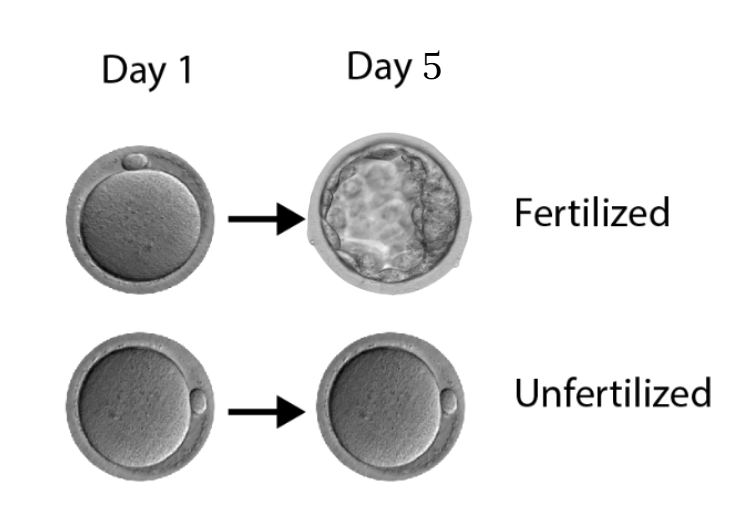
So how often are 0PN zygotes actually fertilized?
A review of studies by Capalbo et al. 2024 showed that zygotes with 0PN fertilization have a 95.1% chance of being diploid, a 3.7% chance of being haploid and a 1.2% chance of being polyploid. In other words, around 95% of 0PN zygotes (that go on to form blastocysts and are eligible for PGT-A) are fertilized normally.
How often are 1PN and 3PN zygotes actually haploid or triploid?
To answer this, PGT can be used. Remember, with PGT-A we’re usually talking about embryos being euploid, but when it comes to checking for ploidy we’re looking for diploid embryos. Review the “What is abnormal fertilization?” section in this post if you’re unclear on this.
A review of studies by Capalbo et al. 2024 evaluated how often 1PN and 3PN/4PN (polyploids) were diploid after PGT:
- 1PN zygotes were actually haploid 27.2% of the time, but 70.5% were diploid and 2.2% were polyploid.
- Polyploids with more than 2 pronuclei, 0.5% were haploid, 45.7% were diploid and 53.8% were polyploid.
In other words, 1PNs were normally fertilized and diploid 70.5% of the time, while 3PNs (and other polyploids) were normally fertilized and diploid 45.7% of the time. I don’t think this review accounted for euploidy with this analysis, so this is based on diploidy alone.
So how can a “false” 3PN show 3 pronuclei but actually be a diploid?
It’s not clear, but Capalbo et al. 2024 explain:
- Before the pronuclear membranes form, the egg’s or sperm’s chromosomes may be grouped into two clusters (when it should have been grouped into one).
- Each cluster gets its own nuclear membrane.
- Result: you see “three pronuclei,” but the total amount of DNA is still diploid.
IVF and pregnancy outcomes for 0PN, 1PN and 3PN zygotes
In terms of blastocyst formation rates, one study found that 1PNs had a lower blast formation rate compared to 2PNs (28.9% vs 67.2%) and were lower quality (Mateo et al. 2020).
Capalbo et al. 2024 summarized the results of multiple studies examining pregnancy and live birth rates for embryos transferred that were 0PN, 1PN and 3PN zygotes at fertilization. They included studies where some embryos were tested for diploidy and others were not (I’m assuming the diploid tested embryos were also euploid).
For 0PN:
- Pregnancy rate: When transferring untested 0PNs, the pregnancy rate was 43.7%; when transferring 0PNs that tested as diploid, the pregnancy rate was 42.6%.
- Live birth rate: When transferring untested 0PNs, the live birth rate was 34.4%; when transferring 0PNs that tested as diploid, the live birth rate was 35.2%.
- This was based on 6 studies and 827 0PN transfers (773 0PNs weren’t tested, 54 were tested and were diploid/euploid).
For 1PN:
- Pregnancy rate: When transferring untested 1PNs, the pregnancy rate was 31.9%; when transferring 1PNs that tested as diploid, the pregnancy rate was 41.3%.
- Live birth rate: When transferring untested 1PNs, the live birth rate was 23.8%; when transferring 1PNs that tested as diploid, the live birth rate was 34.8%.
- This was based on 13 studies and 1239 1PN transfers (1193 1PNs weren’t tested, 46 were tested and were diploid/euploid).
For 3PNs, there’s not much data:
- There’s only one study with a 3PN, which wasn’t tested and resulted in a live birth (Yalçınkaya et al. 2016).
- Two studies involved the transfer of embryos from 2.1PN zygotes, which have two normal sized pronuclei and one that’s smaller (considered a type of 3PN). For these studies, there were a total of 7 transfers, 5 pregnancies and 4 live births. They were all tested and found to be diploid/euploid.
For 4PNs, there’s even less data! There’s just one report where the 4PN tested as diploid and euploid, and led to a live birth. I reported on this study in my post First report of a healthy birth from an “abnormally fertilized” 4PN embryo.
Don’t discard abnormally fertilized 1PN and 3PN zygotes — do PGT!
When embryos show abnormal pronuclei counts like one (1PN) or three (3PN) instead of the usual two (2PN), different organizations have specific guidelines for how to handle them (Capalbo et al. 2024). ESHRE recommends checking pronuclei 16-18 hours after fertilization and advises separating 1PN or 3PN embryos from normal ones, with a strong recommendation against using or freezing 3PN embryos due to high risks of complications. This is echoed by other organizations, with some recommending that 1PNs should be also be discarded.
As shown in the previous section, 1PN and 3PN (and 4PN!!) zygotes can lead to successful pregnancies, so following these guidelines may unnecessarily lead to the discarding of viable embryos. To avoid this, Capalbo et al. 2024 suggests performing “molecular fertilization checks” with PGT on abnormally fertilized zygotes to determine if they’re truly haploid or triploid.
However, using PGT with next-generation sequencing (NGS) for this purpose can be challenging because NGS measures the ratios of chromosomes and may not be able to accurately assess 1PN or 3PN zygotes. When testing for euploidy, NGS can detect imbalances in the ratio of each of the 23 chromosomes, so it can identify an extra copy of one of these chromosomes. However, when testing for ploidy to check for haploidy or triploidy, there are entire sets of chromosomes that could be different. This means the ratios of individual chromosomes might appear normal, making the overall imbalance harder to detect.
Some versions of PGT can include SNP-based sequencing in addition to NGS, which can provide a detailed analysis of chromosome origins and ratios. This type of test is required to accurately determine if an abnormally fertilized zygote is truly haploid, triploid or diploid. This test will also tell you if the embryo is euploid.
As noted by Capalbo et al. 2024, clinics should develop policies for handling these cases, including follow-up on pregnancy and birth outcomes. By publishing this kind of data, it will help us learn more about these zygotes to ultimately provide better treatment for patients.

About Embryoman
Embryoman (Sean Lauber) is a former embryologist and the founder of Remembryo, an IVF research and fertility education website. After working in an IVF lab in the US, he returned to Canada and now focuses on making fertility research more accessible. He holds a Master’s in Immunology and launched Remembryo in 2018 to help patients and professionals make sense of IVF research. Sean shares weekly study updates on Facebook, Instagram, and Reddit regularly. He also answers questions on Reddit or in his private Facebook group.
Related posts:
 Abnormal embryo cleavage
 Meta-analysis shows 1PN embryos may lead to healthy births, especially if euploid
 Some “unfertilized” embryos may actually be fertilized, supporting earlier checks in IVF lab
 Complete Guide to Embryo Grading and Success Rates
 Day 3 or Day 5 embryo transfer?
 Predicting how many day 3 embryos make it to blastocyst
 Shipping embryos or gametes to another clinic
 AI model predicts live births from blastocyst images with highest accuracy yet