
A new study reviewed how fibroids can compromise the endometrium and prevent embryo implantation, identifying key issues such as disrupted blood flow and vascular changes, abnormal endometrial peristalsis, inflammatory responses, and changes in the microbiome.
Fibroids are benign tumors that grow in the uterus and can vary in number, size and location. Larger fibroids that distort the uterine cavity can lead to poor fertility outcomes, but even smaller fibroids can have negative effects on the endometrium and implantation.
In order for a pregnancy to occur, the embryo must implant in the uterine lining during the “window of implantation.” During this time, the endometrium undergoes cellular changes, receives immune support, and experiences blood vessel remodeling to create optimal conditions for the embryo to implant.
Below you can see a diagram of the uterus and the different types of fibroids.
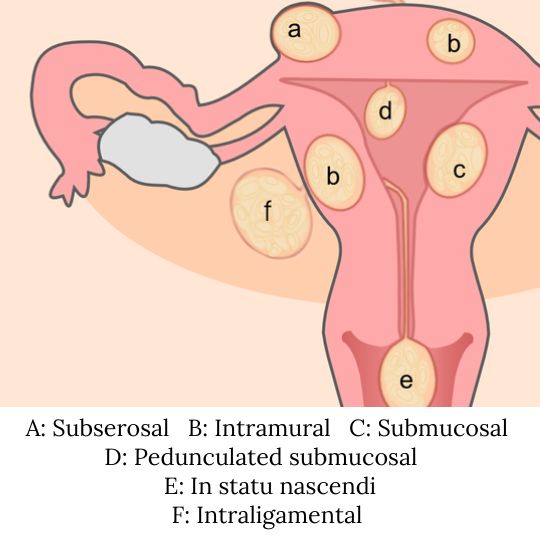
Pritts et al. 2009 found that while subserosal fibroids (A in the diagram) do not impact fertility, submucosal fibroids (C) can. Studies also show that intramural fibroids (B), including those that do not alter the uterine cavity, can affect reproductive outcomes. For more information on small intramural fibroids and fertility outcomes, check out my post Meta-analysis examines impact of small fibroids on pregnancy outcomes.
One way fibroids can compromise fertility is by disrupting the normal architecture of the uterus. Submucosal fibroids (B) protrude into the uterine cavity and potentially block embryo implantation sites. Intramural fibroids, embedded within the uterine wall, can make the uterus less flexible and distort its shape. These changes can create a physical barrier to embryo implantation and alter the uterine environment necessary for pregnancy.
🔗 Original studies are referenced in this post or within the linked Remembryo posts.
💡 Reminder: Terms underlined with a dotted black line have glossary definitions. Hover or tap to see a short definition, or select “Read full definition” in the pop-up to view the complete glossary entry. Viewing glossary entries does not count toward your paywall limit.
Sun et al. 2024 performed a review of research that investigated how fibroids can compromise the endometrium and prevent embryo implantation.
Blood flow and vascular changes:
- Fibroids can compress arteries and disrupt blood flow to the endometrium, depriving it of essential nutrients and oxygen (Donnez and Dolmans 2020). This means less oxygen and nutrients for the endometrium, which is necessary for supporting a pregnancy.
- Fibroids can also cause abnormal growth of new blood vessels that may not function properly, possibly related to abnormal expression of factors like VEGF and eNOS from the fibroid (Don et al. 2023). VEGF is a protein involved in promoting the development of blood vessels in the body.
Endometrial peristalsis:
- The uterus undergoes specific muscle contractions known as endometrial peristalsis, which are needed for helping sperm travel to meet the egg and for guiding the embryo to the right spot for implantation in the endometrium. Abnormal contractions of the uterus may cause the embryo to be expelled from the uterus after transfer (Fanchin et al. 1998).
- Yoshino et al. 2010 showed that patients with intramural fibroids who had a high frequency of peristalsis didn’t achieve a pregnancy, while those who had a low frequency of peristalsis did. Another study by Yoshino et al. 2012 showed that removal of fibroids could restore normal peristalsis, with some patients having a successful pregnancy.
- It’s not clear how fibroids could alter peristalsis, but it might be related to how hard these tissues are compared to surrounding muscle tissue, which could alter how signals are transmitted in the endometrium.
Immune and inflammatory responses:
- Endometrial immune cells play an important role in fertility and show fluctuations throughout the menstrual cycle. For more background, check out my post The role of the immune system in infertility and IVF.
- Miura et al. (2006) showed that areas of the endometrium close to fibroids have a higher density of macrophages compared to areas further away, and suggested that fibroids can trigger an inflammatory response, which might affect implantation.
- Kitaya et al. (2010) showed differences in macrophage, neutrophil, T cell and NK cell levels in the endometrium of patients with fibroids.
Changes in the microbiome:
- The human microbiome consists of trillions of microbial cells that inhabit various parts of the body, such as the vagina and endometrium. The vaginal and endometrial microbiome, mainly composed of Lactobacilli bacteria, affects reproductive health and linked to fertility-related disorders or miscarriages. For more background, check my post The impact of the vaginal and endometrial microbiome on reproductive health and IVF outcomes.
- Winters et al. (2019) and Mao et al. (2023) show that uterine fibroids are associated with changes in the microbiome of the endometrium, vagina or cervix. While there isn’t much data on the topic, it’s possible that uterine fibroids can alter the microbiome of the female reproductive tract to influence susceptibility to infections and create an inflammatory environment that complicates embryo implantation.
Molecular disruptions: As reviewed by Sun et al. (2024), fibroids affect gene expression and hormonal signaling, specifically altering key genes like HOXA10, LIF, TGF-β, BMP-2 and disrupting estrogen and progesterone balances. This can impair the ability of the endometrium to become and remain receptive.
Surgical removal of fibroids may improve outcomes, particularly for patients with submucosal fibroids (Pritts et al. 2009). Pritts et al. 2009 note that there isn’t much information on the removal of intramural fibroids, with available research at the time showing no benefit. In the most recent Cochrane review by Metwally et al. 2020, surgical removal of a variety of fibroid types showed no benefit, although this was based on limited research. More recently, one RCT found an improvement in cumulative live birth rates after removal of 2-5 cm FICO type-3 fibroids (Han et al. 2022).
Reference

About Embryoman
Embryoman (Sean Lauber) is a former embryologist and the founder of Remembryo, an IVF research and fertility education website. After working in an IVF lab in the US, he returned to Canada and now focuses on making fertility research more accessible. He holds a Master’s in Immunology and launched Remembryo in 2018 to help patients and professionals make sense of IVF research. Sean shares weekly study updates on Facebook, Instagram, and Reddit regularly. He also answers questions on Reddit or in his private Facebook group.