
Researchers in a 2025 study performed PGT-A on whole embryos, including arrested embryos and different developmental stages, finding high rates of euploidy.
PGT-A is commonly used in IVF to select embryos with the best chance of success. One of the problems with PGT-A is that it uses a single biopsy of about 5-10 cells to represent the whole embryo, which could be hundreds of cells in size. The biopsy is also exclusively from the trophectoderm, and doesn’t represent the ICM.
This post is a summary of a study by Xu et al. (2025), who performed PGT-A on whole embryos at different stages of development:
- Arrested embryos at various stages (cleavage stage, morula stage, blastocyst stage at expansion 1-2, blastocyst stage at expansion 3-5). Arrested embryos were defined as having no cellular division for at least 24 h.
- CC quality blastocysts at expansion 1-2 and expansion 3-5. Note that this quality would have made these embryos ineligible for PGT-A at this clinic.
- Higher quality blastocysts (grade 4CB/4BC or higher). Note that this quality would have made these embryos eligible for PGT-A at this clinic.
For more background on embryo development and grading, check out my Complete guide to embryo grading and success rates.
For PGT-A reporting, mosaic embryos had cutoffs between 30-70% aneuploid cells, with <30% being considered a euploid and >70% being considered aneuploid.
To be clear — this study isn’t trying to say whether or not PGT is accurate by comparing a second biopsy result to a first result like some other studies I’ve covered. This study is just taking the whole embryo and bulk testing all the cells. If the results showed <30% aneuploid cells in this bulk testing, then they called it euploid.
🔗 Original studies are referenced in this post or within the linked Remembryo posts.
💡 Reminder: Terms underlined with a dotted black line are linked to glossary entries. Clicking these does not count toward your paywall limit.
PGT-A of whole arrested embryos
First, let’s look at the PGT-A results for whole embryos that had arrested at different stages.
Note that “chaotic” isn’t defined in the traditional way here (normally it’s more than 6 abnormalities).

Some interesting results here!
- Some arrested embryos were actually euploid! This shows that having the right number/structure of chromosomes isn’t everything. Embryos can arrest due to a variety of reasons, for example due to metabolic issues or errors in specific genes (reviewed in my Embryo Arrest post).
- Generally, arrested embryos had a high proportion of chromosomal abnormalities (either mosaic or fully aneuploid), with a higher rate of chaotic abnormalities. The exception here was with more developed blastocysts that had a euploidy rate of 50%! However, the sample size for this group was quite small.
PGT-A of whole CC or higher quality blastocysts
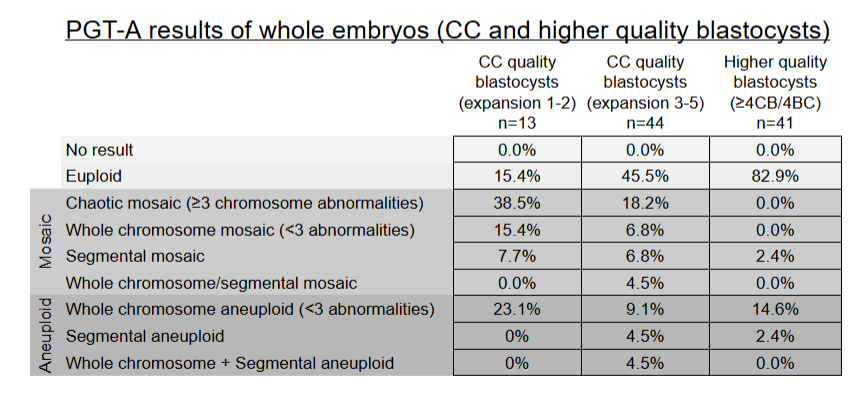
Some interesting results here, too!
- 82.9% of higher quality blastocysts (with grades 4CB/4BC or higher) were euploid. This is a pretty remarkable euploid rate! This specific group of embryos came from patients with an average maternal age of 30.9, which helps explain it a bit.
- The CC quality blastocysts had between a 15.4% – 45.5% euploidy rate, which is also quite high. Importantly, some centers discard embryos like this or won’t biopsy them (potentially over fear of damaging the embryo, since a C-graded trophectoderm has fewer cells). These embryos came from two groups of patients, one with an average age of 30.9 and the other 33.3.
Of the 41 higher quality blastocysts:
- There were 19 that didn’t have a C grade at all and were graded as AA/AB/BA/BB, with 17 that were euploid (89.5%).
- The other 22 had a C graded ICM or trophectoderm as CB/BC, with 17 that were euploid (77.2%).
- There were no statistically significant differences in euploid rates between these groups. This is interesting because it suggests that grade doesn’t influence euploid rates, although this is disputed by other studies (one example is from this post that I reviewed). The sample size is small here also.
They also found that CC quality embryos were more likely to be euploid as they developed, based on a total of 80 CC quality blastocysts:
- 28 of them were early blasts, with 2 that were euploid (2/26 = 7.7%).
- 26 of them were expansion 3 (3CC), with 11 that were euploid (11/26 = 42.3%).
- 28 of them were expansion 4 or 5 (4CC or 5CC), with 14 that were euploid (14/28 = 50%).
Conclusions
This study found that arrested embryos can have a high rate of chaotic abnormalities depending on the stage of development, particularly in cleavage stage embryos. Some arrested embryos were euploid, with higher rates of euploidy in more advanced blastocysts.
A recent study (reviewed in this post) showed that embryos with a higher number of chromosomal errors were more likely to arrest, which agrees with the results here.
They also found that over 80% of blastocysts were euploid, many of which had a C-graded ICM or trophectoderm. Even CC graded embryos, with both a C-graded ICM and trophectoderm, had high euploid rates depending on their developmental stage!
This study looked at PGT-A of whole embryos, rather than just a tiny biopsy, showing high euploid rates (a study I reviewed here shows that 26.1% of expanding/hatching poor quality embryos are euploid/low-level mosaic), even when considering that most patients here were <35 (with an expected euploid rate of about 57% after a conventional biopsy for PGT-A, based on a study I reviewed here).
The high euploid rates show that many embryos have <30% aneuploid cells (the cutoff for euploid in this study). With the higher number of cells involved, aneuploid cells might be diluted by the euploid cells. Also, these euploid cells might be more concentrated in the ICM, which aren’t sampled through traditional PGT. Previous research (that I reviewed in this post) shows that aneuploid cells have a tendency to accumulate in the trophectoderm or die. It’s important to note, though, that this study’s small sample size means larger studies might give different results.
Another study, by Ou et al. (2020), shows that initial biopsy results match the whole embryo results about 2/3rds of the time. Additionally, studies reviewed in my post Does a PGT-A biopsy match the rest of the embryo? — which include whole embryo PGT and repeat biopsies — show that a first biopsy mostly matches other parts of the embryo, but not when the initial result is mosaic. Since mosaics contain a mix of euploid and aneuploid cells, it’s not too surprising that random sampling of a mosaic embryo can give different results.
In reality, most embryos are likely mosaic to some degree. Studies (reviewed here and here) have shown that when single cells are used for PGT instead of whole embryos or whole biopsies, most embryos have some % of aneuploid cells and are mosaic. This detailed, cell-by-cell analysis allows researchers to detect even minor levels of aneuploidy that might be missed in most analyses, which typically apply a 30-70% cutoff for mosaicism.
Still, it’s really interesting that so many embryos in this study had <30% aneuploid cells. Even poorly graded ones! Larger studies are needed to confirm this, particularly with some attention to female age (most patients in this study were younger).
Of course, whole embryo PGT-A can’t be performed because it destroys the embryo, but it’s interesting to see what all the cells of the embryo have to show, and not just a tiny part of the trophectoderm!
You might want to read more about why embryos fail to implant or miscarry, given that more embryos might be euploid than expected!
Reference

About Embryoman
Embryoman (Sean Lauber) is a former embryologist and the founder of Remembryo, an IVF research and fertility education website. After working in an IVF lab in the US, he returned to Canada and now focuses on making fertility research more accessible. He holds a Master’s in Immunology and launched Remembryo in 2018 to help patients and professionals make sense of IVF research. Sean shares weekly study updates on Facebook, Instagram, and Reddit regularly. He also answers questions on Reddit or in his private Facebook group.
Related posts:
 Trophectoderm and ICM biopsies match depending on the abnormality
 Does a PGT-A biopsy match the rest of the embryo?
 Complete guide to PGT-A (PGS testing)
 Can a mosaic embryo result in a normal baby?
 Mosaicism much more common than previously thought, using more sensitive PGT-A technique
 ASRM’s 2024 committee opinion on the use of PGT-A
 More sensitive PGT-A test shows that nearly all blastocysts, fetal tissues are mosaic
 A third of mosaics retest as aneuploid with different PGT-A test