
A new study of over 227,000 IVF couples found that chromosomal abnormalities were uncommon overall but more frequent with recurrent miscarriage, poor sperm quality, and younger age.
When IVF fails or pregnancies keep ending in miscarriage, one possible cause is a chromosomal abnormality in one of the parents. These abnormalities often don’t affect the person’s health but can disrupt embryo development or lead to infertility or miscarriage.
Because of this, many clinics offer karyotype testing before IVF. This test looks for larger chromosome changes, like translocations, inversions, or sex chromosome abnormalities.
In a study by Yuan et al. (2026), researchers analyzed karyotype data from over 227,000 couples seeking IVF to see how common chromosomal abnormalities are and whether factors like reproductive history, sex, age, and sperm quality show differences.
All couples had standard karyotyping before beginning IVF, and included those with primary infertility, secondary infertility, or with a history of miscarriage or fetal chromosomal abnormalities.
🔗 Original studies are referenced in this post or within the linked Remembryo posts.
💡 Reminder: Terms underlined with a dotted black line are linked to glossary entries. Clicking these does not count toward your paywall limit.
What karyotyping found in this study
Karyotyping is a test that looks at the number and structure of chromosomes in a person’s cells.
Most abnormalities in this study were structural, meaning the chromosomes were present but rearranged.
The most common types were:
- Reciprocal translocations (most common): pieces of two chromosomes swap places
- Robertsonian translocations: two chromosomes fuse together
- Inversions: a section of a chromosome is flipped
Many of these changes can be balanced, meaning no genetic material is gained or lost, so the person may not have symptoms. However, they can still affect fertility or increase the risk of miscarriage.
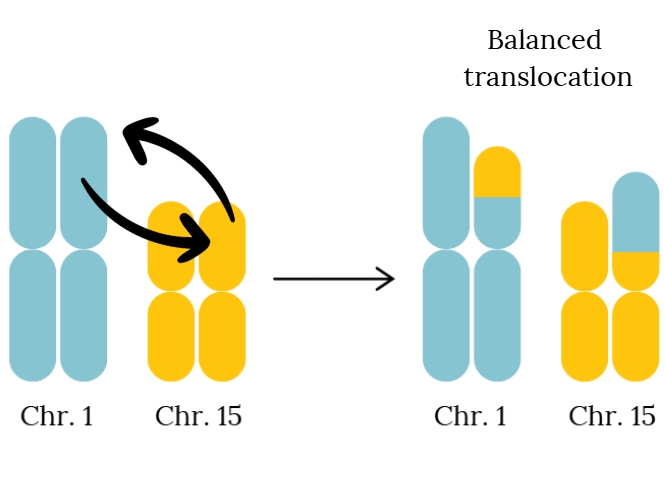
For more background and to understand how balanced translocation can lead to fertility problems, check out the glossary term for translocation.
Some numerical abnormalities were also found, where there are extra or missing chromosomes, such as:
- Klinefelter syndrome (47,XXY) in men
- Turner syndrome (45,X) in women
Chromosomal abnormalities were uncommon but varied by age, sex, reproductive history
Across the 227,818 couples, chromosomal abnormalities were found in 3.42%. The authors note that this is higher than the 0.5-0.8% reported in the general population.
In other words, about 1 in 30 couples had a detectable abnormality on karyotype, which may help explain infertility or pregnancy loss in some cases.
Reproductive history
Chromosomal abnormalities were more common in couples with a history of miscarriage or fetal chromosomal abnormalities.
- History of miscarriage or fetal chromosomal abnormalities: 4.83%
- Primary infertility: 3.54%
- Secondary infertility: 2.18%
Age
Chromosomal abnormalities were more common in younger patients and decreased with age:
- <25 years: 2.36%
- 25 to <30: 1.99%
- 30 to <35: 1.69%
- ≥35: 1.29%
This is likely because younger patients with reproductive issues are more likely to have an underlying chromosomal cause, whereas in older patients, other factors (like egg quality) play a larger role. Note that this is different from PGT-A, which looks at the embryo’s DNA. Embryo chromosomal abnormalities increase with maternal age due to egg quality.
Sperm quality
Rates of chromosomal abnormalities increased as sperm quality worsened:
- Normal semen: 0.89%
- Low motility (asthenozoospermia): 1.68%
- Low count (oligozoospermia): 2.65%
- Very low count (severe oligozoospermia): 6.99%
- No sperm (azoospermia): 12.54%
This pattern was seen across all groups:
- Primary infertility: between 0.67% (normal) to 12.55% (azoospermia)
- Secondary infertility: between 1.01% to 5.60% (severe oligozoospermia)
- History of miscarriage or fetal chromosomal abnormalities: 1.73% to 7.63% (severe oligozoospermia)
There were no men with azoospermia in the secondary infertility or miscarriage/chromosomal abnormality groups.
Overall, this shows that the more severe the sperm issue, the more likely a chromosomal abnormality is present.
Number of prior outcomes
Among couples with a history of miscarriage or fetal chromosomal abnormalities, the risk increased with more events:
- 1 event: 3.07%
- 2 events: 6.32%
- 3 or more events: 9.38%
This stepwise increase suggests that repeated pregnancy loss or fetal chromosomal abnormalities may be linked to an underlying chromosomal issue.
Female infertility diagnoses
Among women with specific infertility diagnoses, chromosomal abnormalities were relatively uncommon overall (0.92%) and didn’t vary much by condition:
- Tubal obstruction: 0.99%
- PCOS: 0.80%
- Pelvic inflammatory disease: 0.72%
- Uterine malformations: 0.87%
This suggests that these conditions are less likely to involve chromosomal abnormalities.
Conclusion
Overall, this study found that chromosomal abnormalities were in 3.42% of couples, which is higher than the ~0.5–0.8% in the general population as reported by other studies.
Rates were highest in couples with a history of miscarriage or fetal chromosomal abnormalities and increased as the number of events increased. In these cases, karyotyping and options like PGT-SR may help identify the issue and reduce the risk of future losses.
Rates were also higher in men with more severe sperm problems, suggesting karyotyping may be helpful in cases of very low sperm count or no sperm.
Abnormalities were more common in younger patients, suggesting genetic causes may play a larger role at younger ages, while infertility at older ages is more often related to egg quality. For younger couples with unexplained infertility, karyotyping may provide useful answers.
Based on these results, the authors suggest considering karyotyping in patients with recurrent pregnancy loss, severe sperm issues, unexplained infertility at a younger age, or a family history of chromosomal abnormalities. For those with a balanced translocation, PGT-SR can help identify embryos with a higher chance of leading to a successful pregnancy.
Limitations: This study only included couples seeking IVF, so the results may not apply to everyone, and karyotyping only detects larger chromosome changes, not smaller genetic problems.
Want to read more about genetics and infertility or miscarriage?
A 2025 study introduces the term “oocyte and early embryo competence defects” to describe younger IVF patients who repeatedly have no transferable embryos due to low quality eggs, finding that about 13–23% had genetic changes. Read more.
A 2025 study of women with repeated IVF failure and unexplained infertility found that about 13% had mutations affecting egg or embryo development, mostly in the TUBB8 and PATL2 genes, suggesting that many “unexplained” cases may have underlying genetic causes. Read more.
Even when embryos are euploid and pass PGT-A, miscarriage can still happen. A new 2025 study suggests that genetic mutations too small to be seen by standard PGT-A may explain some of these losses. Read more.

A 2024 study investigated the genetics of over 3,200 miscarriages, finding that two-thirds were associated with a chromosomal abnormality, with trisomy 16 and the 8p23.1 deletion as the most common abnormalities. Read more.
Reference

About Embryoman
Embryoman (Sean Lauber) is a former embryologist and the founder of Remembryo, an IVF research and fertility education website. After working in an IVF lab in the US, he returned to Canada and now focuses on making fertility research more accessible. He holds a Master’s in Immunology and launched Remembryo in 2018 to help patients and professionals make sense of IVF research. Sean shares weekly study updates on Facebook, Instagram, and Reddit regularly. He also answers questions on Reddit or in his private Facebook group.