
Even when embryos are euploid and pass PGT-A, miscarriage can still happen. A new 2025 study suggests that genetic mutations too small to be seen by standard PGT-A may explain some of these losses.
Aneuploidy, which refers to abnormalities in the number or structure of chromosomes, is the leading known cause of miscarriage and the reason why PGT-A exists.
But even euploid embryos, with the correct number and structure of chromosomes, can still miscarry. It’s not well understood how often this is due to smaller genetic mutations that PGT-A can’t typically detect.
In a study by Arnadottir et al. (2025), researchers sequenced the entire genome of 467 miscarried fetuses, most from the first trimester, along with both parents’ genomes to look for any underlying genetic causes. Of these, 141 fetuses (49.9%) were euploid.
🔗 Original studies are referenced in this post or within the linked Remembryo posts.
💡 Reminder: Terms underlined with a dotted black line are linked to glossary entries. Clicking these does not count toward your paywall limit.
Genetic causes linked to 55% of pregnancy losses
Of the 467 pregnancy losses studied, the researchers were able to identify a probable genetic cause in about 55% of cases. These included:
- 44.1% aneuploidies – involving abnormal chromosome numbers (e.g., monosomy X, trisomy 16), the most common known cause of miscarriage. More on this below.
- 6.4% triploidies – where the fetus had three full sets of chromosomes (69 total) instead of the usual two sets (46). This is usually due to two sperm fertilizing one egg or an egg with two sets of chromosomes being fertilized by a normal sperm. Triploidy is incompatible with life and typically results in very early pregnancy loss.
- 3.3% small sequence variants (SSVs) – these were small harmful mutations in specific genes, many of which arose spontaneously (de novo) rather than being inherited. One such gene was FBLN1 (fibulin-1), which encodes a structural protein involved in blood vessel formation and may play a role in placental development. Another was HECTD1, a gene important for embryonic development and neurodevelopmental processes. These SSVs were about three times more common in miscarried euploid fetuses than in healthy adult genomes, suggesting that most were likely the cause of the loss. The authors estimated that these mutations account for about 6% of euploid miscarriages, or roughly 1 in every 136 pregnancies overall.
- 1.3% copy number variants (CNVs) – large deletions or duplications of DNA segments that can span multiple genes. Some of these CNVs were inherited, while others occurred spontaneously, and they can disrupt essential developmental pathways.
This study identified multiple genes that may have contributed to pregnancy loss, highlighting the role of small genetic mutations that fall below the resolution of standard PGT-A. Although the fetuses were euploid (with the correct number of chromosomes), some carried harmful mutations in genes critical for fetal development.
These mutations could be inherited or de novo (spontaneous, not inherited from either parent).
In one case, the researchers found a euploid fetus with two different harmful mutations in the CPLANE1 gene — one from each parent. A similar finding was seen with the DHCR7 gene. In both cases, the parents were silent carriers, each passing down one faulty copy. When this happens, there’s a 25% chance that a future embryo will inherit both faulty copies. This means that these two couples have about a 1 in 4 chance of creating an embryo with a high risk of pregnancy loss due to that condition. And this embryo could potentially be euploid!
Aneuploidy was still the major cause of pregnancy losses
As expected, they found that most of the pregnancy losses involved chromosomal aneuploidies (44.1%), with monosomy X and trisomy 16 the most frequent (9.90% and 9.20%). You can see the frequency of each chromosomal aneuploidy below.
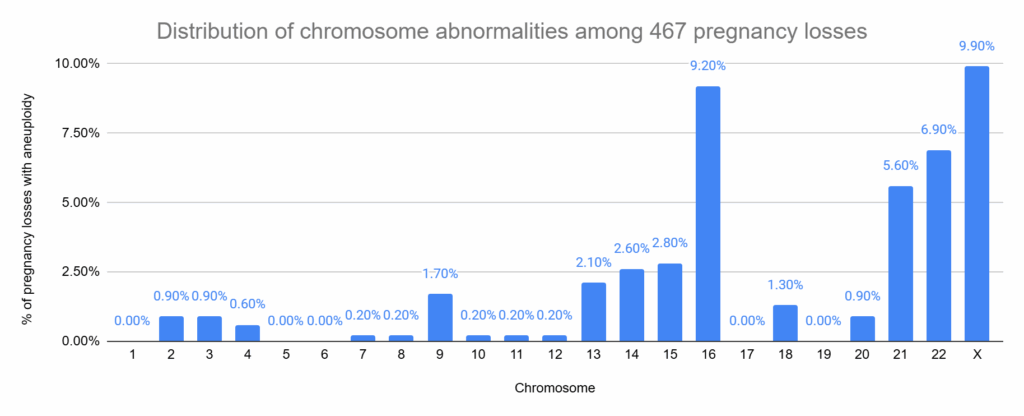
Because they also did genome sequencing on the parents, they were able to show that these abnormalities mostly came from the egg, with the exception of X (about 80% of X aneuploidies were due to the sperm). Chromosome 21 and 22 also showed some paternal inheritance (about 3-4%), as well as chromosome 15 (15.3%).
Conclusions
This study identified a genetic cause for miscarriage in 55% of cases. About 44% were due to large chromosomal abnormalities like monosomy X or trisomy 16, and about 6% due to triploidy. An additional 5% involved smaller genetic changes, including single-gene mutations and structural deletions or duplications, which may not be detected by standard PGT-A.
PGT-A is effective at detecting large chromosomal abnormalities, which accounted for 44.1% of pregnancy losses in this study, as well as triploidies depending on the testing platform. While it is not designed to detect small mutations in individual genes (this is for PGT-M), PGT-A can sometimes identify large deletions or duplications that make up the copy number variant (CNV) category. These may appear as segmental aneuploidies. Smaller or more targeted structural rearrangements may require PGT-SR for reliable detection.
The authors estimate that around 6% of euploid miscarriages are due to small mutations, or about 1 in every 136 pregnancies.
This study shows that small genetic changes can cause pregnancy loss, especially in euploid cases. But it doesn’t mean every unexplained miscarriage is due to a harmful mutation. Most of the identified mutations were rare, and only a minority of cases had a clear-cut genetic cause.
While these findings are important, they are difficult to translate into clinical practice. Many of these small mutations can’t be predicted because they arise spontaneously (de novo) and can’t be prevented. Even with PGT-M, you need to know which gene to test for, so it’s not practical for routine use. Sequencing the entire genome of an embryo could identify these mutations, but this approach raises ethical, financial, and clinical challenges.
Furthermore, nearly half of the pregnancy losses in the study (45%) still had no identifiable genetic cause!
More research is needed to better understand these unexplained cases and to develop more accessible and practical ways to detect smaller genetic changes that may contribute to miscarriage. That said, for couples with unexplained recurrent loss, especially when PGT-A results have been normal, it may be worth discussing the possibility of exome or genome testing with a genetics counselor.
For more reading on this topic, here’s an additional post you might want to check out on Remembryo:
- Study performs genetic analysis on over 3,200 miscarriages. A 2024 study investigated the genetics of over 3,200 miscarriages, finding that two-thirds were associated with a chromosomal abnormality, with trisomy 16 and the 8p23.1 deletion as the most common abnormalities.
lated studies
These additional studies were referenced by the authors of the paper and haven’t been covered on Remembryo. They may be helpful if you’re exploring this topic further. This section is available for paid subscribers.

Reference

About Embryoman
Embryoman (Sean Lauber) is a former embryologist and the founder of Remembryo, an IVF research and fertility education website. After working in an IVF lab in the US, he returned to Canada and now focuses on making fertility research more accessible. He holds a Master’s in Immunology and launched Remembryo in 2018 to help patients and professionals make sense of IVF research. Sean shares weekly study updates on Facebook, Instagram, and Reddit regularly. He also answers questions on Reddit or in his private Facebook group.