
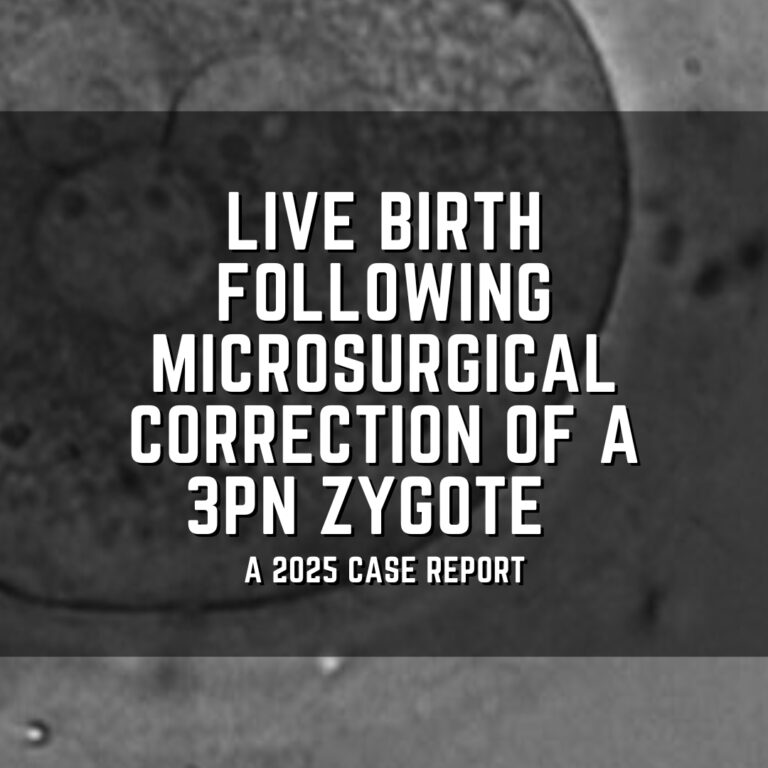
A 2025 case report shows that some ICSI-derived 3PN embryos can be rescued by removing the extra female pronucleus, resulting in a healthy live birth, but the technique remains experimental.
Fertilization is typically confirmed about 16-18 hours after insemination when two pronuclei (2PN) appear in the fertilized egg (zygote): one from the egg and one from the sperm. These structures contain the DNA from the egg and sperm, which join to form the DNA of the embryo.


After conventional IVF, abnormal 3PN zygotes can form by two sperm entering the egg, and in ICSI they can form when the oocyte fails to complete meiosis correctly. This can form 3 sets of chromosomes (triploid) instead of the usual 2 sets (diploid), which can lead to pregnancy losses, so these embryos are often discarded.
Studies (reviewed in my post here) have shown that roughly half of 3PN zygotes are true triploids or polyploids (“true” 3PNs), while the other half are actually diploid (“false” 3PNs). False 3PNs can form when DNA from the egg or sperm fragments or splits into two clusters, creating an extra pronucleus that makes the zygote look 3PN even though it’s actually diploid.
A new case report by Xu et al. (2025) wanted to investigate if it’s possible to rescue true 3PN zygotes by removing one of the pronuclei.
🔗 Original studies are referenced in this post or within the linked Remembryo posts.
💡 Reminder: Terms underlined with a dotted black line are linked to glossary entries. Clicking these does not count toward your paywall limit.
In this case report, a 33-year-old patient with a history of five early miscarriages had ICSI, with seven 3PNs formed, most of which had only a single polar body (suggesting that the zygotes were true 3PNs with 3 sets of chromosomes — explained below).
For the 3PNs, the embryology team offered an experimental approach: microsurgical removal of one of the extra maternal pronuclei (enucleation). They did this by first identifying the maternal pronucleus then used a needle to penetrate the egg and aspirate the pronucleus to remove it (similar to the needle used to perform ICSI).
You can watch a video of the procedure here. For any embryologists reading who want details on the procedure, read the full article (open source).
Six 3PN zygotes underwent this procedure, with all six enucleated zygotes surviving. Four cleaved, three reached usable day 3 embryos, and two formed blastocysts (4AB and 4BB). After non-invasive PGT-A, the 4AB was found to be euploid and was transferred to the patient, resulting in a viable pregnancy and delivery of a healthy boy at 35 weeks. At 9 months, the child showed no developmental concerns.
Why only use this technique on 3PNs with one polar body after ICSI?
The researchers only did the enucleation procedure on 3PNs that had a single polar body after ICSI, which they interpreted as true 3PNs caused by a maternal meiosis error and therefore potential candidates for rescue. Because these zygotes were created by ICSI rather than conventional IVF, the extra pronucleus was unlikely to be from a second sperm. Here’s why that distinction matters (for more background, you can read about egg development and meiosis here).
- Meiosis is how eggs reduce their chromosome number from two sets to one, so its DNA can properly combine with sperm DNA.
- It discards its extra chromosomes in two polar bodies: the first polar body forms when the egg is mature, while the second polar body forms after sperm enters the egg.
- If the second polar body isn’t released, the egg’s DNA isn’t properly reduced and it stays inside the egg. When pronuclei form, the unreduced maternal DNA can split into two female pronuclei, creating a true 3PN zygote with an extra maternal PN.
- This type of 3PN, with a single polar body, can be rescued by removing the extra maternal PN to reduce the egg’s DNA to the proper amount.
What about 3PNs with two polar bodies after ICSI? These are usually not true 3PNs and are ineligible for enucleation:
- If a 3PN has two polar bodies this means that the egg completed meiosis, and the extra pronucleus is not from unreleased maternal DNA.
- After ICSI, where only one sperm is injected, a “3PN + 2 polar body” pattern is likely due to egg or sperm DNA forming two clusters, and doesn’t represent a real extra chromosome set. These 3PNs are likely false and actually diploid, which can be checked by PGT-A.
Bottom line: Only 3PNs with a single polar body, made via ICSI, can be rescued using the enucleation technique.
This technique applies to zygotes created by ICSI, where a single sperm is injected. After conventional IVF, a “3PN + 2 polar body” pattern often means two sperm fertilized the egg, bringing two sets of paternal chromosomes and two sets of sperm centrioles. Because the centrioles help form the spindle for chromosome separation, they would also need to be removed to fully rescue these zygotes. This is more complex than the current case but was successfully done in a 2003 case report.
Conclusions
This case is the first documented instance of a corrected ICSI-derived 3PN embryo developing into a healthy child. It shows that some true 3PN zygotes caused by maternal meiosis errors may be rescued rather than automatically discarded.
A similar report was published in 2003, but that case involved a paternal-origin 3PN from conventional IVF (two sperm entered the egg). The new study is the first to report a live birth after correcting an ICSI-derived 3PN caused by a maternal meiosis error.
But these are still isolated cases, and we don’t know how safe this approach truly is. There’s no long-term follow-up data available, so any developmental risks related to pronucleus removal remain unknown.
For now, the authors highlight that this microsurgical approach should be viewed strictly as an experimental rescue strategy, reserved for rare situations where oocytes are extremely limited, such as when nearly all zygotes are true 3PNs and the patient would otherwise have no embryo to transfer.
Want to read more about 3PNs and abnormal fertilization?
This post covers what occurs during normal fertilization and what it means to have an abnormally fertilized zygote (0PN, 1PN, 3PN, 4PN). Using PGT to test these embryos reveals that many have the correct number of chromosome sets and can lead to successful live births. Read more.
A 2025 meta-analysis found that while 1PN zygotes don’t convert to blastocyst as well and have lower success rates when untested, those confirmed as euploid can lead to healthy births, but extra care is needed to confirm they are truly normal. Read more.
A 2025 study found that 0PN zygotes can actually be normally fertilized but missed during the standard 16–18 hour fertilization check, while those that never form pronuclei are likely unfertilized eggs, supporting a slightly earlier check around 16–17 hours and continued culture of 0PNs to the blastocyst stage for confirmation of fertilization. Read more.
Related studies
These additional studies were referenced by the authors of the paper and haven’t been covered on Remembryo. They may be helpful if you’re exploring this topic further. This section is available for paid subscribers.

Reference

About Embryoman
Embryoman (Sean Lauber) is a former embryologist and the founder of Remembryo, an IVF research and fertility education website. After working in an IVF lab in the US, he returned to Canada and now focuses on making fertility research more accessible. He holds a Master’s in Immunology and launched Remembryo in 2018 to help patients and professionals make sense of IVF research. Sean shares weekly study updates on Facebook, Instagram, and Reddit regularly. He also answers questions on Reddit or in his private Facebook group.
Related posts:
 Abnormal fertilization and the potential of 0PN, 1PN and 3PN zygotes
 Aneuploidy is a key factor in embryo arrest
 Meta-analysis shows 1PN embryos may lead to healthy births, especially if euploid
 Scientists identify genes linked to unexplained infertility and repeated IVF failure
 Some “unfertilized” embryos may actually be fertilized, supporting earlier checks in IVF lab
 Day 3 or Day 5 embryo transfer?
 Chromosomal errors in IVF: What is aneuploidy and what causes it?
 Early research suggests SGO1 may reduce chromosome separation errors in older eggs