
A 2025 study found that 0PN zygotes can actually be normally fertilized but missed during the standard 16–18 hour fertilization check, while those that never form pronuclei are likely unfertilized eggs, supporting a slightly earlier check around 16–17 hours and continued culture of 0PNs to the blastocyst stage for confirmation of fertilization.
In IVF, fertilization is typically confirmed the day after insemination when two pronuclei (2PN) appear in the fertilized egg (zygote): one from the egg and one from the sperm. These structures contain the DNA from the egg and sperm, which join to form the DNA of the embryo.


Pronuclei form at a specific time, typically around 16-18 h after insemination, and then unite before fading and cell division begins. Embryologists will often do their fertilization check around this time and note which zygotes are normally fertilized (2PN) or abnormally fertilized with 1PN, 3PN or even 0PN.
These 0PN zygotes can still divide and reach the blastocyst stage, but it’s not clear if these embryos never formed pronuclei or if the embryologist just missed them.
A study by Coticchio et al. (2025) used time-lapse imaging to investigate whether 0PN embryos ever form pronuclei outside the standard 16-18 h observation window, or whether some embryos really go on to form blastocysts without pronuclear formation.
🔗 Original studies are referenced in this post or within the linked Remembryo posts.
💡 Reminder: Terms underlined with a dotted black line are linked to glossary entries. Clicking these does not count toward your paywall limit.
Study details
- Study type: Retrospective study that took place between 2013–2020 at a single center in Italy.
- Technology: EmbryoScope™ incubator with AI-assisted annotation (CHLOE™, Fairtility)
- Sample size: 6035 ICSI oocytes analyzed by time-lapse:
It’s important to highlight that this study only compared 2PN and 0PN zygotes and excluded 1PN or 3PN zygotes. Because of that, the % of 0PNs will appear higher in this dataset because 1PN/3PNs are excluded. In other words, this study doesn’t give an accurate view on how often 0PNs happen in a typical IVF cycle.
True 0PN embryos arrested and did not form blastocysts
Among the 755 true 0PN zygotes, which never showed any pronuclei forming during development, they found that 474 didn’t go on to divide at all, while the remaining 281 did:
- 186 (25%) underwent one division to form around 2 cells
- 92 (12%) had a second division to form around 4 cells
- and 3 (4%) had a third division to form around 8 cells
None of them went on past a third division, meaning all of the true 0PN zygotes either didn’t divide or arrested before reaching the blastocyst stage.
These true 0PNs likely represent unfertilized eggs, some of which didn’t divide and some that may have divided due to spontaneous activation without sperm, a process known as parthenogenesis. This can occasionally occur after egg manipulation during procedures like ICSI, but these activated eggs typically arrest after a few cell divisions and do not develop into blastocysts.
False 0PN zygotes can develop normally
The researchers examined how many 2PN zygotes would be visible during the standard fertilization check at 16 to 18 hours after ICSI and how many would fall outside that window and be missed. Those missed would appear as “false” 0PNs, meaning zygotes that actually form two pronuclei but either too early or too late to be seen during a routine fertilization check at 16-18 h. They found three timing patterns:
- Group 1 (~97%) — Pronuclei appeared before 16 hours and remained visible past 20 hours. These would be correctly identified as 2PN during a routine check (ie. none are false 0PN).
- Group 2 (~1.6%) — Pronuclei appeared or faded slightly outside the 16–18 hour window, such as a brief or delayed appearance. These might occasionally be misclassified as 0PN (ie. some are false 0PN).
- Group 3 (~1.5%) — Pronuclei formed after 18 hours or faded before 16 hours, meaning they would not be visible at all during the standard check. These would be missed and labeled as 0PN (ie. all are false 0PN).
This means that about 3.1% of 2PNs may be mislabelled as 0PN if a clinic performs a single fertilization check at 16-18 h. They compared the blastocyst formation rates and euploid rates for these groups:
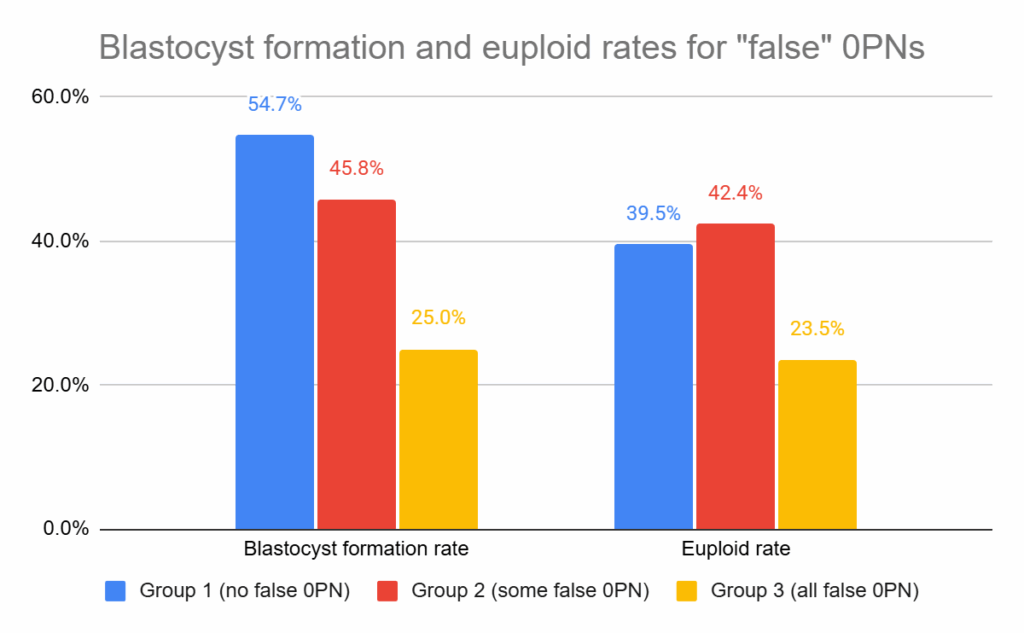
This shows that false 0PNs had lower blastocyst and euploidy rates compared with embryos seen as 2PN during the standard check. For simplicity, the figure above combines the different pronuclear appearance and fading timings into three categories, but there were statistically significant differences between some of the individual timings.
After adjusting for age and other factors:
- Embryos where the pronuclei appeared late (after 18 hours) were much less likely to form a blastocyst (adjusted odds ratio [95% CI] 0.25 [0.13–0.50], p < 0.001).
- Embryos where the pronuclei faded between 18 and 20 hours were more likely to become blastocysts and be euploid (aOR [95% CI]: 1.64 [1.30–2.08], p < 0.001; 1.51 [1.13–2.01], p = 0.005).
Overall, this means that false 0PNs can still be normal, but zygotes with pronuclei that appear too late or fade too early have lower chances of forming healthy blastocysts. The best results came from embryos where pronuclei were visible around the time of the standard check and faded between 18 and 20 hours, suggesting that the 16-18 h check is a reliable window for assessing fertilization.
Conclusions
This study found that embryos labelled as 0PNs can actually represent normally fertilized 2PNs where the pronuclei appeared or faded outside the usual 16–18 hour fertilization check.
The “true” 0PNs that never formed pronuclei were likely unfertilized eggs that may have divided briefly but arrested (potential parthenogenesis). Some missed, or “false,” 0PNs can still form healthy blastocysts, though embryos with pronuclei that appear too late or fade too early are less likely to form blastocysts and be euploid.
The best outcomes were seen when pronuclei were visible around the normal fertilization check and faded between 18 and 20 hours.
Based on this, the authors caution that the standard 16–18 hour fertilization check may miss embryos with early or late pronuclei and recommended shifting the single observation to around 16–17 hours post-insemination, as suggested in a recent consensus (reviewed in this post). They also emphasize checking for the presence of a second polar body as an additional sign of fertilization.
The authors suggest that oocytes appearing as 0PN after a single fertilization check can be cultured to the blastocyst stage, since those that truly lack fertilization arrest early, and any that reach the blastocyst stage can be considered genuinely fertilized. The authors recommend PGT-A to confirm diploidy. For more on abnormal fertilization patterns and the use of PGT-A, see my related post on Abnormal fertilization and the potential of 0PN, 1PN and 3PN zygotes.
Limitations: This was a single-center, ICSI-only study, with no assessment of conventional IVF fertilization timing. It’s also possible that in some 0PNs, pronuclei formed only briefly or outside the camera’s focus and were not detected.
Want to read more about 0PNs or abnormally fertilized zygotes?
This post covers what occurs during normal fertilization and what it means to have an abnormally fertilized zygote (0PN, 1PN, 3PN, 4PN). Using PGT to test these embryos reveals that many have the correct number of chromosome sets and can lead to successful live births. Read more.
A 2025 meta-analysis found that while 1PN zygotes don’t convert to blastocyst as well and have lower success rates when untested, those confirmed as euploid can lead to healthy births, but extra care is needed to confirm they are truly normal. Read more.
A 2025 study of women with repeated IVF failure and unexplained infertility found that about 13% had mutations affecting egg or embryo development, mostly in the TUBB8 and PATL2 genes, suggesting that many “unexplained” cases may have underlying genetic causes. Read more.

This post summarizes the 2025 ESHRE/ALPHA Istanbul consensus on egg and embryo assessment, offering patients a clear overview of how embryologists evaluate and rank eggs, zygotes, and embryos based on updated international guidelines. Read more.
Reference

About Embryoman
Embryoman (Sean Lauber) is a former embryologist and the founder of Remembryo, an IVF research and fertility education website. After working in an IVF lab in the US, he returned to Canada and now focuses on making fertility research more accessible. He holds a Master’s in Immunology and launched Remembryo in 2018 to help patients and professionals make sense of IVF research. Sean shares weekly study updates on Facebook, Instagram, and Reddit regularly. He also answers questions on Reddit or in his private Facebook group.
Related posts:
 Abnormal fertilization and the potential of 0PN, 1PN and 3PN zygotes
 Meta-analysis shows 1PN embryos may lead to healthy births, especially if euploid
 Abnormal embryo cleavage
 Scientists identify genes linked to unexplained infertility and repeated IVF failure
 Day 3 or Day 5 embryo transfer?
 Sperm DNA fragmentation associated with lower embryo quality and implantation
 Blastocyst and pregnancy rates of day 3 embryos based on cell number, fragmentation
 Day 3 quality of a blastocyst is not linked to its chance of live birth