
A 2024 study compared cumulative live birth rates for patients aged 40 to 48, finding that increasing age led to decreasing chances of birth.
Live birth rates after an embryo transfer decrease with age, but there isn’t much data for women 40 and above.
This post is a summary of a study by Nukaga et al. (2024), who measured the cumulative live birth rate in women 40 and above who had up to 10 embryo transfers (average of about 4 retrievals).
🔗 Original studies are referenced in this post or within the linked Remembryo posts.
💡 Reminder: Terms underlined with a dotted black line are linked to glossary entries. Clicking these does not count toward your paywall limit.
Study details
This section covers key details of how the study was performed, including patient characteristics, how they were treated, and other methods used. For those who aren’t interested in these details, and just want to see the results, you can go ahead and skip this part.
- This was a retrospective study that took place between 2010 and 2017 in Japan.
- Exclusions: No fresh transfers, no slow freezing, no donor gametes, no PGT-A, no frozen eggs.
- Patients were 40-48 years old when they had their first egg retrieval, and were followed up for 2 years while they had embryo transfers. Patients could have had multiple retrievals during this time.
- This study had an unconventional way of culturing embryos. All embryos were frozen on day 1 (the day after the eggs were retrieved and inseminated), and then thawed to day 3 to transfer the best embryos. Excess embryos were taken to day 5 and frozen, with some potentially being thawed for additional transfers.
- On average, 1.7 embryos were transferred for each FET.
There were 1011 patients in this study aged 40-48:
- Age 40: 313 patients
- 41: 254 patients
- 42: 201 patients
- 43: 110 patients
- 44: 66 patients
- 45: 45 patients
- 46-48: 22 patients
On average, each patient had about 4.1 retrievals.
Fewer eggs retrieved per cycle with increasing age
The researchers reported on the average number of eggs collected per cycle for women 40 and older, as shown below.
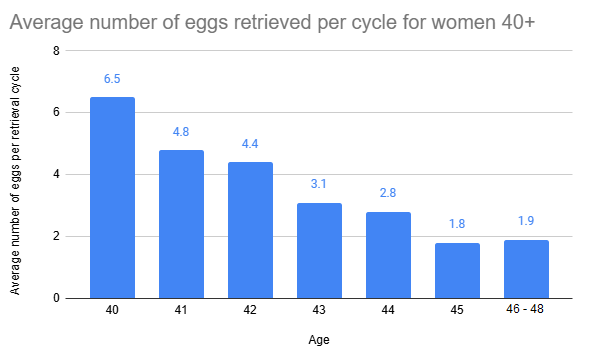
They also reported on the average number of frozen embryos per retrieval cycle. Because of their unusual way of culturing embryos (as described in the previous section), these likely represent fertilized eggs. So the average number of fertilized eggs per retrieval cycle was:
- Age 40: 3.9 fertilized eggs
- 41: 2.9 fertilized eggs
- 42: 2.7 fertilized eggs
- 43: 2.0 fertilized eggs
- 44: 1.8 fertilized eggs
- 45: 1.1 fertilized eggs
- 46-48: 1.1 fertilized eggs
Cumulative live birth rates decreased with increasing age
In this study, patients had up to 10 transfers 2 years after their first retrieval, with each transfer increasing the overall (cumulative) number of live births among these patients. You can see the cumulative live birth rates below for women aged 40-45. Women aged 46-48 didn’t have any live births (there were only 22 patients in this group).
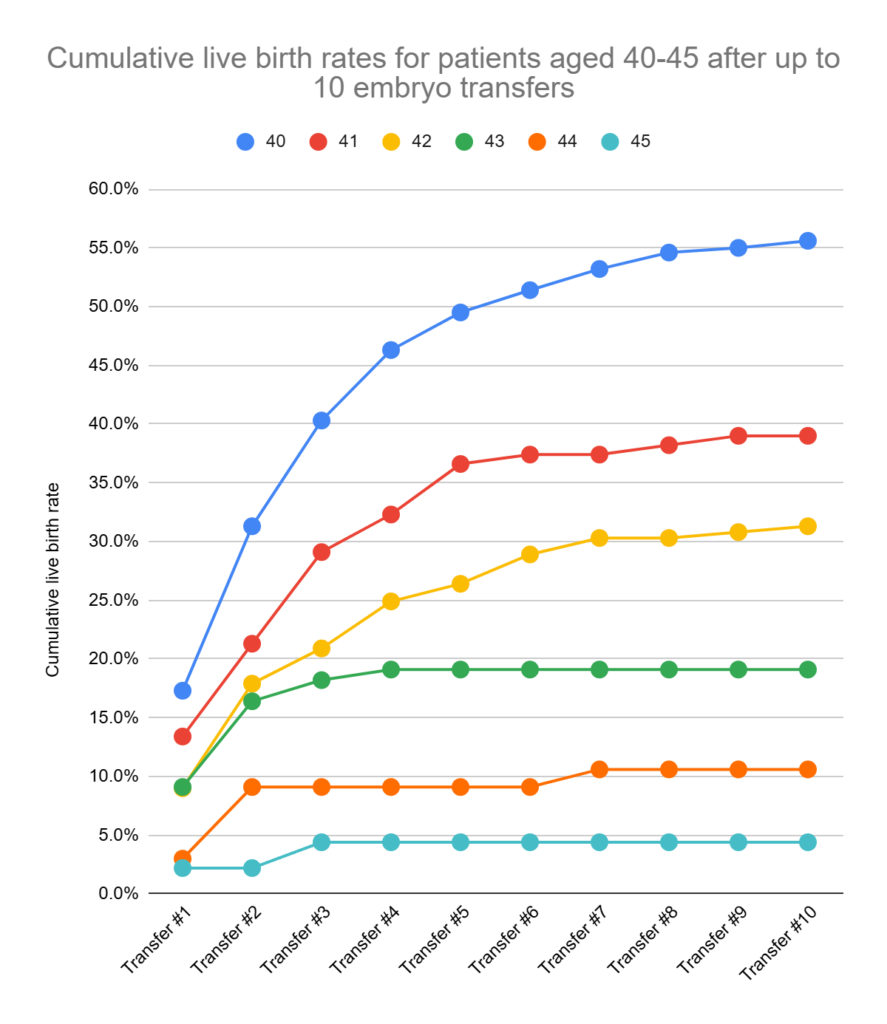
To better understand this graph, let’s look at the 40-year old blue curve. After their first transfer, the live birth rate was about 17.5%. After the second, it was about 31.0%. So women who had two transfers had an overall (cumulative) chance of live birth of 31.0%. This kept increasing until about transfer #8 or so, when it maxed out at about 55.0%.
The final cumulative live birth rate, after 2 years and up to 10 transfers, was:
- Age 40: cumulative live birth rate 55.6%
- 41: cumulative live birth rate 39.0%
- 42: cumulative live birth rate 31.3%
- 43: cumulative live birth rate 19.1%
- 44: cumulative live birth rate 10.6%
- 45: cumulative live birth rate 4.4%
- 46-48: cumulative live birth rate 0%
In the graph, you can see how the cumulative live birth rate kind of flattens out after a certain number of transfers. This is the point where having an additional transfer didn’t really increase the cumulative live birth rate. The researchers didn’t do statistics here, so I can’t say for sure at which point success rates stop increasing. For ages 40-42, it looks like the max cumulative birth rate occurs around transfer 8 or so, while for ages 43 and above it’s around transfer 2 or 3.
Another study, reviewed in my post Cumulative live birth rates in women aged 43+, after up to 10 cycles, found that the max cumulative live birth rate occurred around cycle 5 for women 43 and 44, then around cycle 2 for 45 and 46. The cycles in this study included an egg retrieval and all subsequent transfers, which differs from the study I’m summarizing here. The cumulative live birth rates were also lower, but they had a much higher sample size.
So why does this max cumulative rate happen?
It might be because there’s not many patients left at this point. If we start with 100 patients and 20 of them get a live birth from the first transfer, then 80 are left. Maybe 10 drop out. Now there’s 70 that do another transfer, and 15 get a live birth. Now there’s 55, and let’s say another 10 drop out…etc etc. At some point you don’t get any more live births because there’s not enough patients left (or patients that have embryos left) to get another live birth. The chance of live birth probably isn’t changing each time, but the number of patients left in the study decreases and this causes the cumulative rate to max out. They only did this study for two years. So I think this phenomenon is more of a limitation of how the study is designed than the actual biology of what’s going on.
Conclusions
After 10 transfers, 40-year olds had a cumulative live birth rate of over 55%. In other words, the overall chance of live birth after 10 transfers was 55% in 40-year olds.
This peaked at around 8 or so transfers, meaning that additional transfers after #8 didn’t really increase the chances of a live birth. As I noted before, they didn’t provide stats so this number is an estimate.
As women got older, the birth rates decreased to 4.4% for women aged 45, with the maximum rates seen at around transfer 2 or 3.
They also looked at egg retrieval outcomes for patients aged 40-48, with a steady drop in the number of eggs retrieved as age increased.
One of the limitations of this study is that not all embryos were necessarily transferred by each patient, which could have underestimated the overall results. They didn’t report on the % of patients that used all their embryos, although I imagine many would use up all their embryos before having another retrieval.
After posting this on social media, people were disappointed that PGT tested embryos weren’t transferred here. For cumulative rates I don’t think this really matters. Presumably most/all embryos were transferred from a cycle before they had another retrieval. With PGT-A there’s some embryos that won’t be transferred because they’re aneuploid. When patients have a retrieval and then transfer most/all embryos made from that cycle, I think this gives us a good look at the maximum potential of that cycle to leading to a live birth. Some might argue that day 3 is even better because you’re giving all embryos a chance. This study reported on cumulative live birth rates after transferring up to 5 euploids, finding that over 98% of patients had a live birth. Age doesn’t seem to have an impact on the chance of live birth after transferring a euploid. What matters with PGT-A is it could reduce the time to live birth, by only transferring euploid embryos.
Reference

About Embryoman
Embryoman (Sean Lauber) is a former embryologist and the founder of Remembryo, an IVF research and fertility education website. After working in an IVF lab in the US, he returned to Canada and now focuses on making fertility research more accessible. He holds a Master’s in Immunology and launched Remembryo in 2018 to help patients and professionals make sense of IVF research. Sean shares weekly study updates on Facebook, Instagram, and Reddit regularly. He also answers questions on Reddit or in his private Facebook group.
Related posts:
 Sleep quality and its impact on IVF outcomes
 Study compares IVF cumulative live birth rates based on age, eggs retrieved, diagnosis
 Cumulative live birth rates after up to 15 transfers with untested embryos
 Study estimates number of frozen eggs needed for euploids, live births
 IVF success at 46 with own eggs, adding to uncommon cases over 45
 Study finds poor ovarian responders have no further live births after 4 cycles
 Pilot study shows improved IVF outcomes after spindle transfer in women with poor egg quality
 Meta-analysis combines 74 studies to examine factors linked to euploid transfer success