
In a 2025 study, researchers estimated how many frozen eggs are needed, by age, to reliably yield three euploid blastocysts or achieve one, two or three live births, offering practical guidance for egg freezing patients.
With increasing age, there’s an increased risk of chromosomal errors (aneuploidy) in eggs, and this reduces the chance of getting a euploid by PGT-A. This makes it difficult to know how many eggs should be frozen to achieve a future live birth.
A study by Namath et al. (2025) aimed to determine how many frozen eggs it takes to reliably obtain three euploid blastocysts, and how many eggs are needed for one, two or three live births. The researchers chose a cutoff of 3 euploids based on previous research that showed 3 euploid transfers resulted in a ~92% cumulative chance of live birth. You can read more about this study in my post “True” recurrent implantation failure is rare after five consecutive euploid embryo transfers.
Although this study focused on frozen eggs, it still offers a useful approximation for patients using fresh eggs. That said, you may be better off checking out my post Researchers develop tool to predict chance of euploid from number of mature eggs, which looks at numbers based on fresh eggs.
🔗 Original studies are referenced in this post or within the linked Remembryo posts.
💡 Reminder: Terms underlined with a dotted black line are linked to glossary entries. Clicking these does not count toward your paywall limit.
Study details
- This is a retrospective multi-center study that took place in the US, using data between 2011 and 2023.
- Egg freezing was performed by vitrification and not slow freezing.
- Blastocysts were cultured and PGT-A was used on embryos with a grade BB or better, from days 5-7.
- PGT was done by NGS starting in 2016, before this aCGH or qPCR was used.
- This study used a statistical model that incorporated real-world data to predict the chance of achieving 3 or more euploids or multiple live births, so not all patients necessarily had this number.
In terms of sample size, there were a total of 488 thaw cycles with PGT-A (ages correspond to age at freeze):
- Age <35: 103
- 35-37: 183
- 38-40: 153
- 41-42: 36
- 43+: 13
Number of frozen mature eggs needed for 3 or more euploids increases with age
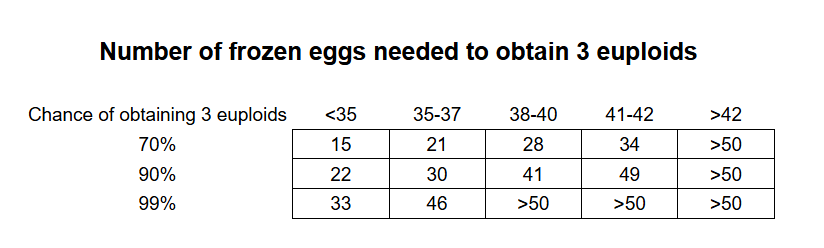
Using a statistical model, the researchers estimated the number of frozen mature oocytes required to yield three euploid blastocysts. Unsurprisingly, the number of mature eggs needed rose with age — from 15 to over 50 to reach a 70% chance.
Number of banked eggs needed for 1, 2 or 3 children
The researchers also estimated how many banked eggs are needed to achieve 1, 2, or 3 children. The chart below shows the approximate number of eggs required to reach a 50% or 75% chance. Note that these values were visually extracted from graphs and are approximate.
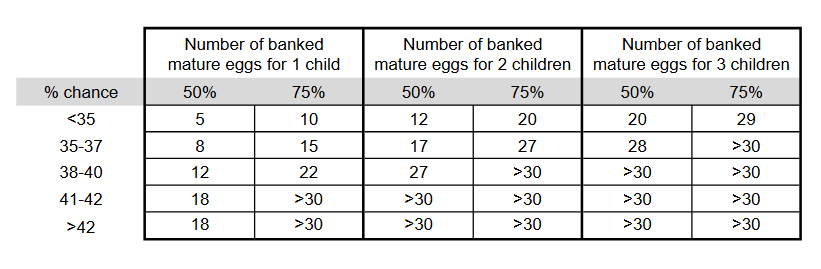
At around a 90% chance, more than 30 banked eggs were required in all scenarios, except for having one child in the <35 group (15 eggs) and the 35–37 group (20 eggs).
Conclusions
Patients who freeze eggs before age 35 have a good chance of banking three euploid embryos from a single egg retrieval cycle, and even achieving multiple live births. Patients aged 38–40 often need twice as many eggs to reach the same goal, making two or more cycles likely. For those over 40, multiple cycles are almost always necessary.
This is because egg quality decreases with age, mainly due to the increased chance of aneuploidy in the egg. To read more about this, check out my post Chromosomal errors in IVF: What is aneuploidy and what causes it?
Limitations of this study include the retrospective study design, a relatively small number of PGT-A cycles overall, limited sample size in the oldest age group, and no adjustment for embryo quality or day.
This study offers helpful guidance for patients on how many eggs they may need to freeze, and what to expect from eggs they’ve already frozen.
Although this study focused on frozen eggs, it still offers a useful approximation for patients using fresh eggs. That said, you may be better off checking out my post Researchers develop tool to predict chance of euploid from number of mature eggs, which looks at numbers based on fresh eggs.
Reference

About Embryoman
Embryoman (Sean Lauber) is a former embryologist and the founder of Remembryo, an IVF research and fertility education website. After working in an IVF lab in the US, he returned to Canada and now focuses on making fertility research more accessible. He holds a Master’s in Immunology and launched Remembryo in 2018 to help patients and professionals make sense of IVF research. Sean shares weekly study updates on Facebook, Instagram, and Reddit regularly. He also answers questions on Reddit or in his private Facebook group.
Related posts:
 Meta-analysis combines 74 studies to examine factors linked to euploid transfer success
 No differences in IVF outcomes when using fresh or frozen donor eggs
 Study explores male and female influence on embryo euploid rates
 Euploid embryos show reduced implantation potential with advancing maternal age
 ASRM’s 2024 committee opinion on the use of PGT-A
 Study finds that female age doesn’t impact euploid embryo transfer success rates
 Chromosomal errors in IVF: What is aneuploidy and what causes it?
 Cumulative live birth rates after up to 15 transfers with untested embryos