
Researchers in a 2023 study found that patients with antibiotic-cured chronic endometritis still had increased rates of pregnancy loss, possibly due to persistent underlying immunological issues.
This study compared patients that had cured chronic endometritis (using antibiotics) and patients who didn’t have chronic endometritis. They wanted to know if there were any differences in pregnancy outcomes after IVF, to see if treating endometritis had any benefit.
🔗 Original studies are referenced in this post or within the linked Remembryo posts.
💡 Reminder: Terms underlined with a dotted black line are linked to glossary entries. Clicking these does not count toward your paywall limit.
For this study, I recommend you check the glossary term for high power field, or HPF, to better understand how endometritis is diagnosed.
How is chronic endometritis diagnosed?
In this study, patients were diagnosed with chronic endometritis based on a uterine biopsy staining positive for CD138. CD138 is a marker that checks for plasma cells, or B cells of the immune system that make antibodies. These cells are present during infections, such as what’s seen with endometritis.
The uterine biopsy is checked with a microscope and these CD138+ plasma cells are counted under a high power field, or HPF. If there’s 5 or more seen in a particular HPF, then the patient is diagnosed with chronic endometritis. If there’s less, they don’t have endometritis.
Study details
This section covers key details of how the study was performed, including the number of patients and their characteristics, how they were treated, and other methods used. For those who aren’t interested in these details, and just want to see the results, you can go ahead and skip this part.
- This was a retrospective cohort study that took place between 2018 and 2022 at a single IVF center in China.
- A single euploid was transferred.
- Only patients having their first frozen embryo transfer (FET) were included.
- All patients had a hysteroscopy with biopsy to check for chronic endometritis.
- Patients were diagnosed with chronic endometritis by hysteroscopy and biopsy (with 5 or more CD138+ plasma cells per high power field or HPF). Only patients diagnosed within 6 months were included.
- Patients with chronic endometritis were cured by treating with doxycycline for 2 weeks, before confirming with a second hysteroscopy/biopsy. If they were still positive, they were treated with levofloxacin lactate and metronidazole for another 2 weeks. If they were still positive they were excluded from the study.
- Other exclusions: endometriosis, PCOS, known autoimmune disease.
- The primary outcome was early pregnancy loss before 10 weeks gestation, including biochemical losses.
In terms of the sample size, there were a total of 833 patients:
- 611 didn’t have chronic endometritis.
- 234 did have chronic endometritis.
In terms of baseline characteristics, the patients were about 31 years old and the two groups were mostly comparable.
Patients with cured chronic endometritis still had increased pregnancy loss
After transferring a single euploid embryo, patients with antibiotic-treated and cured chronic endometritis had a higher rate of pregnancy loss compared to patients without endometritis (21.2% vsa 14.2%, p= 0.016; after statistical adjustment of confounders, the adjusted odds ratio [95% CI] was 1.68 [1.11-2.55]).
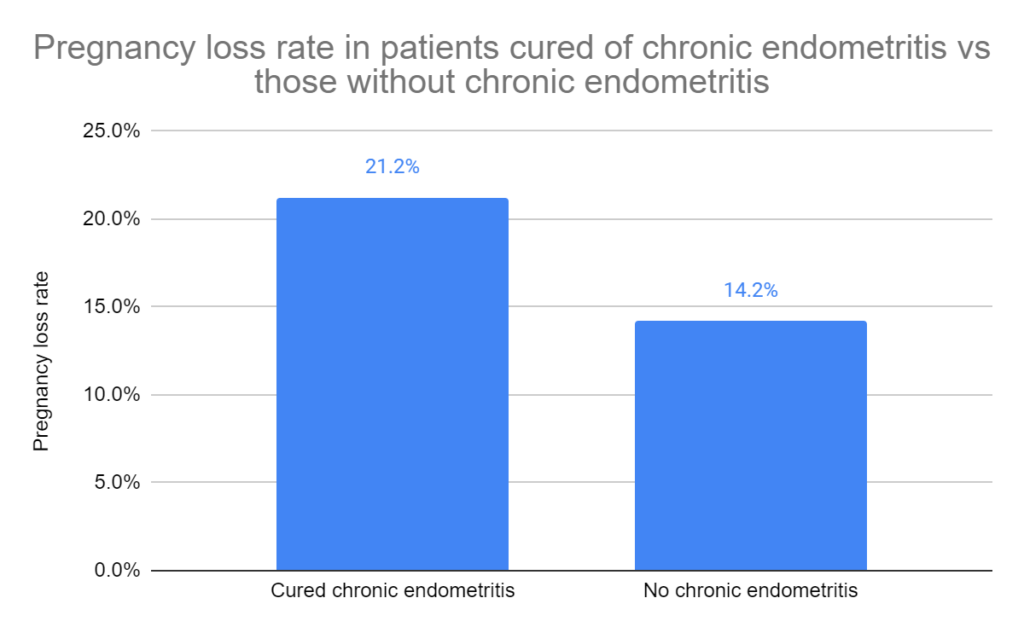
There were no differences in biochemical pregnancy losses (12.2% vs 10.1%), clinical pregnancy rate (57.5% vs 58.4%) or live birth (47.3% vs 51.4%).
Patients without chronic endometritis, but with low levels of CD138+ plasma cells, show increased rates of pregnancy loss
In this study, patients were diagnosed with chronic endometritis based on having 5 or more CD138+ plasma cells per HPF.
This means that patients with 4 or fewer CD138+ plasma cells per HPF don’t have chronic endometritis. In this study, there were 611 patients that didn’t have chronic endometritis:
- 233 had 0 CD138+ plasma cells per HPF.
- 378 had 1-4 CD138+ plasma cells per HPF.
So in the next part of the study, they wanted to see if these patients with 0-4 CD138+ plasma cells showed any difference in pregnancy loss rates and other outcomes. It’s possible that patients with less than 5 CD138+ plasma cells have a more mild form of endometritis and this could have an impact on pregnancy loss.
It turns out that they do have increased pregnancy loss!
After transferring a single euploid embryo, patients with 1-4 CD138+ plasma cells had a higher rate of pregnancy loss compared to patients with 0 CD138+ plasma cells (17.2% vs 9.4%, p= 0.008; after statistical adjustment of confounders, the adjusted odds ratio [95% CI] was 2.21 [1.30-3.74]).
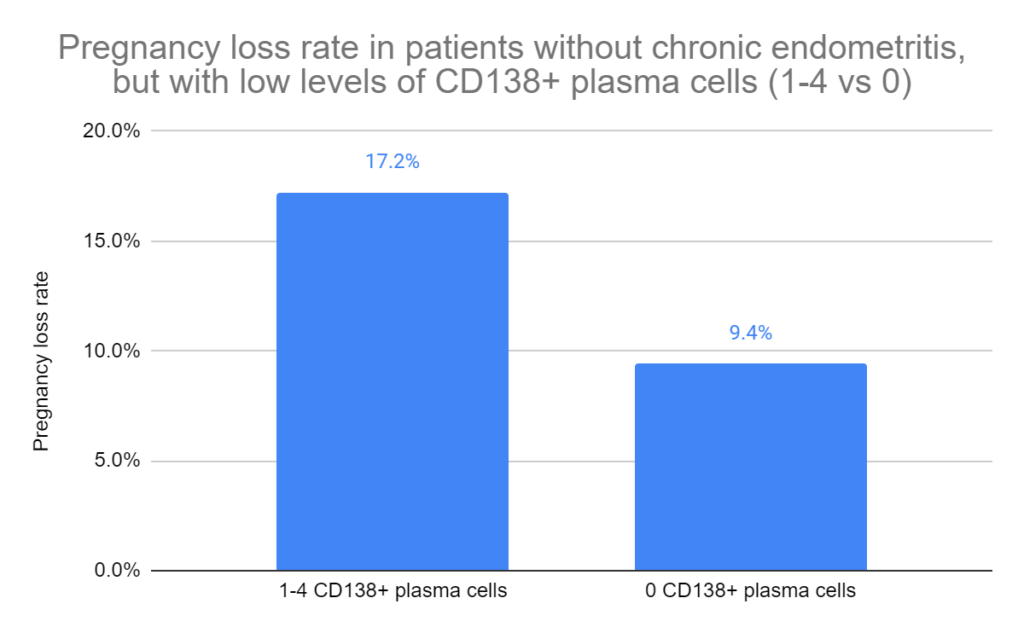
There was also an increase in biochemical losses (12.2% vs 6.9%, p= 0.035), but there were no differences in clinical pregnancy rate (56.9% vs 60.9%) or live birth (48.9% vs 55.4%).
Conclusions
This study found that patients with cured chronic endometritis had a higher chance of losing a pregnancy, compared to patients without endometritis.
There weren’t any differences in clinical pregnancy or live birth rates.
In this study, chronic endometritis was defined as the detection of 5 or more CD138+ cells from a single high power field (HPF) of a uterine biopsy. They did another analysis where they looked at the group without endometritis, who had 4 or fewer CD138+ cells per HPF.
The patients with 0 CD138+ cells had the lowest chance of losing a pregnancy. Patients with 1-4 CD138+ cells had an increased risk.
This shows that having any amount of these cells increases the risk of pregnancy loss. Remember, these cells are B cells from the immune system, and they’re present in the endometrium because they’re trying to fight an infection. So any amount of them may indicate an infection.
But why are women who are cured by antibiotics still having an increase in pregnancy loss? The authors aren’t sure, and write that endometritis might not be due to a simple infection but could be a sign of an immune imbalance in the endometrium. It’s possible that treatment with antibiotics might not treat the underlying issue. It’s also possible that treatment with antibiotics removes beneficial bacteria.
On this point of the antibiotics eliminating the good bacteria, I’m not sure this study supports that. The patients with 0 CD138+ plasma cells showed a drop in pregnancy loss rates, compared to those with 1-4 plasma cells. Both these groups were treated with antibiotics, but only the patients with 0 CD138+ cells had decreased pregnancy loss rates.
Some studies agree with this research, while others don’t. This is probably due to differences in how endometritis is diagnosed and the threshold used for CD138+ plasma cells.
A recent meta-analysis (Santoro et al. 2023) combined the results of 9 studies, which showed different methods of diagnosing chronic endometritis: some used 5/HPF as this study did, while others used 1/HPF, 0.25/HPF or 0.1/HPF (ie 1 out of 10 HPF). They concluded that 0.5/HPF may be the most appropriate.
When a uterine biopsy is performed to check for endometritis by CD138, only a small section is evaluated under a HPF of the microscope. Some studies, like this one, only look at a single section, while others look at more sections. Either way, this may not represent the whole uterine environment. Plasma cells might not be evenly distributed, and can form clusters.
It might be better to diagnose chronic endometritis using other methods besides counting CD138+ cells.
“The diagnosis of the disease and the practical effectiveness of chronic endometritis therapy on reproductive
Zhang et al. (2023)
outcomes appears to be a more challenging matter than expected.”
The authors note that larger studies are needed to confirm these results.
Related studies
Not all research may agree with this study. There were a number of studies referenced that you might want to check out, as shown below (8 links):

Reference

About Embryoman
Embryoman (Sean Lauber) is a former embryologist and the founder of Remembryo, an IVF research and fertility education website. After working in an IVF lab in the US, he returned to Canada and now focuses on making fertility research more accessible. He holds a Master’s in Immunology and launched Remembryo in 2018 to help patients and professionals make sense of IVF research. Sean shares weekly study updates on Facebook, Instagram, and Reddit regularly. He also answers questions on Reddit or in his private Facebook group.
Related posts:
 Why do embryos in IVF fail to implant or miscarry?
 Meta-analysis of commonly used IVF immunotherapies shows no benefit
 The impact of the vaginal and endometrial microbiome on reproductive health and IVF outcomes
 NK cells in IVF
 How many failed embryo transfers is too many?
 RCT finds no change in birth rates for standard or ERA-timed euploid transfer
 Meta-analysis compares medicated and natural FET adverse pregnancy and birth outcomes
 “True” recurrent implantation failure is rare after five consecutive euploid embryo transfers