

Researchers in a 2023 study examined neonatal outcomes based on endometrial thickness and found that a thinner endometrium was associated with an increased preterm birth risk.
This study investigated whether or not endometrial thickness on the day of hCG trigger was associated with neonatal outcomes after a fresh transfer. This was a retrospective study done between 2016 and 2021 at a single IVF center in China. A total of 2,010 women were included in this study.
🔗 Original studies are referenced in this post or within the linked Remembryo posts.
💡 Reminder: Terms underlined with a dotted black line are linked to glossary entries. Clicking these does not count toward your paywall limit.
Study details
- These were all fresh transfers, and a live birth must have had occurred during their first three IVF cycles.
- Exclusions: Donor egg cycles, PCOS, cycles that weren’t long GnRH agonist or antagonist, women with maternal complications during pregnancy, multiple births, vanishing twins, uterine malformations, cervical incompetence, or a history of intrauterine/cervical surgery, women older than 42.
The 2,010 women were grouped based on their endometrial thickness on the day of hCG trigger: 6.0-8.9 mm (n= 378), 9.0-9.9 mm (n= 444), 10.0-10.9 mm (n= 541), 11.0 or greater (n= 647). The average values for endometrial thickness were 7.84 ± 0.68, 9.11 ± 0.23, 10.08 ± 0.20 and 11.70 ± 0.90.
In terms of baseline characteristics, there were many differences between the groups, including maternal age (30.58 vs 31.50), basal FSH, AMH, day 3 vs day 5 embryos transferred, and more. These were statistically adjusted and controlled for in their multivariate analysis.
A thicker endometrium led to a small increase in gestational age
Based on the different groups of endometrial thickness, the researchers found small increases in gestational age (p= 0.013):
- 6.00-8.90 mm (± standard deviation): 38.74 ± 2.00
- 9.00-9.90 mm: 38.96 ± 1.68
- 10.00-10.90 mm: 39.06 ± 1.52
- 11.00 mm or greater: 39.08 ± 1.73
Rather than looking at the intervals alone, they plotted the (statistically adjusted) gestational age against the endometrial thickness, as shown below. Compared to the 6.00-8.90 mm group, each thicker interval showed a statistically significant increase in gestational age (0.29 week increase with the 9.00-0.90 mm group; 0.47 week increase with the 10.00-10.90 mm group; 0.55 week increase with the 11.00 mm or greater group; p= 0.0226, 0.0019 and 0.0005, respectively).
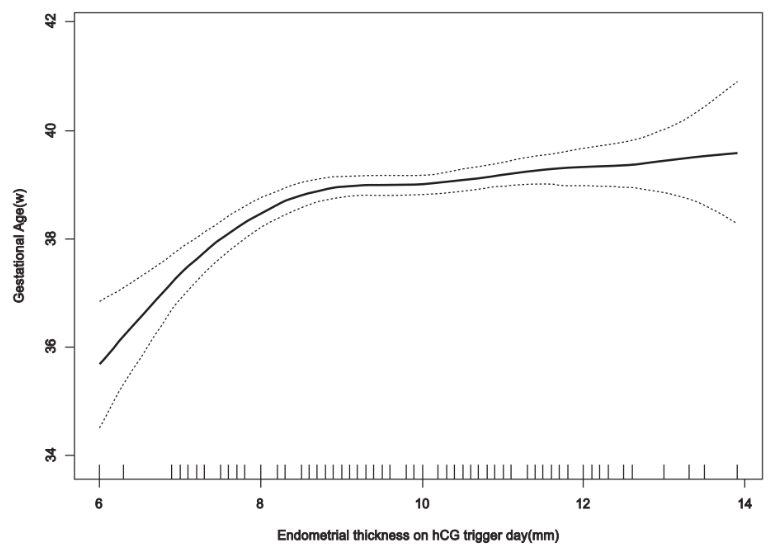
For ≤7.8 mm, they found that the gestational age increased significantly with endometrial thickness (adjusted odds ratio [95% CI]: 1.94 [1.26-2.63]). This means that an endometrial thickness above 7.8 mm has no impact on gestational age.
A thinner endometrium led to an increased risk of preterm birth
Next, they looked at the risk of preterm birth. Preterm birth is a birth that occurs between 32 weeks and less than 37 weeks.
With increasing endometrial thickness, there was a decrease in the chance of preterm birth (p= 0.023):
- 6.00-8.90 mm: 12.70% (48 patients)
- 9.00-9.90 mm: 8.78% (39)
- 10.00-10.90 mm: 7.58% (41)
- 11.00 mm or greater: 3.71% (24)
Like above, they plotted the preterm birth rates (statistically adjusted) against the endometrial thickness. Compared to the 6.00-8.90 mm group, there was a decrease in the odds of preterm birth with each thicker interval (45% decrease in the odds of preterm birth with the 9.00-0.90 mm group; 58% decrease with the 10.00-10.90 mm group; 75% decrease with the 11.00 mm or greater group; p= 0.0451, 0.0211 and 0.0034, respectively).
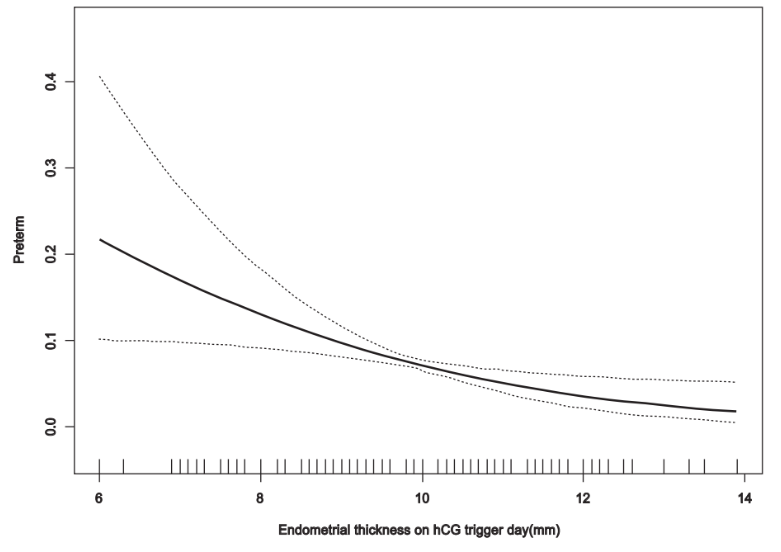
For ≤7.6 mm, they found that the risk of preterm birth decreased significantly as endometrial thickness increased (adjusted odds ratio [95% CI]: 0.47 [0.03-0.99]). This means that endometrial thicknesses above 7.6 mm have no impact on preterm birth risk.
You might be wondering how a small increase in gestational age, as shown in the previous section, relates to larger differences in preterm births. If you check the preterm birth section, you can see how the rate drops from 12.70% for the thinnest to 3.71% for the thickest, while the gestational age goes from 38.74 ± 2.00 to 39.08 ± 1.73. The ± is a standard deviation,
They used an overall cutoff of 7.8 mm to describe changes in both gestational age and preterm birth risk as a result of endometrial thickness.
Other factors associated with gestational age
The researchers did a statistical test called a univariate analysis to see what other factors were associated with gestational age.
The following were associated with changes in gestational age:
- Maternal age
- Paternal age
- Maternal BMI
- Number of previous IVF cycles
- Female gender of newborn
The following were not associated with gestational age:
- Basal FSH
- AMH
- Primary or secondary infertility
- Infertility cause
- Stimulation duration
- GnRH-a vs antagonist
- Number of eggs retrieved
- IVF vs ICSI
- Day 3 vs day 5 embryos
- Number of embryos transferred
- Endometrial pattern
Neonatal outcomes not associated with endometrial thickness
Besides gestational age, they found no differences in other neonatal outcomes (after adjustment):
- Very preterm (<32 weeks)
- Birth weight
- Z-score
- Low birth weight
- Fetal macrosomia
- Small for gestational age
- Very small for gestational age
- Large for gestational age
- Very large for gestational age
Conclusions
This study found that increases in endometrial thickness on the day of hCG trigger led to small increases in the gestational age of the baby born, while a thinner endometrium was linked to a higher risk of preterm birth. This was apparent until the endometrium was about 7.8 mm.
A thin endometrial lining could impact neonatal outcomes due to decreased blood flow and availability of oxygen, altered blood vessel development, and pregnancy complications like high blood pressure.
Other neonatal outcomes, including birth weight, weren’t affected by endometrial thickness.
Because of the heightened risk for preterm birth, the authors conclude that women with an endometrial thickness less than 7.8 mm should receive additional support from their doctors.
You might be wondering how a small increase in gestational age relates to larger differences in preterm births. If you check the preterm birth section, you can see how the rate drops from 12.70% for the thinnest to 3.71% for the thickest, while the gestational age goes from 38.74 ± 2.00 to 39.08 ± 1.73. Remember, a preterm birth is one that occurs between 32 and less than 37 weeks. So how does 39.08 ± 1.73 include values less than 37? Because the ± 1.73 refers to a standard deviation, which only represents 68% of the dataset.
Reference

About Embryoman
Embryoman (Sean Lauber) is a former embryologist and the founder of Remembryo, an IVF research and fertility education website. After working in an IVF lab in the US, he returned to Canada and now focuses on making fertility research more accessible. He holds a Master’s in Immunology and launched Remembryo in 2018 to help patients and professionals make sense of IVF research. Sean shares weekly study updates on Facebook, Instagram, and Reddit regularly. He also answers questions on Reddit or in his private Facebook group.
Related posts:
 Complete guide to embryo implantation and implantation failure
 Endometrial thickness and pregnancy outcomes after 96,000 embryo transfers
 Meta-analysis shows growth hormone improves endometrial function
 NK cells in IVF
 How many failed embryo transfers is too many?
 RCT finds no change in birth rates for standard or ERA-timed euploid transfer
 Meta-analysis compares medicated and natural FET adverse pregnancy and birth outcomes
 Patients with antibiotic-cured endometritis still show increased pregnancy loss