

A 2024 study compared successful and unsuccessful euploid transfers, finding that female age had no impact, while BMI, embryo quality and the type of FET used did.
PGT-A is a selection technique that identifies which embryos are euploid and have the right number of chromosomes.
Unfortunately, not all euploid transfers are successful, and a new study compared patients who had a successful or unsuccessful euploid transfer.
To get more background on PGT-A, check out my Complete guide to PGT-A (PGS testing).
🔗 Original studies are referenced in this post or within the linked Remembryo posts.
💡 Reminder: Terms underlined with a dotted black line are linked to glossary entries. Clicking these does not count toward your paywall limit.
Study details
This section covers key details of how the study was performed, including patient characteristics, how they were treated, and other methods used. For those who aren’t interested in these details, and just want to see the results, you can go ahead and skip this part.
- This was a retrospective study that took place between 2017 and 2023 at a single IVF center in the United Arab Emirates.
- Patients had a single euploid transferred; and had a natural or medicated FET transfer.
- No day 7 embryos; no PGT-M.
- Ongoing pregnancy rates were measured (>12 weeks gestation), and patients who didn’t have a successful pregnancy either didn’t get pregnant, had a biochemical loss or early pregnancy loss.
- The way they defined good/fair/poor quality embryos was not clear (there was overlap with how they defined fair and poor quality embryos). I’ve contacted the corresponding author for clarification, but they didn’t respond.
In terms of sample size, there was 1923 transfers from 1464 couples:
- Aged ≤35: 1173 transfers
- 36-37: 230 transfers
- 38-40: 304 transfers
- >40: 216 transfers
Multivariate regression analysis was used to statistically adjust for BMI, embryo quality and type of FET (medicated/natural FET). Results of this test were reported as odds ratios.
Female age doesn’t impact euploid transfer success rates
The researchers compared patients who either did or didn’t have an ongoing pregnancy (past 12 weeks gestation) after transferring a euploid.
Patients with a different age at the time of embryo transfer didn’t show any differences in ongoing pregnancy rates (p= 0.609, no odds ratios for this comparison). This means that pregnancy rates didn’t change based on female age at the time of euploid transfer.
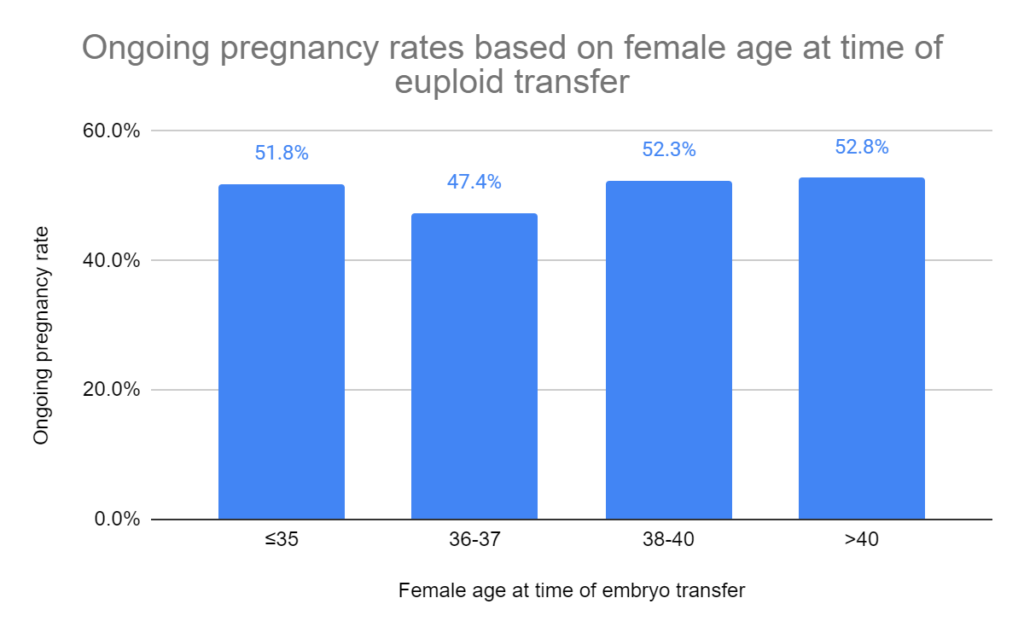
They also compared outcomes based on female age at the time of egg retrieval (the egg retrieval that led to the formation of the euploid). They didn’t find any differences (p= 0.819 and no statistically significant differences in the odds ratios by multivariate regression).

They also did a sensitivity analysis where they grouped patients based on embryo quality or the type of FET they had (medicated or natural cycle). They didn’t find any evidence of age at time of egg retrieval impacting ongoing pregnancy rates.
So overall, the chance of an ongoing pregnancy after transferring a euploid was the same for patients — regardless of their age when they obtained or transferred the euploid.
BMI, type of FET and embryo quality impact euploid transfer success
Besides age at egg retrieval and time of transfer, the researchers compared other factors for successful vs non-successful euploid transfers:
- No differences based on male age at egg retrieval.
- No differences in how long the euploids were frozen.
- No differences based on AMH levels.
- BMI influenced euploid transfer ongoing pregnancy rates. Compared to normal weight individuals, overweight and obese women were less likely to have an ongoing pregnancy after euploid transfer (odds ratio [95% CI]: 0.74 [0.59-0.92]; 0.71 [0.55-0.92]), with no difference with underweight BMIs.
- Embryo quality influenced euploid transfer ongoing pregnancy rates (55.5% vs 39.9% vs 31.9% for good vs fair vs poor). Compared to fair quality euploids, good quality euploids had a higher chance of leading to an ongoing pregnancy (odds ratio [95% CI]: 1.94 [1.34-2.80]), with no differences with poor quality embryos. Note that this study used an unconventional method of grading embryos, and I was unable to clarify this with the corresponding author.
- The type of FET influenced euploid transfer ongoing pregnancy rates. Compared to medicated FETs, natural cycle FETs had a higher chance of leading to an ongoing pregnancy after euploid transfer (46.6% vs 57.5%, p< 0.001; odds ratio [95% CI]: 1.50 [1.23-1.83]). Medicated FETs had a higher chance of miscarriage.
Conclusions
This study looked for differences in patients who either had a successful euploid transfer or didn’t.
Factors that DID matter for having a successful euploid transfer:
- BMI (overweight/obese had a lower chance)
- Embryo quality (good quality had a higher chance)
- Type of FET done (natural cycle FETs had a higher chance)
Factors that DIDN’T matter for having a successful euploid transfer:
- Female age at time of transfer
- Female age at time of egg retrieval
- Male age
- How long the embryo was frozen for
- AMH levels
The big finding here is that female age — at either the time of retrieval or transfer — didn’t matter.
The chance of getting a euploid decreases with female age, but once you get one, this study is showing it has the same chance as someone younger, regardless of when you got the embryo (the time of retrieval) or when you transferred it.
Some studies have found no difference with female age and euploid success rates, while others have. A recent meta-analysis found that age did impact euploid success rates, although they included studies that used both NGS and non-NGS DNA sequencing methods for PGT-A, which may have influenced the results. In general, more research is needed on this topic.
I’ve covered several studies that have looked at maternal age and euploid success:
- Euploid embryos show reduced implantation potential with advancing maternal age — this is the largest study to date on the topic, which found that women who did a euploid transfer at an older age had lower live birth rates compared to younger women.
- Study evaluates factors affecting pregnancy outcomes after euploid transfer — this study found no differences in pregnancy outcomes after transferring euploid embryos in women <40 and >40. They also looked at BMI, FET protocol, the day the embryo was biopsied, and AMH levels.
- Meta-analysis combines 74 studies to examine factors linked to euploid transfer success — this study found a slight influence in female age at time of retrieval and euploid success rates. They also compared a large number of other factors, like embryo quality, BMI, diagnosis, type of assisted hatching and more.
Ultimately, it’s possible that there are small differences in live birth rates that aren’t detectable unless there’s a large sample size. The lower success rates may have to do with reduced mitochondrial quality/function.
Women who performed a medicated FET were more likely to have a miscarriage and had a reduced chance of ongoing pregnancy. This could be because the corpus luteum, present in natural cycle FETs but absent in medicated FETs, produces factors like relaxin and VEGF that are not replaced in medicated cycles. These factors may aid implantation, sustain pregnancy, and reduce adverse outcomes. This is discussed in more detail in my post Comparing frozen embryo transfer/FET protocols.
Related studies
To learn more about this topic, you can check out a number of studies referenced in this study below (2 links):

Reference

About Embryoman
Embryoman (Sean Lauber) is a former embryologist and the founder of Remembryo, an IVF research and fertility education website. After working in an IVF lab in the US, he returned to Canada and now focuses on making fertility research more accessible. He holds a Master’s in Immunology and launched Remembryo in 2018 to help patients and professionals make sense of IVF research. Sean shares weekly study updates on Facebook, Instagram, and Reddit regularly. He also answers questions on Reddit or in his private Facebook group.
Related posts:
 Study evaluates factors affecting pregnancy outcomes after euploid transfer
 Meta-analysis combines 74 studies to examine factors linked to euploid transfer success
 Study examines potential of PGT-A on poor quality embryos
 Researchers develop “FORTUNE” model to predict number of euploids from IVF
 Euploid embryos show reduced implantation potential with advancing maternal age
 Study compares PGT-A outcomes for patients with different diagnoses
 ASRM’s 2024 committee opinion on the use of PGT-A
 Study evaluates PGT-A outcomes for good prognosis patients, based on age