

Researchers in a 2023 study developed an AI model trained on blastocyst images and a set of clinical features that has the highest accuracy in predicting live births seen yet.
Artificial intelligence (AI) has been used to predict disease risk using images associated with lung cancer, breast cancer and other diseases. It has also been used to predict the chance of live birth based on a picture of a blastocyst with varying success.
Liu et al. (2023) developed an AI model to predict live birth based on images from 17,580 blastocyst and clinical features of the patient couple. The data was from patients with live birth data undergoing a frozen embryo transfer between 2016 and 2020 at a single hospital-based IVF center in China.
Check out my complete guide to embryo grading and success rates to learn more about embryo development, grading and success rates.
To develop their model, they used 80% of the blastocysts to train the AI, 10% to validate the model, and 10% as a testing set.
During the training step, the AI analyzes blastocyst images from both live birth and non-live birth cases, and identifies differences in the pictures between the two groups. During this stage the AI sees the data and learns from it.
During the validation step, the AI uses what it learned from the training step to make predictions with unseen blastocyst images. The researchers make adjustments here if needed.
The test step uses the final model to evaluate its performance.
More information on training, validation and testing in AI can be found here.
Note: This post relies pretty heavily on the terms ROC and AUC, and you should probably check out that definition in the glossary (see the red note below).
🔗 Original studies are referenced in this post or within the linked Remembryo posts.
💡 Reminder: Terms underlined with a dotted black line are linked to glossary entries. Clicking these does not count toward your paywall limit.
The AI model is highly predictive for live birth, particularly when including the couple’s clinical features
The researchers developed different AI models and compared their ability to predict live births by plotting ROC curves.
One model made use of only blastocyst images during the training. This model had an AUC of 0.67 (95% CI: 0.65-0.70).
Another model used blastocyst images as well as the patient couple’s clinical features (age, number of retrieved eggs, etc. — a total of 16 features were used, more on this below). The AUC for this model was 0.77 (95% CI: 0.75-0.79), and is the highest AUC by any AI model to date.
Because the AUC increased, this second model was better than the first. So including the patient couple’s clinical features during AI training improved the ability of the AI to predict live birth from blastocyst images.
AI trained with or without clinical features focused on different parts of the blastocyst
What’s really interesting is how the AI looked at blastocyst images for each of these models. Lucky for me (and you!), this was an open source article so I’m able to republish the image:

The first column shows the blastocyst image and the location of the trophectoderm (TE) and inner cell mass (ICM). The second and third columns show a heat map for what the AI was focusing on without or with clinical feature training.
Without clinical feature training, the AI focused more on the ICM than anything, but with the clinical features it focused more on the trophectoderm. The authors suggest that this may be due to the vital role that the trophectoderm and endometrial features play in the implantation process, which is necessary for a live birth.
Clinical features ranked for live birth prediction
The researchers then ranked the different clinical features in their ability to predict live birth. Out of 103 features, they identified 16 to be the most predictive based on their AUC values:
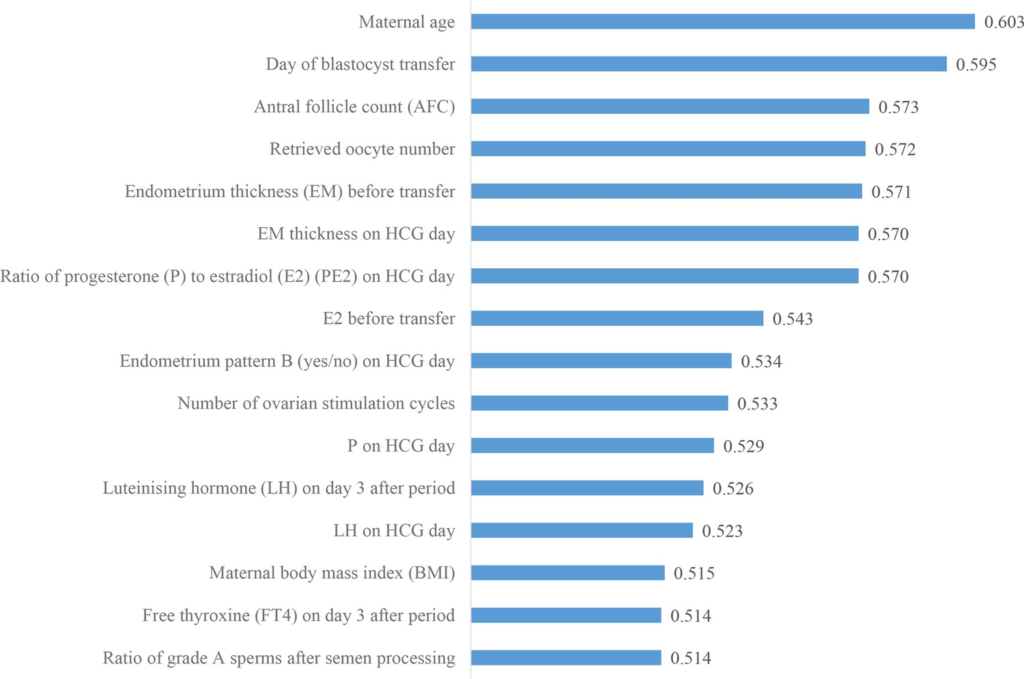
Note that the “day of blastocyst transfer” likely indicates the day the embryo was frozen (so a day 5, day 6 or day 7, although they didn’t specifically indicate what days were considered).
You can check out the whole list of the 103 clinical features here (supplementary file 1), but keep in mind that some of it is kind of vague! They also don’t show AUC values for any of them, so there’s no ranking like there is above.
Conclusions
This study found that combining blastocyst images with 16 clinical features resulted in an AI model that could predict live birth rates better than any other model to date.
The authors reference a number of papers showing the progression of AI models in predicting live birth using blastocyst images. Traditional grading using the Gardner system produced an AUC of 0.58-0.61, AI models trained on blastocyst images achieved an AUC of 0.65, while including blastocyst images and select clinical features (maternal age, AMH and BMI) achieved an AUC of 0.74. In this current study, an AUC of 0.77 was achieved, which is the highest to date.
It’s interesting to note how much lower the AUC for the Gardner system is compared to the AI models, demonstrating the limited ability of an embryologist’s grade to predict live birth rates.
The author’s note that the AI model focuses more on certain trophectoderm clusters, whereas the traditional Gardner grading system typically evaluates the entire trophectoderm and its cell count. It’s not clear why the AI focuses on specific clusters and more work needs to be done here to address this.
The next step that the researchers are planning is to perform a randomized controlled trial using embryos selected for transfer based on this AI model and conventional grading. It would also be interesting to see how this compares with a PGT-A tested euploid embryo.
Reference

About Embryoman
Embryoman (Sean Lauber) is a former embryologist and the founder of Remembryo, an IVF research and fertility education website. After working in an IVF lab in the US, he returned to Canada and now focuses on making fertility research more accessible. He holds a Master’s in Immunology and launched Remembryo in 2018 to help patients and professionals make sense of IVF research. Sean shares weekly study updates on Facebook, Instagram, and Reddit regularly. He also answers questions on Reddit or in his private Facebook group.
Related posts:
 Predicting live birth rates, multiples based on 223,377 transfers
 Complete Guide to Embryo Grading and Success Rates
 Study examines association with embryo quality and male to female sex ratio
 Day 3 or Day 5 embryo transfer?
 Predicting how many day 3 embryos make it to blastocyst
 An Italian consensus on key performance indicators for assessing IVF clinics
 Study evaluates the potential of day 4, 5, 6 and 7 blastocysts
 Poor quality blastocysts show acceptable live birth rates, no change in perinatal outcomes