

Researchers in a 2023 study found that flushing follicles during an egg retrieval increased the number of eggs retrieved and reduced the chance of obtaining zero eggs.
During an egg retrieval, each follicle is drained by aspiration to obtain the egg inside. The egg might be retrieved with a single aspiration, but sometimes it isn’t, and the doctor may attempt to retrieve it by flushing the follicle with multiple aspirations.
This study was a randomized controlled trial (RCT) that evaluated the impact of follicular flushing on egg retrieval outcomes. It involved 105 patients at a single IVF center in Greece in 2022.
For more background on egg quality (and quantity!), check out my Complete guide to egg quality.
🔗 Original studies are referenced in this post or within the linked Remembryo posts.
💡 Reminder: Terms underlined with a dotted black line are linked to glossary entries. Clicking these does not count toward your paywall limit.
Key study details
- For each patient, one ovary was aspirated once and other one was flushed, which was randomized.
- The follicular flushing group had aspirations up to five times, with 96.8% of eggs retrieved by the second flush.
- Egg retrievals were done by the same doctor.
- Eggs from both groups were cultured separately to assess development.
- Embryo quality was evaluated on day 2; good quality embryos had 3 or more cells with minimal fragmentation.
- The primary outcome was the number of eggs retrieved.
The 105 patients were further grouped based on their ovarian response:
- Low responders had 5 or less follicles (n= 35)
- Normal responders had 6-18 follicles (n= 35)
- High responders had 19 or more follicles (n= 35)
For this study, all the values were reported as the median, or middle point in a set of data (check the glossary on this for more info).
Follicular flushing increased the number of eggs retrieved
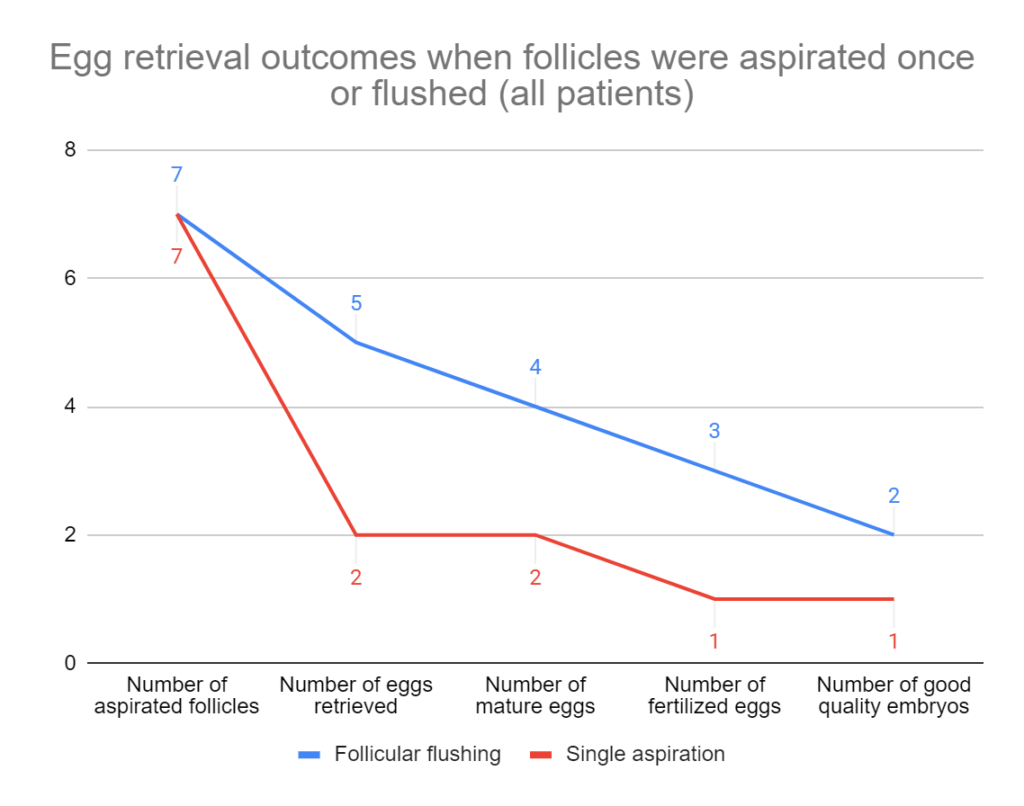
Below, you can see the retrieval outcomes after follicles were aspirated a single time or flushed multiple times. From a median of 7 follicles, follicular flushing resulted in more eggs (5 vs 2), more mature eggs (4 vs 2), more fertilized eggs (3 vs 1) and more good quality embryos (2 vs 1). In all cases the differences were statistically significant (p< 0.001).
They also looked at the retrieval outcomes in those with low, normal or high ovarian responses. All had statistically significant increases in retrieval outcomes when flushing was used. Normal responders had similar results to the overall results above, and the low responders only had a median of 1 follicle, so I won’t show these results.
Below you can see the retrieval outcomes for the high ovarian response group. From a median of 12 follicles aspirated, there were more eggs in the flushed group (9 vs 5), more mature eggs (8 vs 4), more fertilized eggs (5 vs 2) and more good quality embryos (4 vs 2). All outcomes were statistically significant (p< 0.001).

Fewer egg retrievals with zero eggs when flushing is used
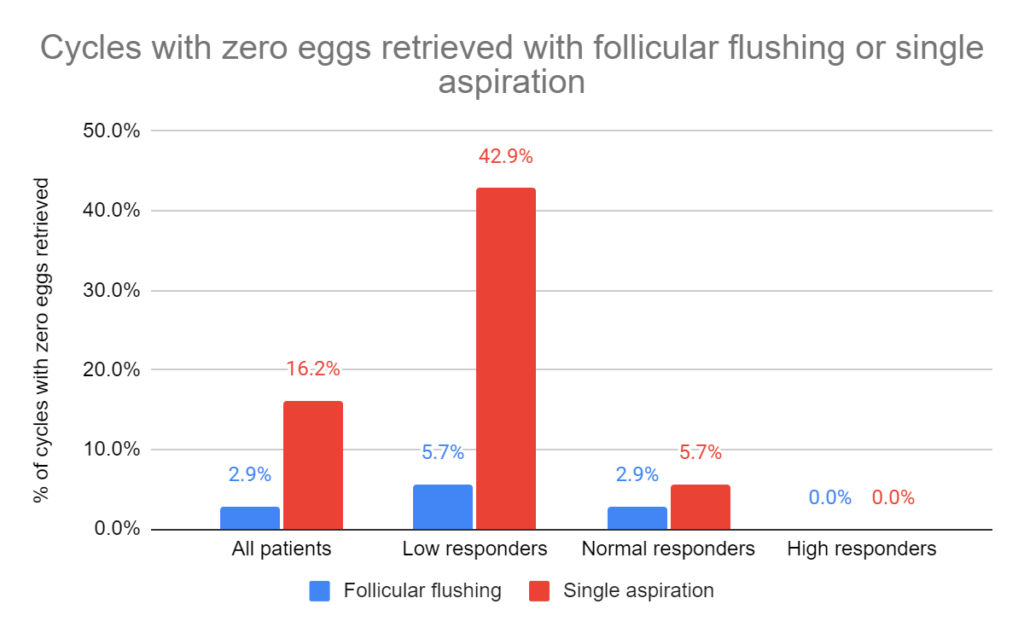
They also looked at the proportion of cycles that didn’t get any eggs retrieved after aspiration.
Of the 105 cycles in this study, when flushing was used there were 3 (2.9%) cycles with zero eggs retrieved compared to 17 (16.2%) when single aspiration was used (p= 0.001). Flushing also decreased the rate of zero eggs retrieved for low responders (5.7% vs 42.9%, p< 0.001), but there was no difference in the normal or high responder groups.
Conclusions
This study found that follicular flushing increased the number of eggs retrieved, and therefore the number of mature eggs, fertilized eggs and good quality embryos. This was true for low, normal and high responders, who had a small amount or many follicles.
They also found that flushing reduced the chance of getting zero eggs during egg retrievals, especially for patients with fewer follicles.
It was really clever of them to use one ovary for single aspiration and one for flushing. This is a really great way to control for differences between patients.
Unfortunately, other studies that looked at this used separate patients that were aspirated once or flushed. Martini et al. (2021) performed a meta-analysis and grouped the results of 11 studies that found a lower number of eggs retrieved with flushing. Another variable to consider is the flow rate during aspiration (or how hard the aspirator is suctioning), which isn’t accounted for in many studies and could influence the results.
As for limitations, this study had a low retrieval rate (the number of retrieved eggs divided by the number of follicles x 100%) of 45.5% with the single aspiration. In other words, for every 10 follicles they were able to retrieve about 5, which really is quite low. With flushing it increased to 88.9% (or about 9 eggs retrieved for every 10 follicles). It’s not clear how significant the results would have been if they had a higher retrieval rate. Other studies should be done to see if these results can be repeated.
Reference

About Embryoman
Embryoman (Sean Lauber) is a former embryologist and the founder of Remembryo, an IVF research and fertility education website. After working in an IVF lab in the US, he returned to Canada and now focuses on making fertility research more accessible. He holds a Master’s in Immunology and launched Remembryo in 2018 to help patients and professionals make sense of IVF research. Sean shares weekly study updates on Facebook, Instagram, and Reddit regularly. He also answers questions on Reddit or in his private Facebook group.
Related posts:
 Study examines impact of ovarian stimulation on egg quality
 Meta-analysis shows growth hormone improves endometrial function
 Aneuploid-only first PGT-A cycle has no impact on future PGT-A outcomes
 Growth hormone (omnitrope) increases number of eggs retrieved in updated meta-analysis
 Intraovarian PRP results in more eggs retrieved, but no improvement in egg quality
 Risk of poor ovarian response with repeat IVF cycles
 Study finds poor ovarian responders have no further live births after 4 cycles
 Pilot study shows improved IVF outcomes after spindle transfer in women with poor egg quality